
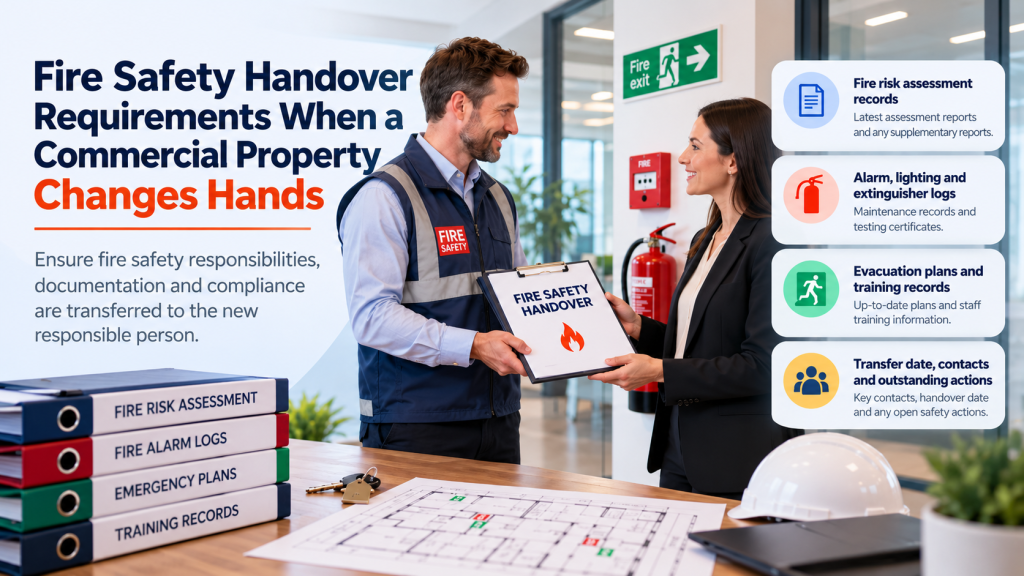
In the event that there is a transaction for a commercial property, it is imperative to make sure that the fire safety responsibility is also transferred along with the property keys. Lack of assessment information, lack of clarity on who owns the defects that remain and outdated evacuation plans can put the new person who has become responsible at huge risk. Fire safety handover allows for important documentation to be passed on and maintained properly.
Table of Contents
Need Help With a Fire Safety Handover?
Get professional support with fire risk assessments, safety documentation and property handover requirements.
Get a Free Quote Call: 020 3051 1294The Legal Trigger Is Narrower Than Most People Think
It is not true that any sale, lease or appointment of a new agent will automatically lead to the need for a handover. The relevant article in the Fire Safety Order – Article 22A – applies only when one person ceases to be the responsible person for premises and another becomes responsible for them.
Change of building ownership becomes relevant as the purchaser assumes the obligations of the owner, which not all sales will accomplish. The issue of responsibility cannot be considered an issue of ownership, as any individual controlling the premises would bear the same responsibility. An arrangement under which an individual was responsible for the maintenance and repair of part of the premises could grant him control to that extent.
Where there were two or more individuals sharing one building, then each must name the other individuals, give his UK address for communication and specify the portions controlled by each of them.
What Has To Be Transferred?
Listed in Article 22A, the information required to be transferred by the outgoing individual is separated from additional information in the table below.
| Items | Required Under Article 22A? | Reason |
|---|---|---|
| Records of fire risk assessment and review | Yes | Summarises results and actions taken |
| Identified responsible parties that assisted in the assessment | Yes | Allows purchaser to challenge the assessment |
| Names of other responsible persons and UK contact address | for notices | Yes, if known |
| Information on the accountable person and other building | safety systems, if known | Yes, if known |
| Information provided pursuant to Regulation 38, if any | Yes | Describes as-built condition |
| Alarms, lighting and extinguishers maintenance logbooks | Good practice | Proves maintenance |
| Training records, evacuation plans, and PEEPs | Good practice | Demonstrates staff training |
| As-built fire strategy, fire-stopping and dampers location | Good practice | Assists in determining compartment size |
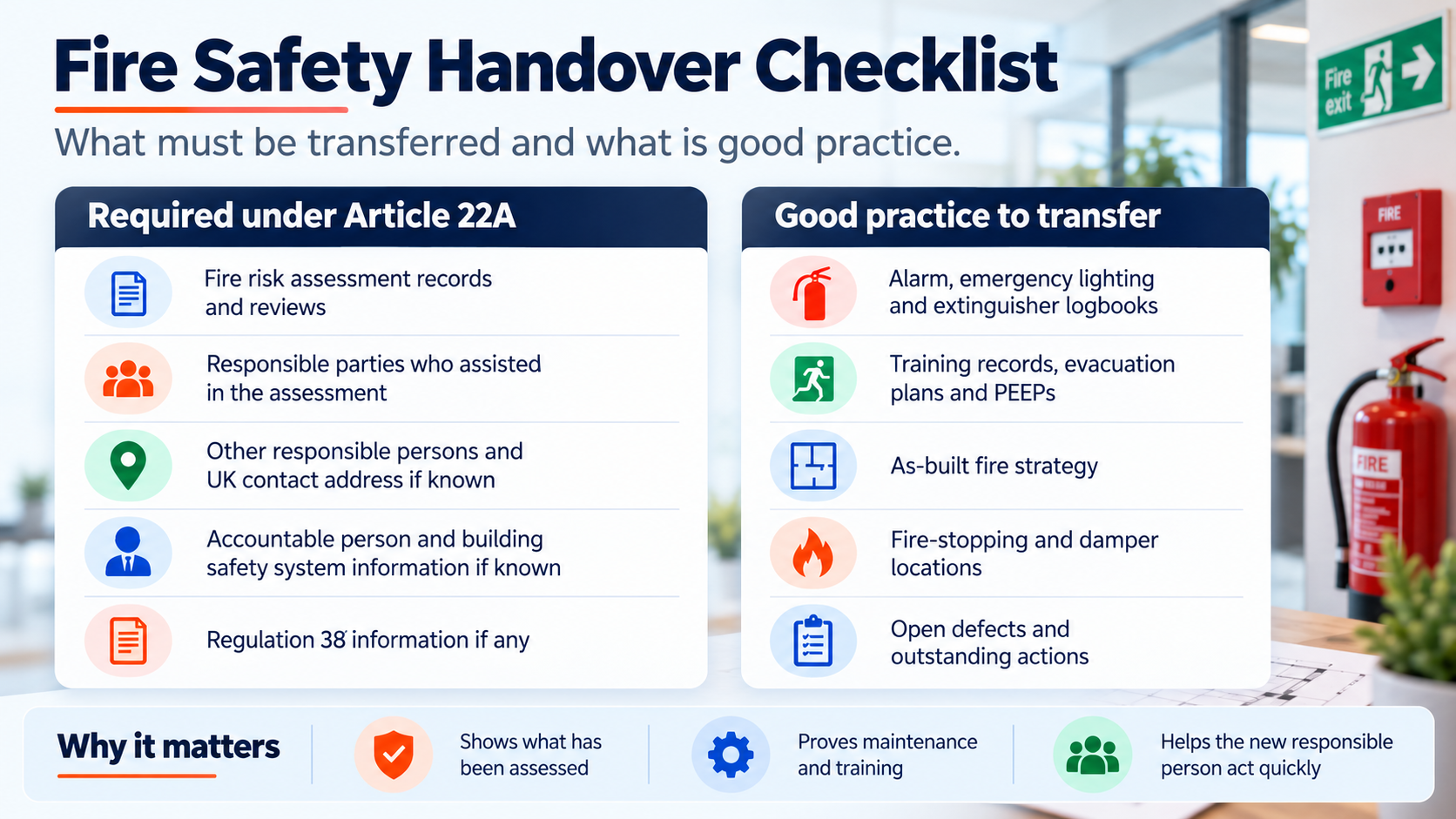
Information contained within Regulation 38 exists only in relation to qualifying building works, which include erections, extensions, or a relevant change of use. Any other form of refurbishment is not covered by the law, and therefore the purchaser should not expect any fire safety documents for new owners. It makes sense for sellers to include any information related to fire safety for the new owner that goes beyond the requirements of the law, as it is used by assessors to determine what the building can do.
In cases where the new party cannot be identified, the official advice is to try to establish contact with the owner or manager first before suggesting that all of it is passed to the owner or manager.
Where Does The Trail Go Cold?
It doesn’t just go missing all at once, since it is spread across the inbox of a former agent, the spreadsheet of a contractor and the completion pack of a solicitor. Tracking down property fire safety checks from all these places before completion is far cheaper than rebuilding them after. Open checks cause the most quiet damage, since a buyer does not know which checks are closed and who made them with what.
Inspectors are never short on paperwork either, since 50,195 fire safety checks were done in England by fire and rescue authorities in the year to March 2026. Emergency routes and exit points were number one for fire safety checks, with 11,286 breaches of Article 14. These figures are based on overall audit results, not handovers, but they show where the gaps in buildings occur most.
A thorough fire safety handover compiles the evidence behind the checks into one folder before handing over the keys.
Walk The Building Before You Rely On The Binder
The binder is only an old description of how the building looked the last time it was inspected, so check each path to the exits from every occupied area of the building. Note any broken doors, crowded corridors because of shops being placed in them, and signs covered up by recent renovations. Any differences between the information you have and reality need to be asked about because there could be important changes to risk or response planning as a result.
Also ask for a copy of the emergency lighting logbook because emergency lighting compliance with BS 5266-1:2025 is a benchmark instead of the previous edition of 2016. It is recommended to perform monthly and annual tests for the full duration, which is best practice and not wording in the Fire Safety Order. Compare the history of the alarm panel and servicing of the extinguishers to what the seller claims, making a note of any discrepancies in writing.
Risk Assessment London has undertaken 512+ projects in more than 150+ UK locations over 25 years, operating from offices in Strand and Marshgate Lane. They undertake emergency light testing, fire alarm testing, and fire door surveys, suitable for a pre-completion walk-around.
The Early Weeks Of Being the New Owner
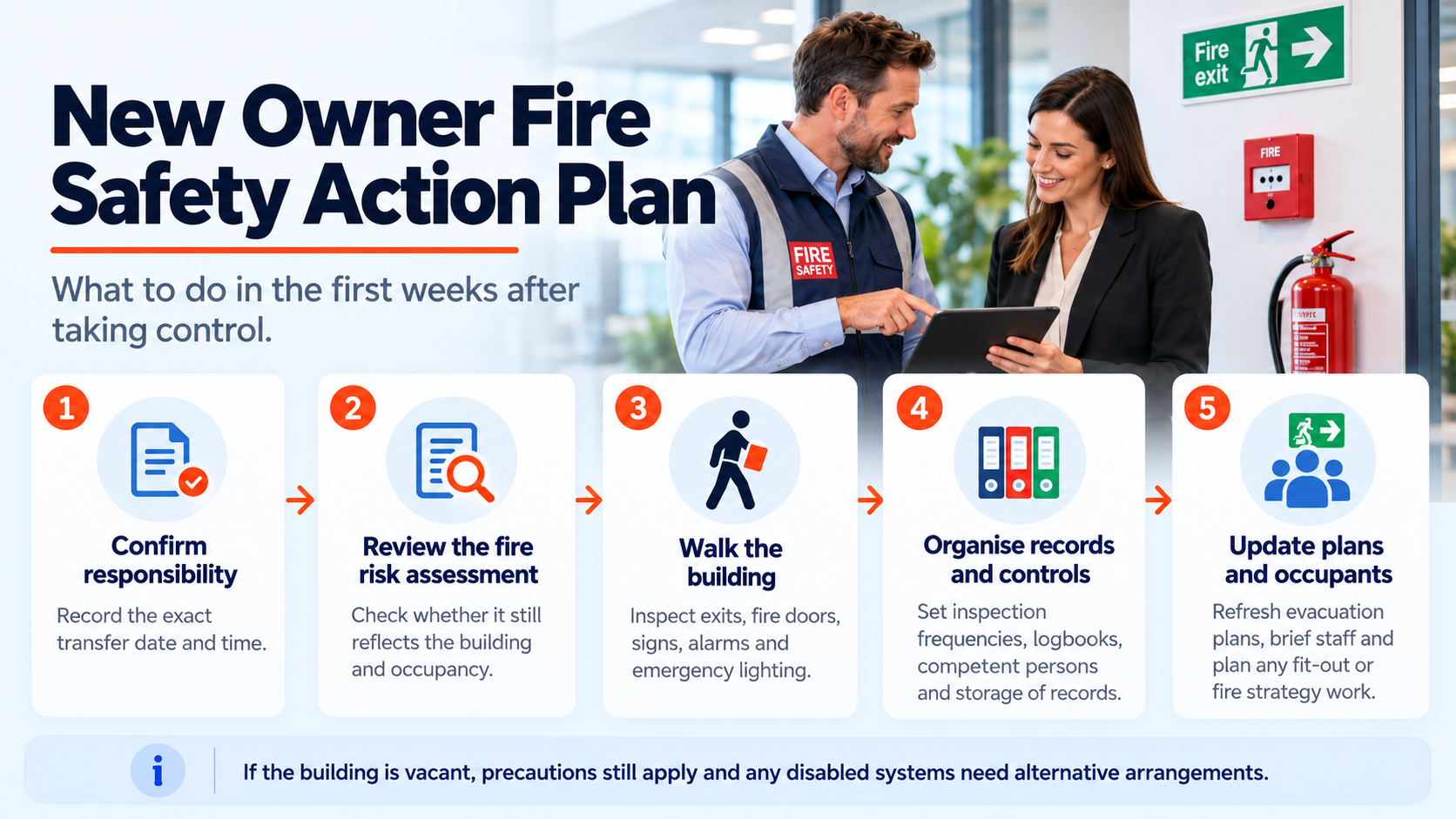
First off, decide if the existing fire risk assessment is still applicable to your new building because it may have become outdated due to some changes in the building itself. The fire risk assessment legal requirements are very clear in saying that you must document both the assessment and arrangements regardless of the size of your premises and also make sure that the fire risk assessment remains up-to-date. Assessors must be competent, but this has not been implemented in the law yet.
Afterwards, prepare a fire safety management plan that specifies who is going to inspect which parts, the frequency of inspection, who the competent person will be, and where the property fire safety records will be kept. Update evacuation plans and inform the new occupants as early as possible since the staff cannot comply with the arrangements that are drawn up for someone else’s premises. Planned fit-out or change of occupancy usually requires a fire strategy, a pre-construction document which explains the process of escape, compartmentation, and fire service access.
Fire Strategy Assessment London provides its fire strategy services along with the assessments, thus ensuring that property owners who are going to alter their property do not have different strategies and assessments for the same premises. The team has prepared over 250 fire strategies.
In The Building Sits Empty?
Control can slip into a void between the last day of occupancy and completion, so note the exact date and time when control changes hands. Fire safety responsibilities for vacant properties do not go away as soon as the lights are switched off, because there may be contractors, surveyors, and security guards present on-site. Precautions must remain in place throughout the transfer process, and any disabling of alarm and lighting systems requires a risk assessment along with alternative arrangements.
The asbestos management obligation also continues, because the duty to manage applies to all non-domestic buildings and can lie with the owner, landlord or maintainer. Insurance companies typically add terms regarding vacancy, after which point reading the policy documentation becomes essential, rather than relying on the rule of thumb of 30 days. It is also advisable to document the state of fire doors, alarms, and exits in the vacant property.
Four Transactions, Four Paper Trails
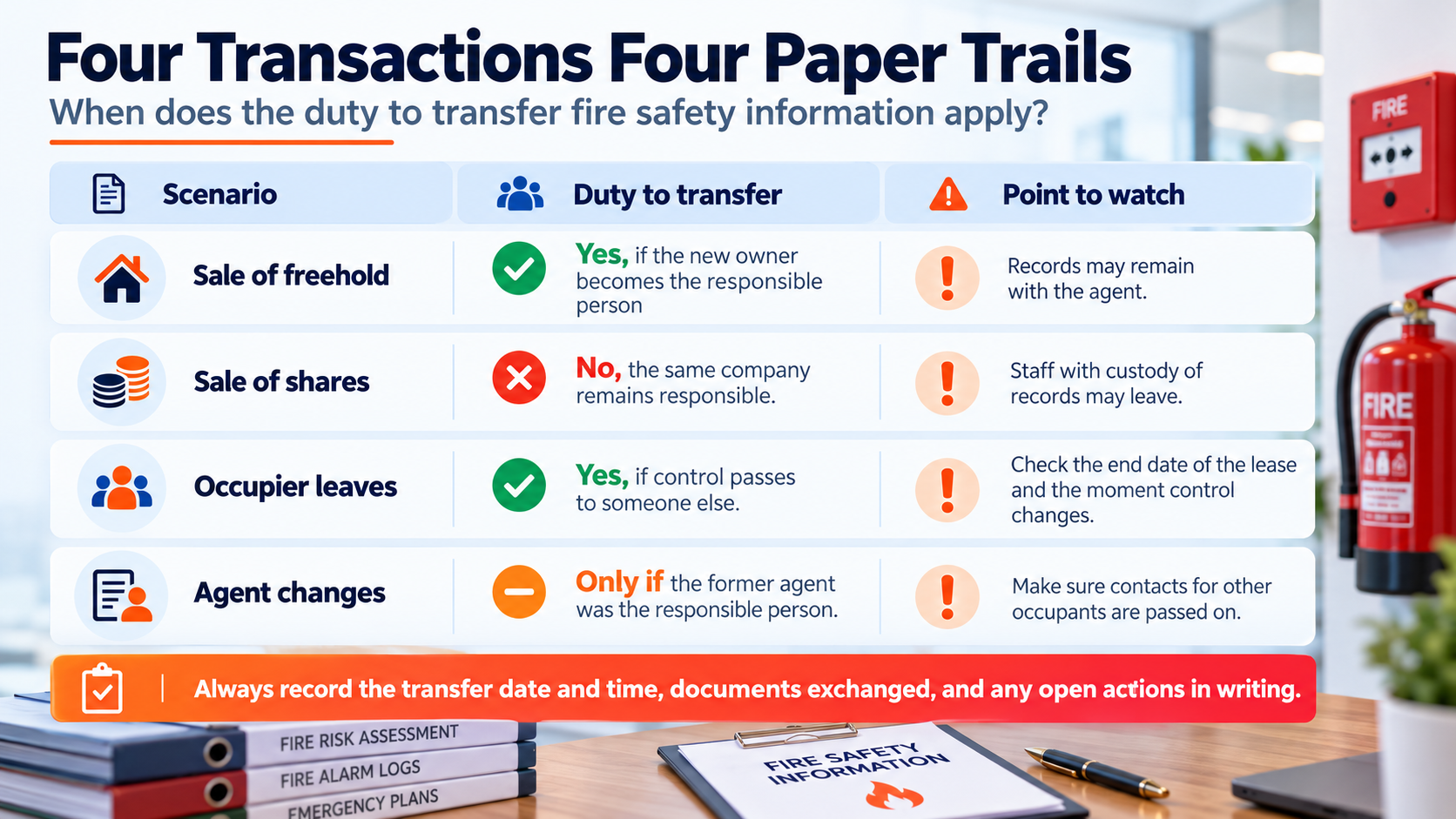
The path depends on the transaction, and the table below reflects the transfer of duty in four typical cases.
| Scenario | Duty to Transfer? | Points to Watch Out for |
|---|---|---|
| Sale of freehold | Yes, if the new owner is the responsible person | Records might remain with agent |
| Sale of shares | No, the same company remains responsible | Staff with custody of records might go |
| Occupier leaves | Yes, if control passes to someone else | End date of lease compared to control passing |
| Agent changes | Only if the former agent was the responsible person | Contacts for other occupants |
Whether by whatever means, the written transfer of the property, the time and date of transfer, documentation exchanged, and any remaining tasks provide both sides with a solid basis. Agree on who will take enquiries and for how long, and always have a written and signed copy. Consider each future fire safety handover as just the same, building up the record at each step.
Transfer date and time are the gap left by negligent transfers but are far more important than they seem at first. Remember the initial scenario, the Friday keys and the Monday fault light, and determine who was responsible in between.
Learn who is accountable for workplace fire prevention and compliance in our guide to who is responsible for fire safety in the workplace.
Make Your Commercial Property Fire Safety Handover Easier
Speak to experienced fire safety professionals about assessments, outstanding risks and documentation before responsibility changes hands.
Get a Free Quote Call: 020 3051 1294Frequently Asked Questions
Is A Tenant That Takes Over The Property Given Fire Safety Information?
Yes, when the tenant takes over responsibility for that portion of the building as a responsible person. Responsibilities may arise through control of an area and through the lease agreement to maintain or repair; therefore, both need consideration. Contact the landlord for shared area assessment and information.
What If The Outgoing Owner Is Untraceable?
Ask the managing agent, the solicitor for completion and the former assessor, and make notes of each attempt. Should there be further shortcomings, carry out another assessment rather than making assumptions about the building.
Is The Seller’s Assessment Sufficient In Itself?
It serves as a good starting point but no more than that. Compare it to the building and the current occupancy, and amend it to account for any changes in use, configuration or occupancy.
Does Regulation 38 Apply To All Refurbishments?
No, it applies to refurbishments involving erection, extension or relevant change of use of a building where Part B of the Building Regulations imposes a requirement. Other types of refurbishments do not produce this transfer package.
When Should Fire Safety Documents Be Handed Over During a Property Sale?
Fire safety documents should be provided before or at the point when responsibility transfers to the new responsible person. Early sharing allows the incoming party to review essential safety information and identify potential concerns.
Who Is Responsible for Fire Safety in a Multi-Tenanted Commercial Building?
Fire safety duties may be shared between landlords, tenants and managing agents according to their control of the premises. Each responsible person must cooperate with others to maintain appropriate fire safety arrangements.
Can Fire Safety Records Be Transferred Electronically?
Fire safety records can be shared electronically, provided the information is complete, accessible and securely maintained. Digital copies should be organised so the incoming responsible person can locate important documents when required.
What Happens to Outstanding Fire Safety Repairs When a Property Is Sold?
Outstanding fire safety repairs should be identified during the property handover, with their status and any interim precautions clearly documented. The incoming responsible person must address risks within their control, regardless of any contractual arrangements concerning repair costs.