
Fire Door Surveying
From £15/Door | BM Trada Q-Mark Certified
Regulation 10 compliant fire door inspections by BM Trada Q-Mark certified surveyors. Photographic reports with prioritised remediation plans.
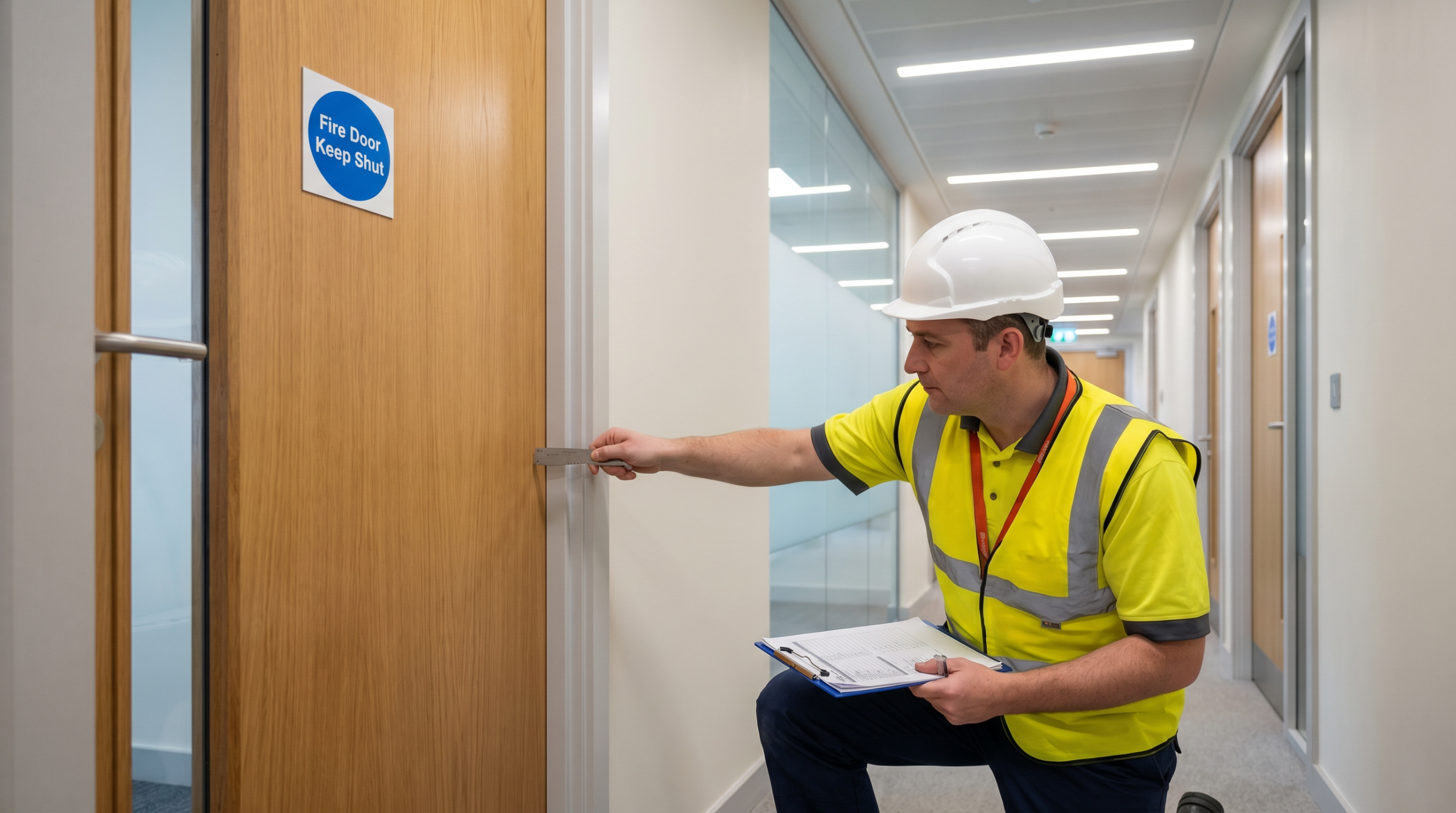



What is fire door surveying?
What does a fire door survey involve?
A fire door survey is a systematic inspection of every fire door in a building to confirm it will perform as rated during a fire. An FD30-rated door must hold back fire and smoke for 30 minutes. An FD60-rated door must hold for 60 minutes. The survey checks whether each door can still deliver that protection.
Under Regulation 10 of the Fire Safety (England) Regulations 2022, building owners and managers of residential buildings with storeys 11 metres or above must carry out regular checks of all fire doors in common parts. The Regulatory Reform (Fire Safety) Order 2005 already placed a broader duty on responsible persons to maintain fire safety measures in non-domestic and residential common areas. A fire door survey is how you meet both obligations in practice.
Why fire door surveying matters
Fire doors contain fire — they do not detect it
Fire doors are passive fire protection. They do not detect a fire or raise an alarm. They contain it. A properly functioning fire door holds back fire and hot smoke from escape routes, stairwells, and corridors, giving people time to get out and giving the fire service time to respond.
Regulation 10 introduced specific inspection duties
Regulation 10 of the Fire Safety (England) Regulations 2022 introduced specific inspection duties for residential buildings 11 metres or above. Flat entrance doors in these buildings must be checked every three months. All fire doors in common parts must be inspected at least once a year. These are legal minimums, not recommendations.
Consequences of non-compliance
- Enforcement notices requiring immediate action
- Prohibition notices that can close all or part of a building immediately
- Unlimited fines for failing to comply with fire safety duties
- Prosecution — several managing agents and freeholders have already been prosecuted for fire door failures in residential blocks
Since Grenfell, fire and rescue authorities have increased both the frequency and severity of enforcement action. If a fire door is damaged, incorrectly installed, or missing components, it can fail within minutes rather than holding for its rated 30 or 60 minutes. A single defective door on an escape route can be the difference between a contained incident and a fatal one.
Why choose FireRisk.io?
BM Trada Q-Mark certified surveyors with 25 years of fire safety experience
BM Trada Q-Mark certified
Our fire door surveyors hold BM Trada Q-Mark certification for fire door installation and maintenance. This is one of the most widely recognised third-party certifications in the UK fire door industry. Reports from Q-Mark certified inspectors carry weight with fire authorities, insurers, and building control officers.
Regulation 10 compliant inspections
Every survey meets the inspection requirements set out in Regulation 10 of the Fire Safety (England) Regulations 2022. We cover the correct door types at the correct frequencies — quarterly for flat entrance doors, annually for all fire doors in common parts. You stay compliant without tracking the legislation yourself.
Photographic reports with remediation plans
Every defect gets photographed and logged against the door’s location in your building. You receive a full report grading each door as pass, advisory, or fail, with prioritised remediation recommendations. Building managers, freeholders, and contractors can all work from the same document.
Fire door inspection schedule
The frequency of fire door inspections depends on the building type and the role each door plays. Regulation 10 sets out minimum intervals for residential buildings, while the RRO 2005 requires ongoing maintenance in all non-domestic premises.
Quarterly checks
Flat entrance doors in residential buildings 11 metres or above must be inspected every three months. These doors take the most daily wear. Residents open and close them dozens of times a day, and they are often the first line of defence between a flat and a shared escape route.
Annual inspections
All fire doors in common parts of buildings 11 metres or above must be inspected at least annually. This covers corridor doors, stairwell doors, riser cupboard doors, and any door forming part of a compartment wall. For commercial premises, annual inspection of all fire doors is considered best practice under the RRO 2005.
After damage or alteration
Any fire door that has been damaged, modified, or had hardware replaced should be inspected before it is returned to service. Fitting a new lock, replacing a closer, or repairing impact damage can all compromise the door’s fire rating if not done correctly.
| Building type | Frequency | What is checked |
|---|---|---|
| Flat entrance doors (residential 11m+) | Quarterly | Leaf, frame, seals, gaps, closer, hardware |
| All fire doors in common parts (residential 11m+) | Annually | Full inspection per BS 8214 |
| Commercial premises (all fire doors) | Annually | Full inspection per BS 8214 |
| Any fire door after damage or alteration | Before reuse | Affected components and overall integrity |
Regulation 10 reminder
These are legal minimums under the Fire Safety (England) Regulations 2022. Your fire risk assessment may recommend more frequent inspections depending on the building’s use, occupancy, and fire strategy.
What a fire door inspection covers
A proper fire door inspection is not a quick visual check from the corridor. Each door is examined against a detailed checklist based on BS 8214, the British Standard for timber fire doors.
Door leaf condition
The door leaf is checked for damage, warping, delamination, and holes. Even small areas of damage can compromise the fire rating. Any unauthorised modifications — letter boxes, cat flaps, additional locks — are recorded, as these may void the door’s certification.
Frame and seals
The frame must be securely fixed and in good condition. Intumescent strips and smoke seals are checked for continuity around the full perimeter of the door. Intumescent strips swell when exposed to heat, sealing the gap between the door and frame. If they are missing, painted over, or damaged, the door will not perform as rated.
Gap measurements
Gaps between the door and frame must fall within strict tolerances. The maximum permitted gap on the top and sides is 3mm. At the threshold, 8mm to 10mm is acceptable. Anything outside these tolerances means fire and smoke can pass through before the intumescent strips have time to activate.
Hinges
FD30 doors require a minimum of three hinges. Hinges must be CE marked or UKCA marked and rated for fire door use. Loose, missing, or non-rated hinges are a common cause of failure.
Self-closing device
Every fire door must close fully into its frame from any open angle without manual assistance. The closer is tested for function and speed. Doors propped open with wedges, extinguishers, or other objects are recorded as non-compliant unless fitted with a hold-open device linked to the fire alarm.
Glazing
Any glazed panels must be fire-rated and correctly installed with the right beading and intumescent glazing tape. Non-rated glazing or cracked panes are an immediate fail.
Certification and signage
Inspectors look for the original certification label or plug on the door leaf and frame, confirming the manufacturer, fire rating, and test evidence. Correct “Fire Door Keep Shut” or “Fire Door Keep Locked” signage must be present and legible.
FD30 vs FD60 fire door ratings explained
Fire door ratings tell you how long a door will resist fire under test conditions. The two ratings you will see in most UK buildings are FD30 and FD60.
FD30 means the door has been tested to hold back fire for 30 minutes. These are the standard fire doors found in most commercial buildings, offices, residential common areas, and corridors.
FD60 means the door has been tested to hold back fire for 60 minutes. These are required in higher-risk locations: stairwell enclosures in high-rise buildings, means of escape routes where extended protection is needed, plant rooms, and areas with a higher fire load such as kitchens or storage areas with combustible materials.
| Rating | Fire resistance | Typical locations |
|---|---|---|
| FD30 | 30 minutes | Offices, residential corridors, flat entrance doors, retail units |
| FD60 | 60 minutes | High-rise stairwells, plant rooms, kitchens, storage areas, high fire load zones |
The required rating for each doorway is determined by the building’s fire strategy and fire risk assessment. Getting it wrong — fitting an FD30 door where an FD60 is needed — leaves a weak point in the building’s compartmentation. During a survey, we verify that the correct rating is installed in the correct location.
What is included in our fire door surveying service
Every survey we carry out follows BS 8214 and meets the inspection requirements of Regulation 10. Here is what you get:
Our service includes
- Visual and physical inspection of every fire door on site
- Gap measurement using calibrated feeler gauges (3mm sides/top, 8-10mm threshold)
- Intumescent strip and smoke seal integrity check around the full perimeter
- Self-closing device function test from multiple open angles
- Hinge assessment — number, condition, rating, and fixings
- Condition grading for each door: pass, advisory, or fail
- Photographic report showing each defect with door location reference
- Prioritised remediation recommendations for every advisory and fail result
- Compliance certificate confirming the scope and outcome of the survey
Every report includes clear photographs so you can see each defect and understand exactly what needs fixing. Remediation recommendations are prioritised by risk, so you know what to address first.
Fire door surveying costs
Pricing is based on the number of doors and the size of the building. Here are typical costs:
| Building size | Number of doors | Typical cost |
|---|---|---|
| Small building | Up to 20 doors | £300 – £500 |
| Medium building | 20 to 50 doors | £500 – £1,000 |
| Large building | 50+ doors | Custom quote |
For larger batches, per-door pricing starts from £15 to £25 per door for 20 doors or more.
Final cost depends on building access, door locations (e.g. risers, plant rooms), and whether you need a combined survey covering both fire doors and passive fire protection. For a quote based on your building, call us directly or use our online booking form.
Our fire door survey process
From booking to report in 5 steps
Book your survey
Call us or fill in the form. We schedule around your building operations and resident access requirements.
Surveyor arrives
A BM Trada Q-Mark certified surveyor arrives with calibrated gauges and inspection equipment.
Doors inspected
Every fire door is inspected against BS 8214 — leaf, frame, seals, gaps, hinges, closer, glazing, and signage.
Report delivered
Photographic report with pass/advisory/fail grading and prioritised remediation plan within 24 hours.
Certificate issued
Compliance certificate confirming the survey scope, findings, and Regulation 10 compliance.
512+
Projects Completed
25+
Years Experience
150+
UK Areas Covered
24hr
Report Turnaround
What our clients say
Trusted by 500+ UK businesses for fire safety compliance
“FireRisk.io completed our fire alarm testing within 24 hours when we were facing a compliance deadline. Professional, thorough, and the certificate was ready the same day.”
“Used this company for fire alarm testing and servicing across multiple properties. Always arrived on time and had the certificates back within 24 hours. Highly recommend.”
“Very professional and knowledgeable engineers. Great quality work on our fire alarm system and competitive pricing. Would definitely recommend.”
“Professional company, professional staff. Fire alarm testing and fire risk assessment both completed efficiently. Clear communication throughout.”
“FireRisk.io completed our fire alarm testing within 24 hours when we were facing a compliance deadline. Professional, thorough, and the certificate was ready the same day.”
“Used this company for fire alarm testing and servicing across multiple properties. Always arrived on time and had the certificates back within 24 hours. Highly recommend.”
“Very professional and knowledgeable engineers. Great quality work on our fire alarm system and competitive pricing. Would definitely recommend.”
“Professional company, professional staff. Fire alarm testing and fire risk assessment both completed efficiently. Clear communication throughout.”
Frequently asked questions
Common questions about fire door surveying
Ready to book your fire door survey?
BM Trada Q-Mark certified. Regulation 10 compliant. From £15 per door. Photographic reports within 24 hours.
Explore more fire safety resources
Fire door guides
Related services
Building types
Tools and resources
Fire door surveying across the UK
BM Trada Q-Mark certified surveyors available in every major region
Serving 150+ areas across England
Get a quote for fire door surveying
Regulation 10 compliant surveys from £15 per door. 24-hour report turnaround.