
Table of Contents
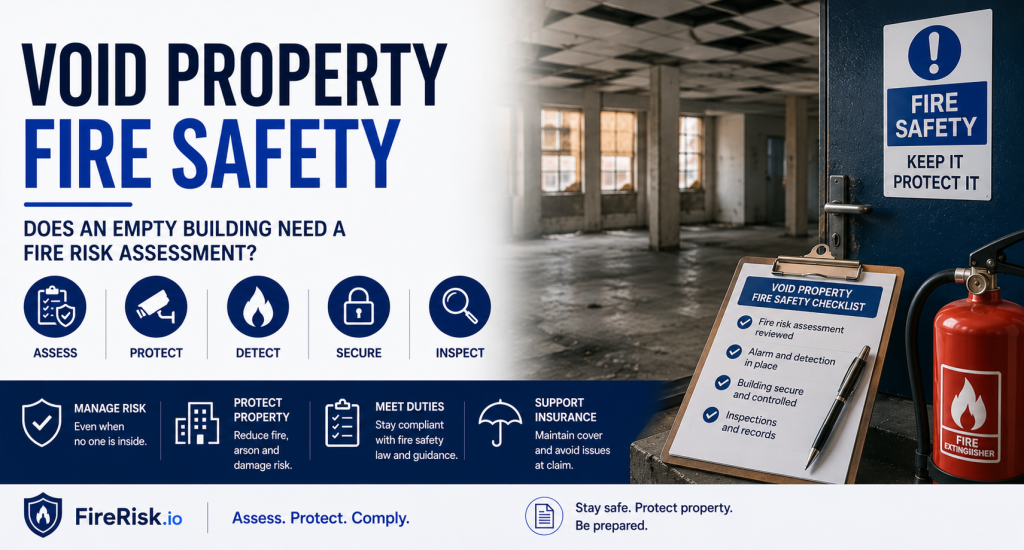
If a building is empty, the fire risk assessment does not simply stop. For business premises, commercial units, workplaces, public-access premises and the common parts of multi-occupied residential buildings, the duty sits with the person or organisation that has control of the premises. GOV.UK describes this person as the Responsible Person and says they may be the employer, owner, landlord, occupier, facilities manager, building manager, managing agent or another person with control of the premises. The Responsible Person must carry out a fire risk assessment, review it regularly, maintain appropriate fire safety measures, plan for an emergency and provide information or instruction where people may be affected.
That means a vacant office floor, closed restaurant, empty retail unit, unlet warehouse, void HMO, unoccupied block common area or property awaiting refurbishment can still need a suitable and sufficient fire risk assessment. The fact that the normal occupants have left does not remove the risk to contractors, security staff, neighbouring occupiers, firefighters, rough sleepers, trespassers or passers-by. In some cases, it changes the risk profile enough to trigger an immediate review.
The important distinction is scope. The Fire Safety Order does not usually apply inside a single private dwelling used only as someone’s home. It does apply to workplaces and commercial premises. It also applies to the common areas of blocks of flats and HMOs. If a single flat becomes void inside a block, the flat itself may sit outside the main Fire Safety Order scope, but the common parts, flat entrance door, risers, plant rooms, staircases, bin stores and escape routes remain firmly within fire safety management duties.
Here is the practical version. If the building has a landlord, managing agent, housing provider, commercial owner, employer, contractor or asset manager making decisions about access, services, security or maintenance, someone needs to own the fire risk assessment. If the use of the building has changed from occupied to empty, the assessment should be reviewed rather than left as it was when the building was trading, staffed or lived in.
Why void properties catch people out
We often see the same misunderstanding on void sites: because there are no staff, residents or customers inside, the fire risk is treated as if it has reduced. Sometimes it has. Cooking, customer activity and daily electrical use may have stopped. But other risks can increase quickly. Doors get forced. Rubbish builds up. Alarm contracts lapse. Heating is left on to protect pipes. Contractors bring temporary lighting, chargers and hot works. Water leak s damage electrics. Post piles up behind a door. A rear yard becomes a dumping point. Nobody is walking the building each day to notice the small change before it becomes a claim.
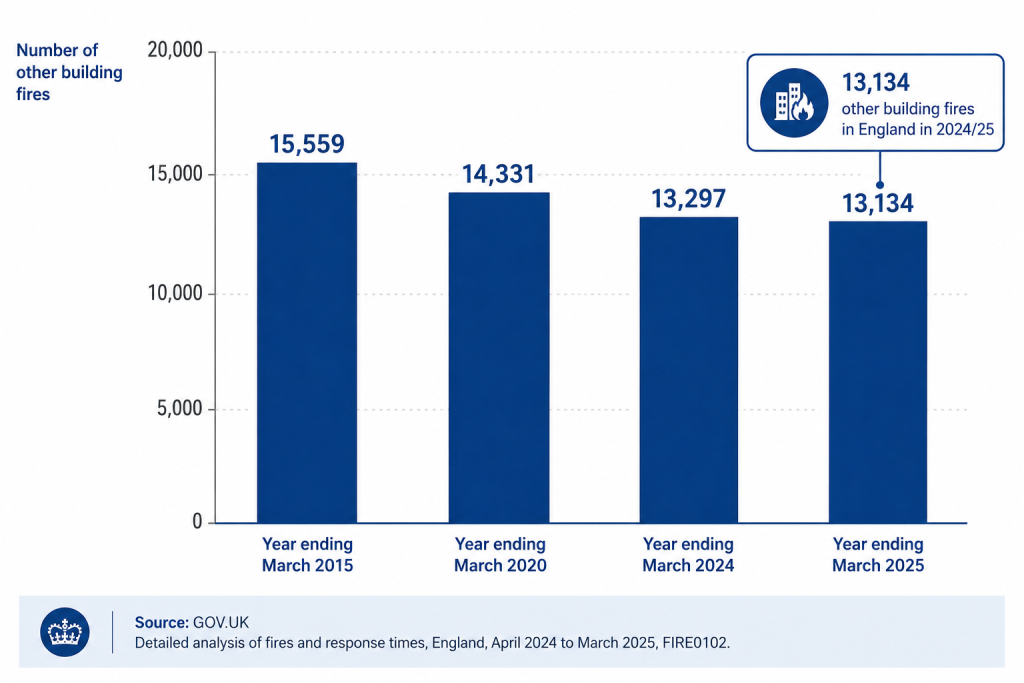
Official fire statistics show why this matters. In England in the year ending March 2025, fire and rescue services attended 13,134 other building fires. Those fires caused 12 fire-related fatalities and 919 non-fatal casualties. Twenty six per cent of other building fires were larger fires, meaning the fire spread beyond the item first ignited or the room of origin.
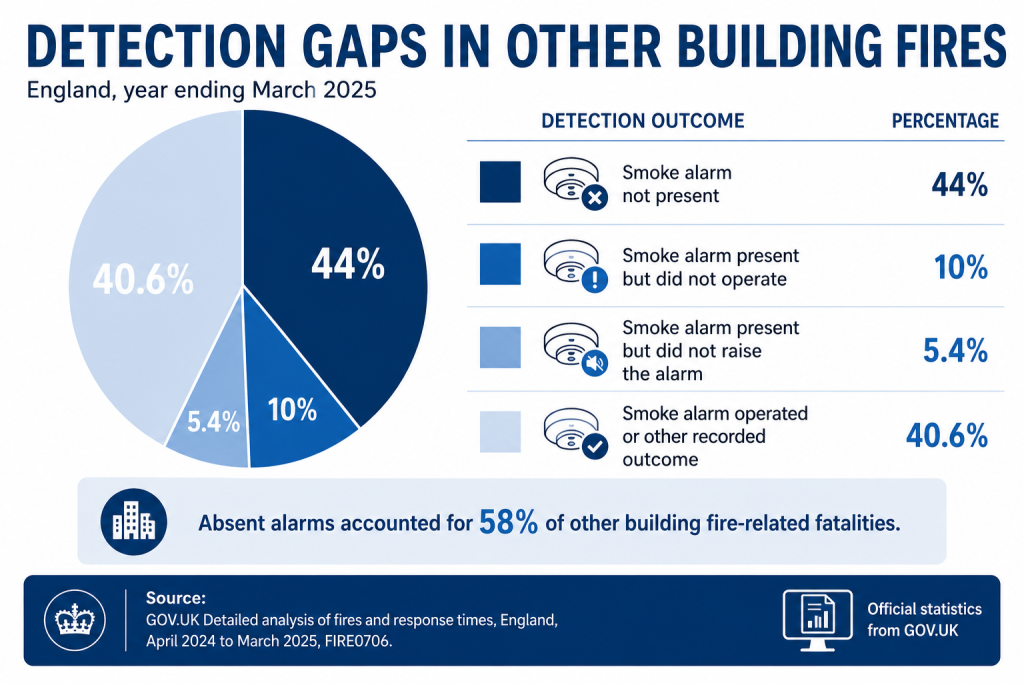
Detection is another weak spot. In the same England 2024/25 fire statistics, smoke alarms were not present in 44% of other building fires and in 58% of other building fire-related fatalities. A further 10% of other building fires had a smoke alarm present but it did not operate. For an empty property, that matters because a fire can grow without anyone inside to smell smoke, hear a sounder or call 999.
The wider trend is also moving the wrong way. In the year ending December 2025, fire and rescue services in England attended 175,918 fires, up 29% on the previous year. Building fires, including dwellings and other building fires, reached 40,350. Other building fires reached 14,052. These are not void-property figures, but they set the context: fire services are still attending a large volume of building fires and empty sites should not be managed on hope.
The real risk is not just the empty room
A void property risk assessment should not only ask, ‘What could burn inside?’ It should ask who would be affected if it did. That is where empty buildings become more serious than they look from the pavement.
In a town centre, fire in an empty shop can affect the flat above, the takeaway next door, the escape route at the rear, the bin store in a shared yard and the firefighters who may have to enter a building with unknown structural condition. In a vacant warehouse, the first people at risk may be security guards, engineers, unauthorised entrants and staff in the neighbouring unit. In a residential block, a void flat can expose residents if the door has been removed, service penetrations are left unsealed or contractors wedge open the communal fire door while carrying materials.
British Safety Council guidance, citing National Fire Chiefs Council data from 2017/18, noted that every day up to 60 fires occur in or next to an empty property in the UK. It also reported that arson accounted for 50.5% of all fires attended by UK fire and rescue services in that period. The Fire Protection Association has also highlighted around 9,000 fires in empty buildings each year and the high share of direct damage costs linked to these fires.
The lesson is simple: the absence of normal occupants can make a building more attractive to trespassers, vandals and metal thieves. It can also mean delayed discovery. Both affect life safety and property protection.
When should the fire risk assessment be reviewed?
The review point is not ‘once a year’ when a building becomes void. The review point is when the risk changes. A property becoming empty is a risk change. So is a tenant moving out, a shop closing, a block entering decant, a school building being mothballed, a hotel wing being taken out of use, a warehouse being prepared for sale or a refurbishment contractor taking possession.
A good void-property review should happen at four moments:
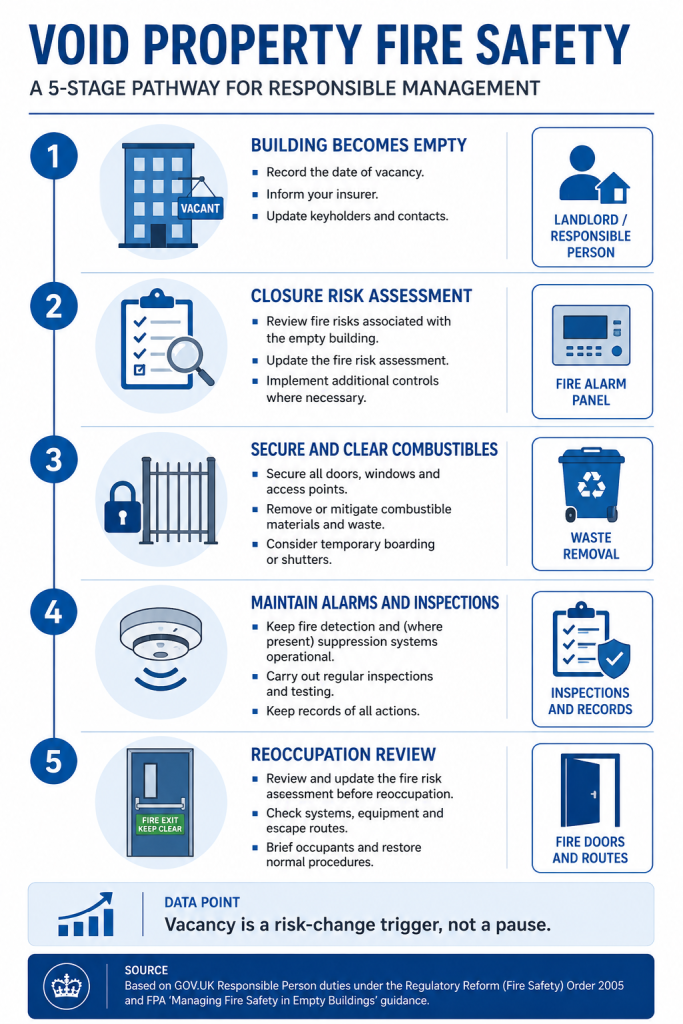
First, before the building is left unattended. This is the closure review. It captures services, security, alarms, fire doors, combustibles, emergency contacts and insurer requirements before the last regular occupant leaves.
Second, within the first week. This is the reality check. It confirms whether the closure controls actually work. Are the locks holding? Is the alarm still monitored? Has waste been cleared? Have contractors already started storing materials?
Third, at a planned inspection frequency during the void period. The right frequency depends on site condition, location, previous incidents, attractiveness to trespassers, neighbouring risks, weather exposure, alarm monitoring and insurer conditions. Some properties may need daily or weekly checks. Others may be suitable for less frequent documented inspections. The key is that the interval is risk-led and recorded.
Fourth, before works or reoccupation. A building that has been empty for months should not reopen with an old assessment. Fire doors may have swollen, detectors may be isolated, emergency lights may have failed, escape routes may be blocked and compartmentation may have been damaged by contractors or theft.
What a void-property fire risk assessment should cover
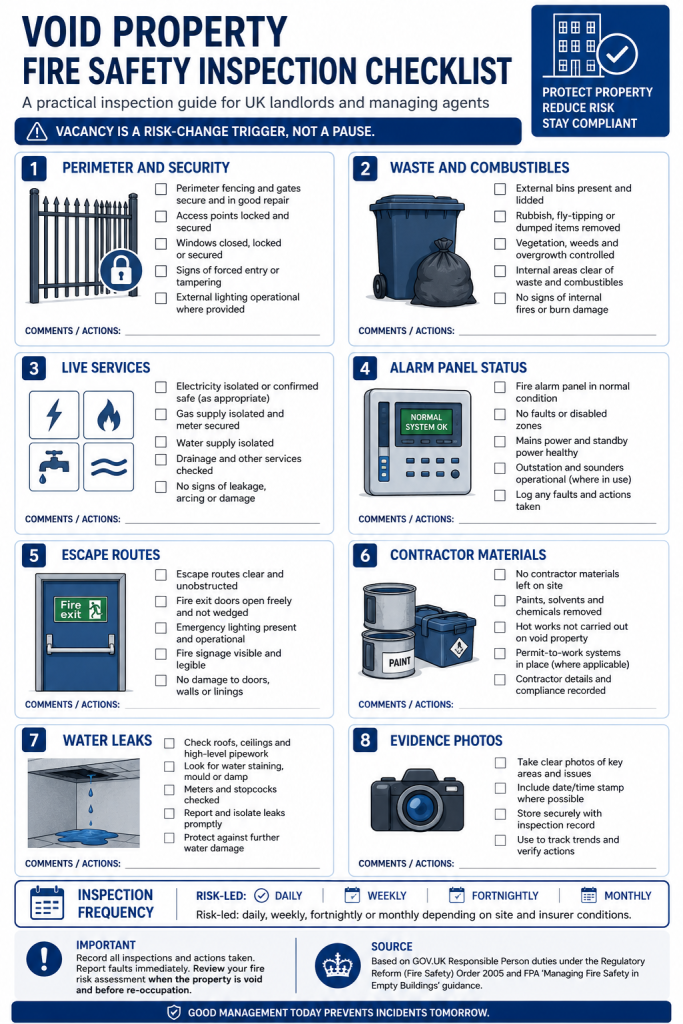
A generic fire risk assessment template can miss the details that matter in an empty building. The assessment needs to follow the same legal principles, but the questions should be sharper.
Start outside the building. This is where our assessors usually learn most about the true risk. Is the site obviously empty? Are there broken windows, graffiti, fly-tipped waste, damaged fencing, loose letterboxes, unsecured rooflights or evidence of forced entry? Is there combustible storage against the wall? Are wheelie bins kept under windows or next to external cladding? Can a fire appliance get close enough if the gate is locked?
Then look at ignition sources. Live electrical distribution should be reduced to what is needed. Unused equipment should be unplugged. Temporary heaters should be controlled or removed. Battery charging should be banned unless there is a designated safe charging arrangement. Gas should be isolated where it is not needed. Plant rooms, server cupboards, lift motor rooms and boiler rooms should remain part of the assessment, even if the main occupier has left.
Next, look at fuel. Empty buildings are often full of things nobody wanted to take responsibility for: packaging, old furniture, carpets, files, paint tins, cleaning chemicals, marketing displays, pallets, timber, textiles and general rubbish. The quickest risk reduction is often a full combustible-clearance plan. That includes the inside, yards, bin stores, outbuildings and roof void access points.
Detection and warning need careful thought. In an occupied building, staff or residents may raise the alarm. In a void property, detection often needs to do more work. If the alarm system is to remain live, confirm it is maintained, tested, monitored where needed and not impaired by isolated zones. If the system is being taken out of service, the assessment must say how the risk will be controlled instead. A silent local-only sounder in a locked empty unit is not the same risk control as a monitored system with a named key holder.
Means of escape still matters. Contractors, surveyors, estate agents, utility engineers, cleaners, security staff and authorised visitors may enter. They need safe routes, working emergency lighting where required, unlocked final exits during access periods and a clear emergency procedure. If a building is unsafe to enter, that needs to be stated, controlled and communicated.
A practical void property control plan
The following control plan is the type of structure a Responsible Person can use to turn the assessment into actions. It is not a replacement for a competent assessment, but it shows the level of detail expected when a site is empty.
| Area | What to check | Typical evidence | Why it matters |
| Control and ownership | Responsible Person, key holders, emergency contacts, contractor control and site access rules | Named responsibility matrix, contact sheet, handover note | No one should be guessing who can authorise repairs, alarm resets or emergency access. |
| Security | Locks, shutters, fencing, broken glazing, rooflights, CCTV, intruder alarm, trespass evidence and site lighting | Inspection photos, alarm monitoring record, security log | Unauthorised access increases arson, smoking, vandalism and injury risk. |
| Combustibles | Waste, old stock, soft furnishings, pallets, paperwork, bins, vegetation, flammables and roof void storage | Waste transfer notes, clearance photos, inspection checklist | Fuel reduction is often the fastest way to lower fire severity. |
| Services | Electrical supply, gas, water, heating, plant rooms, temporary supplies and charging equipment | Isolation certificates, PAT or EICR evidence where relevant, contractor permits | Unmanaged live services are a common source of void-property problems. |
| Detection and alarm | Fire alarm condition, monitoring, isolated zones, call points, detectors, weekly tests and fault log | Alarm test records, maintenance certificates, monitoring confirmation | A fire in an empty building needs early detection because no one may be present. |
| Escape and access | Contractor routes, emergency lighting, final exits, staircases, fire doors, fire service access and site plans | Marked plan, access procedure, emergency lighting test record | People still enter void buildings and firefighters may need reliable access. |
| Hot works and refurbishment | Permits, temporary fire loading, contractors, dust, cutting, welding, roof works and end-of-day checks | Hot works permit, RAMS, fire watch record, end-of-day sign-off | Many void fires occur during works or after contractors leave. |
| Review trigger | Change in use, attempted break-in, flood, storm damage, new works, alarm fault, new tenant or reoccupation | Review log, updated action plan, photographs | A void property changes quickly. The assessment must keep up. |
Example 1: empty high street retail unit between tenants
A retail unit on a parade has closed. The tenant removed stock, but left display boards, packaging, a fridge, a router, fluorescent fittings, cleaning materials and a rear yard full of cardboard. The landlord has the keys, the alarm contract is still in the previous tenant’s name and the flat above is occupied.
This is not a paperwork issue. The Responsible Person needs to check whether the fire alarm or detection still works, whether the electrical installation remains safe for the limited equipment left live, whether combustibles have been removed and whether the rear escape route or yard creates risk for the flat above. Bins should not sit under windows. The shutter should not trap firefighters out if the only key is with a letting agent 20 miles away. If contractors are showing new tenants around, they need a simple emergency instruction.
Key takeaway: a closed shop can still affect residents, neighbouring businesses and contractors. The assessment should focus on access, alarm continuity, combustible clearance and shared escape routes.
Example 2: void flat inside a managed block
A housing provider has a void flat in a purpose-built block. The tenant has left. Repairs are planned. The flat entrance door is damaged, the kitchen has been stripped, contractors are using extension leads and the corridor is being used for materials while works are underway.
The assessment issue is not only the empty flat. The block’s common parts remain occupied and must be protected. If the flat entrance door no longer provides the expected fire resistance, smoke could enter the corridor. If contractors wedge open communal doors or store materials outside the flat, they can compromise the protected route for everyone else. The Responsible Person should link the void works process to the building fire risk assessment, contractor induction and post-works sign-off.
Key takeaway: a void flat can become a common-parts fire safety problem if the front door, risers, corridor storage or contractor controls are poor.
Example 3: warehouse awaiting sale
A warehouse is empty after the occupier moved out. The owner wants to reduce costs while the sale is agreed. Heating is turned off, lighting is reduced, old pallets remain in a corner and the sprinkler maintenance visit is postponed because no staff are on site.
This is exactly where insurers and fire assessors get nervous. Empty warehouses can attract trespass, metal theft and waste dumping. A fire can grow large before anyone sees it. If sprinkler, alarm or pump systems are impaired, the property protection strategy may have changed completely. If the fire service cannot access the site because the gate is chained and there is no key box, the delay can affect neighbouring premises too.
Key takeaway: cost cutting during vacancy should never remove the controls that keep the asset insurable, saleable and safe for neighbours and firefighters.
Insurance, evidence and the uncomfortable conversation after a fire
Fire risk assessment is a legal duty, but insurance is where many void property issues become painfully practical. Empty properties often have policy conditions. These may include notifying the insurer when the building becomes unoccupied, draining down or maintaining heating, isolating services, keeping alarms maintained, removing waste, securing the building and carrying out recorded inspections. The exact wording sits in the policy, not in a blog, so the Responsible Person should check it rather than assume.
The Fire Risk Heritage summary of FPA empty-building guidance makes the same point in practical terms: when a building becomes empty, owners should manage closure in an orderly way, inform the property insurer, undertake a risk assessment and take steps to reduce fire or intrusion risk. It also describes putting the building ‘to sleep’ through security, service isolation where appropriate, removing valuable items, stopping deliveries and clearing rubbish or surplus furniture.
After a fire, the question is not only whether the building was empty. The question is what you did when you knew it was empty. Can you show the latest fire risk assessment? Can you show who owned the action plan? Can you prove the alarm was maintained? Can you show inspection records, photos, contractor permits and waste clearance? Can you show that the insurer was told? If those records are missing, the building may look unmanaged even where some controls were in place.
How often should an empty property be inspected?
There is no single inspection frequency that fits every void. A locked office in a secure managed building is not the same as a derelict pub on a busy high street with previous break-ins. The frequency should come from the risk assessment and insurer conditions.
As a working rule, high-risk voids need more frequent checks. High risk might mean poor security, a history of trespass, combustible storage, live services, ongoing works, heritage construction, adjoining occupied premises, vulnerable neighbours, previous arson, remote location or poor fire service access. Low-risk voids still need checks, but the interval may be different if the building is secure, empty of combustibles, properly alarmed, monitored and stable.
A useful inspection should not be a tick-box walk past the front door. It should include the perimeter, signs of entry, waste, external combustibles, doors, windows, rooflights, service rooms, alarm panel status, internal combustibles, water leaks, contractor materials, escape routes and any change since the last visit. Photographs help because they show condition over time. A date, time and name are not enough if the building later shows clear signs that nobody was looking properly.
What FireRisk would document on a void-property assessment
For a void property, a clear report should make it obvious what has changed since the building was occupied. We would expect the assessment to record the current occupancy status, areas in use, areas out of use, who can access the site, whether contractors are present, whether any part is still occupied and what fire safety systems remain active.
The action plan should be practical. ‘Improve housekeeping’ is too vague. ‘Remove combustible waste from rear yard within 48 hours and keep bins 6 metres from the building where practicable’ is useful. ‘Check alarm’ is too loose. ‘Confirm fire alarm monitoring account remains live, test signal to alarm receiving centre and record weekly local test’ gives a person something to do. ‘Secure building’ is not enough. ‘Repair broken rear window, fit temporary board, inspect rooflight fixings and update key holder list’ is better.
We would also separate life safety actions from asset protection actions. The law is primarily concerned with life safety, but the owner still needs to protect the building, neighbouring occupiers and business continuity. GOV.UK’s property protection review notes that property protection aims include reducing accidental or malicious fire likelihood, limiting fire and smoke spread, reducing business interruption, protecting buildings, maintaining the safety of people in and around the building including firefighters and protecting the environment from the consequences of fire and firefighting. That wider view is especially relevant when the building is empty but not worthless.
Before reoccupation: do not hand over yesterday’s risk
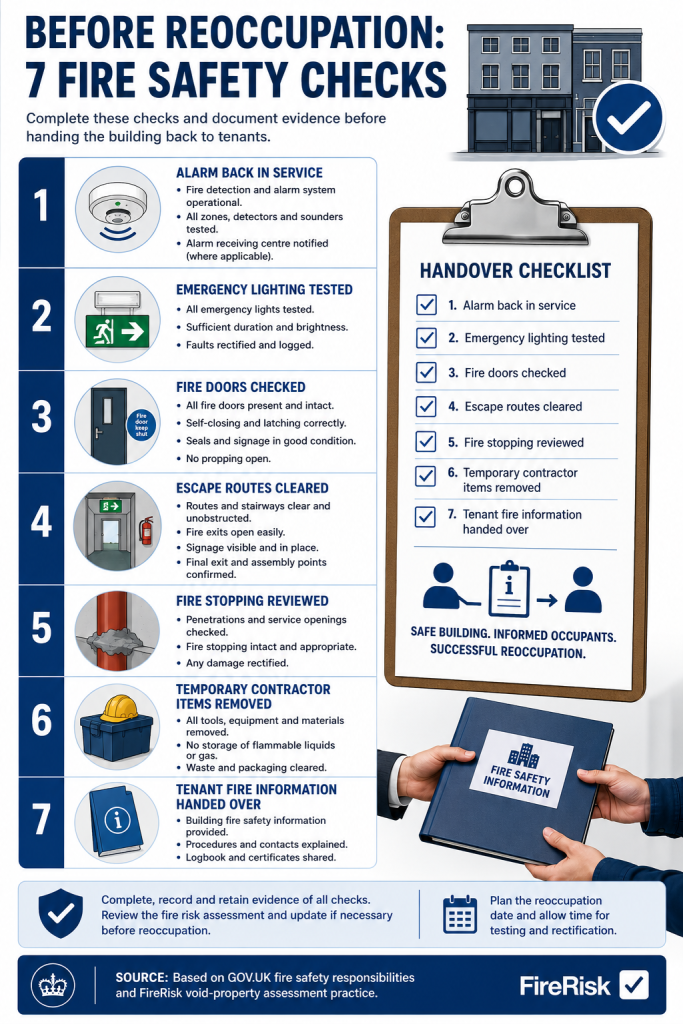
When the property is ready to be let, sold or reopened, do one more review. Void periods often leave hidden defects: isolated detectors, temporary cable routes, altered locks, missing signage, damaged doors, blocked vents, untested emergency lighting, new storage, changed layouts and penetrations through compartment walls. If the next tenant inherits those issues, the building can fail its first fire safety inspection before it has properly started trading.
Before handover, confirm that fire detection and alarm systems are active, maintained and suitable for the new use. Test emergency lighting. Check extinguishers if they are provided. Inspect fire doors. Remove temporary contractor materials. Close and fire stop service penetrations. Confirm final exits open correctly. Update the fire action notice. Provide the incoming tenant with relevant fire safety information for their demise and any shared areas. Where the property is in a block, update the building file and common-parts fire risk assessment if the void works changed the risk.
This final review is often the cheapest safety improvement in the whole void period. It prevents the new tenant, managing agent or occupier from starting with unknown risk.
Quick answer for landlords and managing agents
Does an empty building need a fire risk assessment? If it is a workplace, commercial premises, public-access premises or common part of a multi-occupied residential building, yes, the fire risk assessment duty normally still applies. If the building has become empty, review the assessment because the risk profile has changed.
For a single private dwelling, the Fire Safety Order will not usually apply inside the home itself, but landlords, insurers and local housing duties may still create practical obligations. For flats, HMOs and blocks, the common parts and building-wide fire safety arrangements remain relevant even when individual units are void.
The safest approach is simple: treat vacancy as a trigger, not a pause. Review the fire risk assessment, secure the site, remove combustibles, control live services, maintain suitable detection, record inspections and keep evidence. An empty building may not have daily occupants, but it still has people around it and a duty holder responsible for what happens next.
FAQs
Does a completely empty office still need a fire risk assessment?
Yes, if it is non-domestic premises within the scope of the Fire Safety Order. The assessment should be reviewed when the office becomes empty because risks such as security, live services, alarm monitoring, contractor access and combustible waste may change.
Is a void flat covered by fire safety law?
The inside of a single private flat is not usually covered by the Fire Safety Order. However, the common parts of the building, flat entrance doors, risers, plant rooms, staircases and other shared fire safety arrangements remain relevant. A void flat can still create a common-parts risk if works damage the front door, storage blocks the corridor or contractors affect escape routes.
Should the insurer be told when a building becomes empty?
Usually yes. Many property policies include unoccupancy conditions. The Responsible Person or property owner should check the policy and notify the insurer when required. Do not assume normal cover terms remain unchanged after a property becomes void.
What is the biggest fire risk in an empty property?
There is no single risk for every site. Common high-risk issues include arson, unauthorised access, combustible waste, poor security, live electrical supplies, temporary contractor equipment, alarm systems taken out of service and delayed discovery of fire.
How often should a void property be inspected?
Inspection frequency should be risk-led and should also reflect insurer conditions. A high-risk void with previous break-ins, exposed services or combustible storage may need frequent checks. A secure, empty, monitored and stable building may justify a different interval. The frequency should be recorded in the fire risk assessment or management plan.