
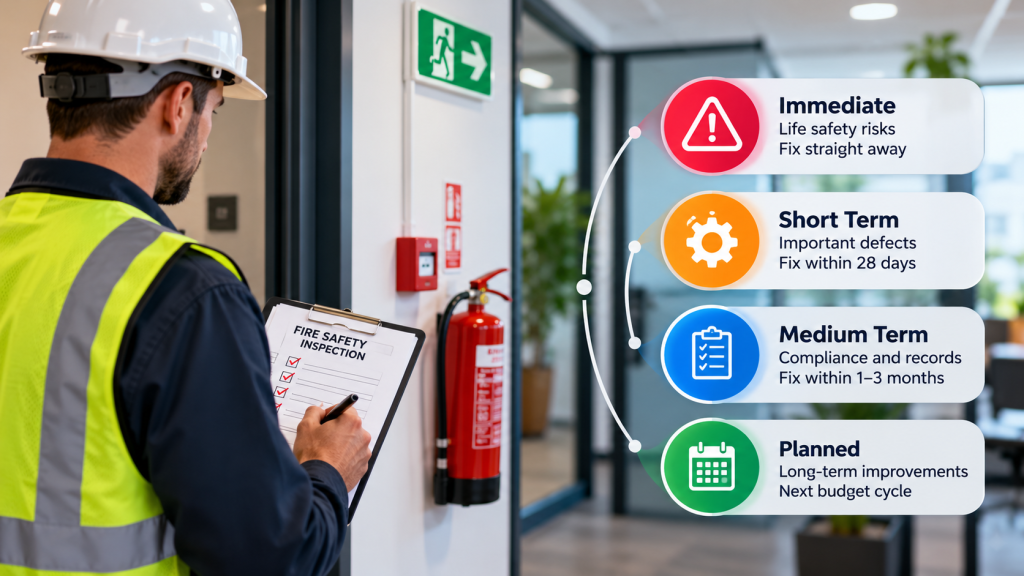
A fire safety inspection will find many things wrong, but the ability to know what problems are most important to fix is vital to keeping everyone safe and meeting all their legal obligations. Things such as blocked exits, faulty fire doors, and malfunctioning alarms are just some of the problems that need to be sorted out according to their importance. The knowledge of how to prioritise fire safety remedial actions is necessary.
Table of Contents
Need Help Prioritising Fire Safety Actions?
Our experienced fire risk assessors can help you identify urgent risks and plan the next steps.
Get a Free QuoteWhy Does The Order Of Work Matter More Than The Length Of The List?
Fire and rescue services in England conducted 50,195 fire safety inspections during the year ending March 2026, of which nearly 40 per cent (20,286) were deemed unsatisfactory. The breaches of Article 14 on the emergency routes and exits were counted 11,286 times, while failures in maintenance according to Article 17 were 9,727.
This Fire Safety Order applies to England and Wales; thus, the guide takes into account English standards. Whichever person has prepared your report, the final determination of the meaning of each line will be made by the responsible person, since reports include critical defects along with just observations. Many of them contain a fire risk assessment template with a column of ratings, so each of them must be cross-checked against the floor. Each line converted into the work is your fire safety corrective action, and the order is in your hands.
Rank Each Finding Based on How It Affects People
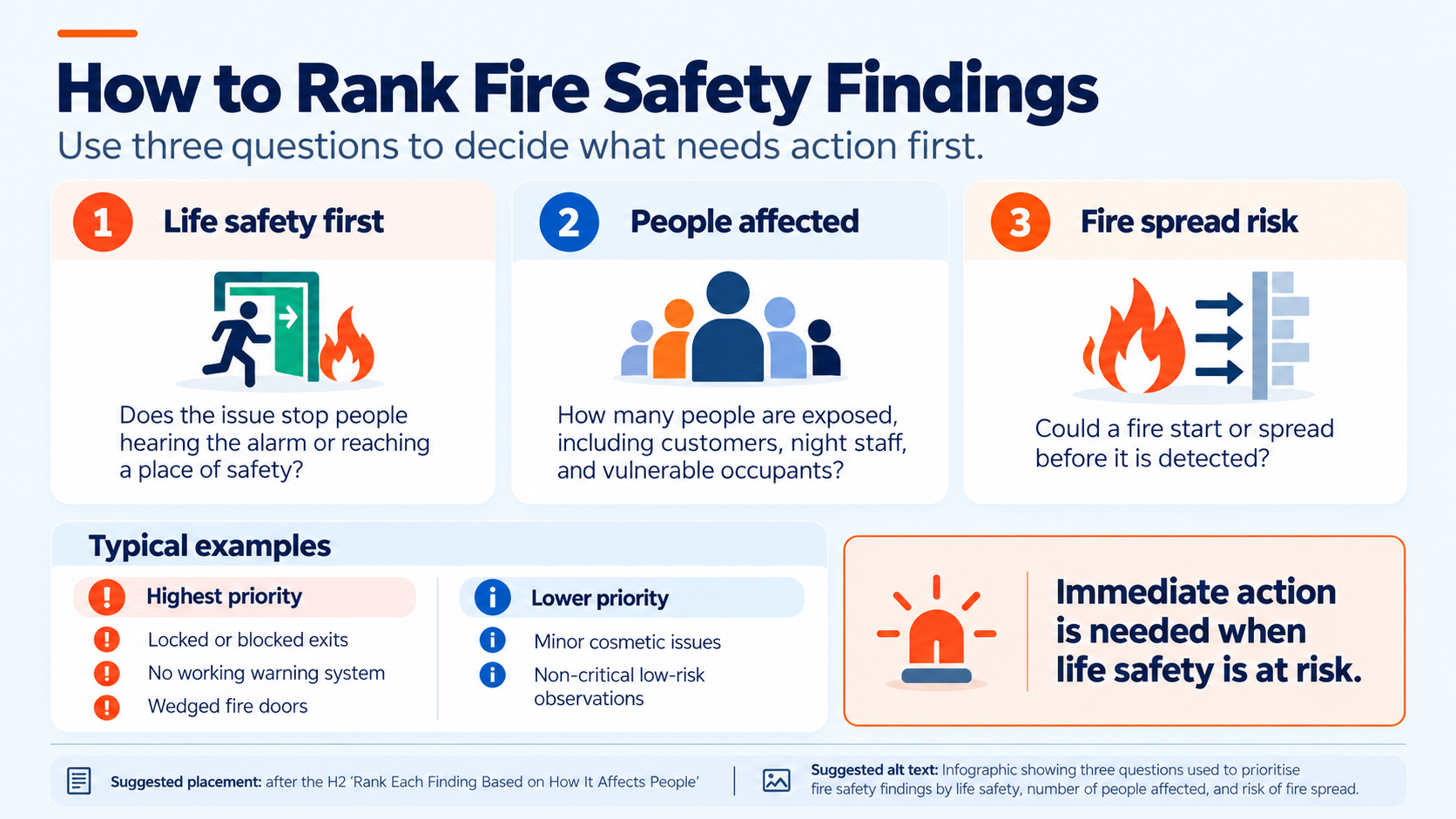
The stained ceiling tile will be rated as less serious than the chained fire exit, but the fire exit will be capable of trapping people if smoke starts filling up the corridor. Three simple questions rank each finding to prioritise before any cost is incurred:
- Does the issue affect people’s ability to hear the alarm or reach a point of safety?
- What is the population affected, including customers or night staff?
- Is there a high possibility of fire occurring or spreading to the adjoining area before being detected?
The government guidelines for offices and retail premises are straightforward when it comes to priorities, and the guidelines can be written in one sentence. Findings that endanger people immediately, such as locked exits, will be sorted immediately, while the rest will be scheduled as the risk permits.
Office Fire Risk Assessment Prioritisation
The typical suspects in such an office fire risk assessment will include cables installed into the walls following IT work, boxes in the corridors, and open doors. Prioritising fire safety defects based on their consequences is the key element in fire safety defects’ prioritisation, and it prevents inexpensive yet hazardous projects from lining up behind expensive but harmless ones.
A Timeline That Separates “Safe Now” From “Fixed For Good”
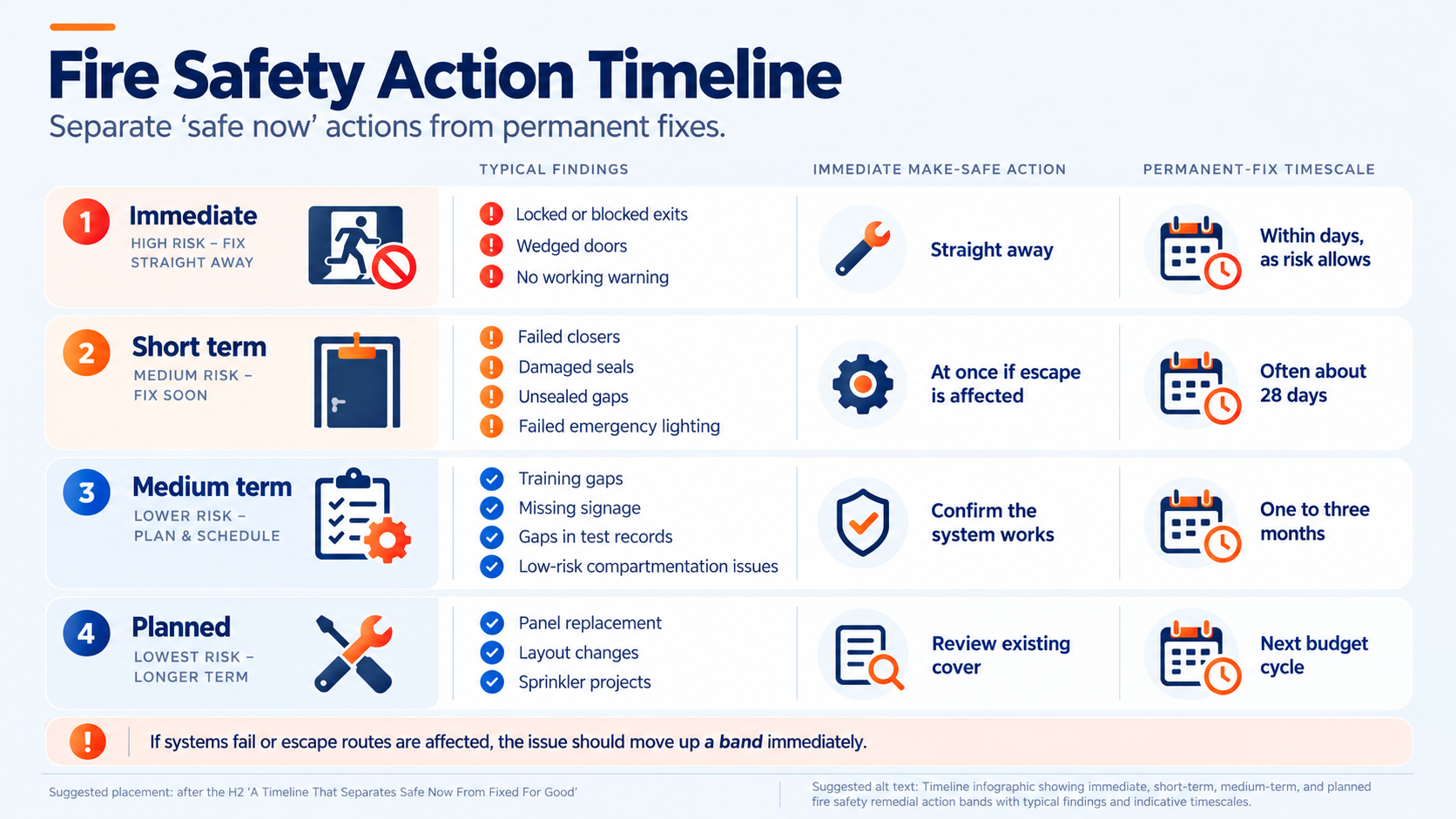
Prioritisation becomes useful when it is translated into a schedule, which is shown in the table below.
| Band | Typical Findings | Make Safe | Permanent Fix |
|---|---|---|---|
| Immediate | Locked or blocked exits, wedged doors, no working warning | Straight away | Within days, as the risk allows |
| Short term | Failed closers, damaged seals, unsealed gaps on escape routes, failed emergency lighting | At once if escape is affected | Often about 28 days |
| Medium term | Gaps in test records, training gaps, signage, compartmentation in low-risk areas | Confirm the test happened and the system works | One to three months |
| Planned | Panel replacement, layout changes, sprinklers | Review existing cover | Next budget cycle |
Think of each row as a means of assisting you in your own structure planning rather than an enforceable deadline. The 28 days mentioned is applicable in formal enforcement notice cases where there is a 21-day right of appeal, and hence nothing about your own assessment.
Whatever falls in the category of failure in systems or exposure becomes a jump of a band instantly. Similarly, fire safety remedial actions involving escape routes must not be left to a monthly meeting.
Protect Occupants While The Long-Term Solution Is Arranging
Never wait to protect the occupants while you await the services of a contractor.
- Prohibit access to the affected room/area until the work has been completed and tested.
- Inspect each escape route every day and confirm its unobstructed state in writing.
The reasons for failure of the alarm explain how to choose a suitable temporary safety measure based on the building, problem and occupants. Make an appointment for the installation and maintenance of fire alarm systems with a reliable engineer immediately, and ask for a recommendation regarding the most appropriate temporary alarm for the building. The use of gongs, whistles, air horns and training may be acceptable temporarily. Bigger buildings will probably require additional trained security personnel, and all unsafe areas should close down until the problem is solved.
The fire detection systems have to be serviced every six months by a qualified engineer; therefore, an alarm failure necessitates an investigation into the service history of the system. Record the reason for the interim control, starting and review dates for each measure because it turns out to be a long-term solution without a fixed end date.
Fire Doors: Easily Repaired and Easily Misjudged
Dull things make doors faulty, like sealant that is painted over, stalled closers, and clearances past the 4 mm benchmark. Every doorset will have a specification for the exact clearance. The simple test here is that when you open the door wide, release it, and again open the door at about 15 degrees and release it, it must close strongly.
Risk Assessment London has over 25 years of experience and has successfully completed over 512 projects. Fire door surveying is provided by Risk Assessment London for offices, warehouses, retail units, and residential blocks.
Fire Door Inspection Frequency
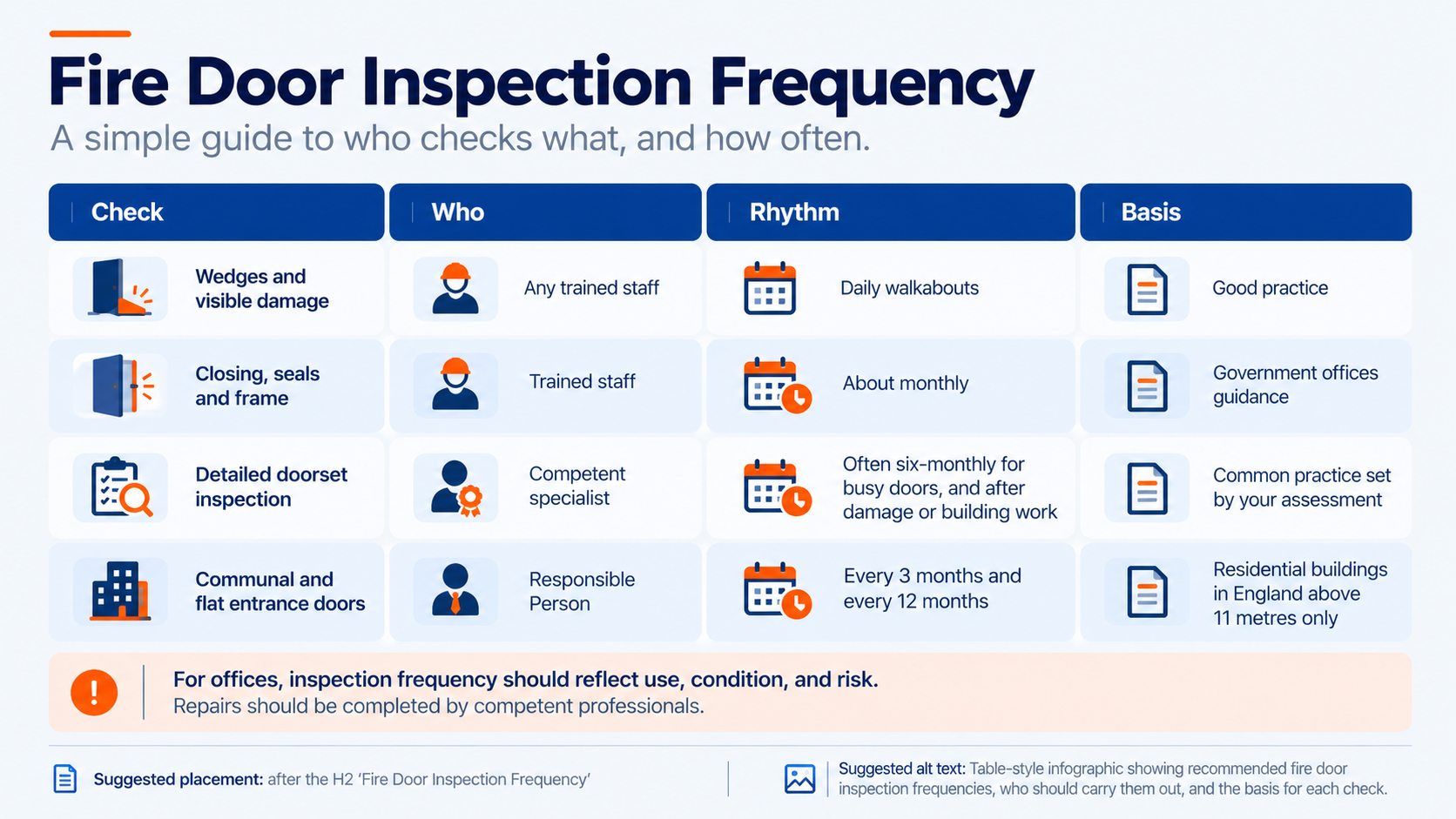
How often fire doors need to be inspected in an office has no single legal answer. The order states that there should be a suitable arrangement for maintenance.
| Check | Who | Rhythm | Basis |
|---|---|---|---|
| Wedges and visible damage | Any trained staff | Daily walkabouts | Good practice |
| Closing, seals and frame | Trained staff | About monthly | Government offices guidance |
| Detailed doorset inspection | Competent specialist | Often six-monthly for busy doors, and after damage or building work | Common practice, set by your assessment |
| Communal and flat entrance doors | Responsible Person | Every 3 months and every 12 months (best endeavours) | Legal duty, residential buildings in England above 11 metres only |
That list is covered in the Fire Safety (England) Regulations 2022 and does not apply to offices. Even there, regular inspections coexist with specialist periodic assessments instead of replacing them, and all repair work needs to be performed by a professional.
Assign Each Action an Executor, a Deadline, and Evidence of Completion
A remedial action plan requires an individual to be assigned to each task rather than a department, and a deadline and a type of evidence are always to be provided. Assign tasks depending on the trade, but never allow this grouping to slow down Band 1 tasks. End all tasks with appropriate evidence of completion, for example, a follow-up inspection of doors and fire stopping or documented completion of training courses.
Check the register once a week while fire safety remedial actions are ongoing and refer all overdue entries to senior management. The register is to be reviewed annually, as well as following each refurbishment, change of occupier or near miss.
Who Should Be Doing It?
Fire stopping, alarms and door fitting generally require experts, but the legal responsibility remains with the responsible person no matter who is holding the screwdriver. Skills have to meet the task at hand; therefore, the qualifications of an assessor mean very little when it comes to a firm’s ability to install fire doors or stop up a riser.
Risk Assessment London provides inspections for offices, warehouses, retail outlets, HMOs and care facilities from its London base, and every inspection ends with an action plan. The company’s staff also perform fire alarm testing, emergency lighting tests and extinguisher servicing, meaning any questions on these tasks can be asked of the same company.
Question That Your Report Does Not Ask
Every report describes the problems that exist at the moment, but no report ever asks the critical question for the audit next year – which of these flaws will reappear? Holes from the recent cable installation, an open door on a busy Friday, and a neglected review are the common means of recurrence. This answer resides in the register that you have just created and in what it reveals when there are three or four reviews lined up next to each other. Go through the sections described above with this question in your mind, and the sequence of actions becomes quite different.
Follow our guide on how to conduct a fire risk assessment to understand the key steps involved in identifying fire hazards and assessing risks in your premises.
Get a Free Quote Call: 020 3051 1294Frequently Asked Questions
Who Determines How Urgent The Action Item Is – The Assessor Or The Responsible Person?
An assessment gives its recommendation regarding the rating, but the Responsible Person holds the responsibility and should be able to substantiate it. Write down an explanation from the assessor for any unusual ratings.
Is Every Action Required Completed In 28 Days After the Assessment?
No, because the 28 days cited are those in an enforcement notice and not for all actions. Some actions need to be completed much earlier, and other low-priority tasks can be done as per the plan.
Should I Wait Until The Budget For High Priority Action Is Available?
Not advisable, as people will remain exposed till the problem is resolved. Take some interim measures and document them. The budget decision needs to be escalated to the senior level.
What Can I Do To Demonstrate To Inspector That The Action Is Done?
Have dated photographs, an engineer’s certificate and invoices and ensure that the repairs are inspected by a competent person. Also, update the register on the same day.
Can a Business Remain Open With Outstanding Fire Safety Defects?
A business may remain open if outstanding defects do not pose serious risks and suitable safety measures are in place. Significant hazards may require restricted access or temporary closure.
Who Pays for Fire Safety Remedial Work in a Commercial Building?
The cost of remedial work depends on the lease agreement and the responsibilities of the landlord and tenant. Both parties must understand their obligations under UK fire safety legislation.
What Is the Difference Between a Fire Safety Defect and an Observation?
A fire safety defect indicates a problem that could affect safety or compliance, while an observation may highlight an area for improvement. Both should be considered according to the level of risk involved.
Should a Fire Risk Assessment Be Updated After Building Renovations?
A fire risk assessment should be reviewed when renovations significantly affect the building’s layout, escape routes or fire protection systems. Any newly identified risks must be assessed and appropriate safety measures implemented.