
Table of Contents
Fire safety is an important responsibility for every school. From classrooms and science laboratories to kitchens and assembly halls, schools have several areas where a fire can start if the right precautions are not followed. A clear school fire safety checklist helps headteachers, school administrators, governors and facilities teams identify potential risks and take action before an emergency occurs.
Effective fire safety in schools involves more than installing fire alarms and extinguishers. It includes keeping escape routes clear, inspecting electrical equipment, training staff and ensuring pupils understand evacuation procedures. Appropriate school fire safety measures help reduce risks and support safe evacuation during an emergency.
Schools across the UK must follow the fire safety legislation applicable to their location. In England and Wales, the Regulatory Reform (Fire Safety) Order 2005 requires a suitable and sufficient fire risk assessment. Scotland and Northern Ireland have separate fire safety legislation.
The assessment should reflect the building, its activities and the people who use it. Regular reviews and maintenance help ensure that fire safety arrangements remain effective.
Why Is a School Fire Safety Checklist Important?
Schools accommodate children, teachers, support staff, contractors and visitors throughout the day. Younger pupils may need additional assistance during an evacuation, while laboratories, kitchens and electrical rooms can contain specific fire hazards.
Get a School Fire Risk Assessment
A school fire safety checklist helps the responsible person check whether fire prevention measures are working as intended. It also makes it easier to record problems, assign responsibilities and follow up on outstanding actions.
The main benefits include:
- Identifying potential fire hazards before they cause an incident.
- Keeping fire exits and escape routes clear.
- Checking that fire alarms and emergency lighting work correctly.
- Helping staff and pupils understand evacuation procedures.
- Maintaining records of fire drills, inspections and equipment servicing.
- Supporting compliance with relevant UK fire safety requirements.
Regular fire safety checks should form part of the school’s wider health and safety arrangements rather than being treated as a one-off task.
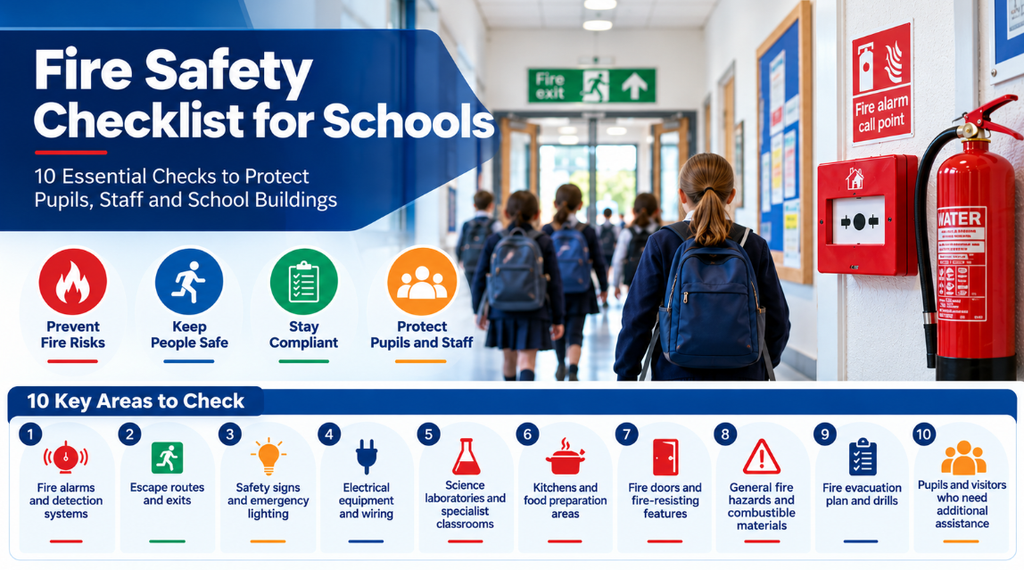
School Fire Safety Checklist: 10 Essential Checks
Use the following checklist as a practical starting point for reviewing fire safety across the school. The checks should be adapted to the building’s fire risk assessment and the activities carried out in each area.
|
Fire Safety Area |
What Schools Should Check |
|
Fire Alarms and Detection |
Check alarms, smoke detectors, manual call points and maintenance records. |
|
Fire Exits and Escape Routes |
Keep corridors, stairways and exits clear and accessible. |
|
Safety Signs and Emergency Lighting |
Check exit signs, fire action notices and emergency lighting. |
|
Electrical Equipment |
Look for damaged cables, overloaded sockets and faulty equipment. |
|
Science Laboratories |
Check heating equipment, chemical storage and fire safety procedures. |
|
Kitchens and Food Preparation |
Inspect cooking equipment, extraction systems and firefighting equipment. |
|
Fire Doors |
Check that doors close properly and have no visible damage. |
|
General Fire Hazards |
Identify combustible waste, unsafe storage and potential ignition sources. |
|
Fire Evacuation Procedures |
Review escape routes, assembly points, staff responsibilities and fire drills. |
|
Additional Evacuation Assistance |
Review PEEPs and support arrangements for pupils and visitors. |
1. Check Fire Alarms and Detection Systems
Fire alarms provide an early warning so that pupils, staff and visitors can leave the building promptly. Smoke and heat detectors can also help identify a fire before it spreads.
As part of routine school fire safety checks, make sure that:
- The fire alarm system is tested and maintained according to the applicable requirements and manufacturer’s instructions.
- Manual call points are accessible and clearly identifiable.
- Smoke and heat detectors are unobstructed and appear undamaged.
- Any faults are reported and repaired promptly.
- Testing, servicing and maintenance records are kept up to date.
Staff should know how the alarm sounds and what action to take when they hear it. If a fault affects the alarm system, suitable temporary safety measures should be arranged until the problem is resolved.
2. Keep Fire Exits and Escape Routes Clear
Blocked corridors, locked exits and cluttered stairways can delay an evacuation. This is especially important during lesson changes, lunch breaks and school events when many people may be moving around at once.
Check that:
- All designated escape routes are free from furniture, bags, boxes and other obstructions.
- Fire exits can be opened easily from the direction of escape.
- Stairways and corridors are kept clear.
- Fire doors are not wedged open and close properly.
- Alternative escape routes are available where required.
- Assembly points are suitable for the number of people expected to use them.
Include classrooms, sports halls, dining areas, staff rooms and after-school club spaces in these inspections.
For more detailed guidance, schools can use a suitable fire evacuation plan to establish clear escape routes, assembly arrangements and responsibilities during an emergency.
3. Inspect Fire Safety Signs and Emergency Lighting
Clear signs help people find fire exits, identify firefighting equipment and understand emergency instructions. This is particularly important for visitors, supply teachers and contractors who may not know the school layout.
As part of your school fire safety checklist, confirm that:
- Fire exit signs are visible and point towards the correct escape routes.
- Fire action notices are displayed in appropriate locations.
- Signs identifying firefighting equipment are clear.
- Fire doors have suitable signs where required.
- Emergency lighting is maintained and tested.
- Faulty or damaged signs and lights are repaired or replaced.
Emergency lighting is important because a power failure can leave corridors and stairways dark during an evacuation. Schools should also review the placement and condition of their fire safety signs to ensure that important instructions remain easy to see and understand.
4. Review Electrical Equipment and Wiring
Classrooms, computer rooms and offices often contain computers, interactive boards, chargers, printers and other electrical equipment. Damaged cables, overloaded sockets and poorly maintained appliances can increase fire risks.
Include these checks in your school fire prevention routine:
- Look for damaged plugs, cables and sockets.
- Avoid overloading sockets or connecting extension leads in unsafe ways.
- Keep electrical equipment away from combustible materials where appropriate.
- Ensure electrical installations and portable appliances receive suitable inspection and maintenance.
- Switch off equipment when required by the school’s procedures.
- Keep electrical cupboards and distribution boards accessible to authorised personnel.
Do not attempt to repair damaged electrical equipment unless you are suitably qualified. Report faults to the responsible maintenance team and arrange professional repairs.
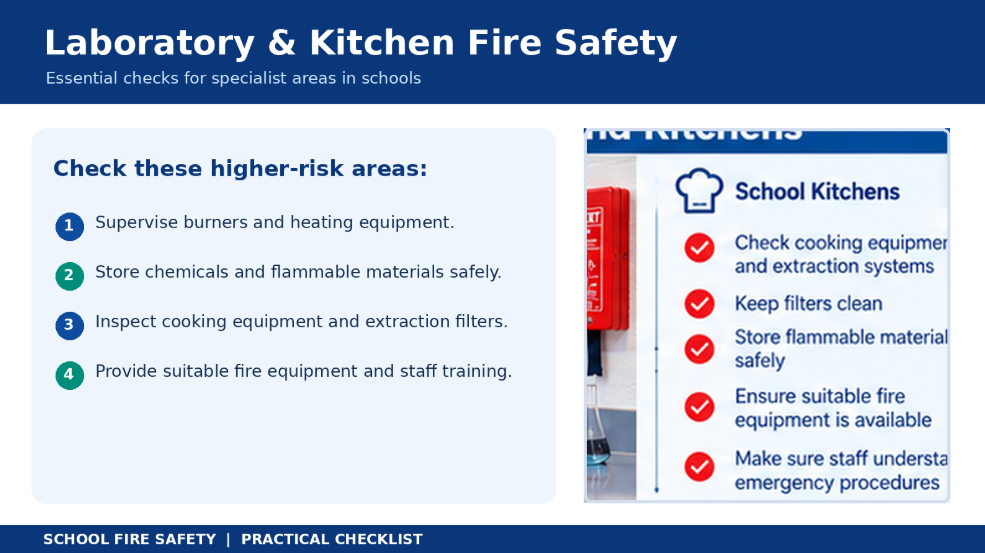
5. Check Science Laboratories and Specialist Classrooms
Science laboratories, design and technology rooms and art classrooms may contain heat sources, gas supplies, chemicals and materials that can burn easily. These areas need controls suited to the activities taking place.
Important checks include:
- Ensuring Bunsen burners and other heating equipment are used under appropriate supervision.
- Keeping combustible materials away from flames and hot surfaces.
- Storing chemicals according to their hazards and relevant safety guidance.
- Checking gas equipment and connections for visible damage.
- Making sure suitable fire blankets and firefighting equipment are accessible where required.
- Ensuring staff and pupils follow the relevant laboratory safety procedures.
Equipment should never be left operating unattended where supervision is required. School staff should also ensure that specialist rooms have suitable risk assessments and emergency arrangements.
6. Inspect Kitchens and Food Preparation Areas
School kitchens can contain ovens, hobs, deep-fat fryers and other heat-producing equipment. Cooking oils, grease deposits and combustible packaging can add to the risk if they are not managed correctly.
Your checklist should include:
- Checking cooking equipment for visible damage and faults.
- Keeping flammable materials away from heat sources.
- Ensuring extraction systems and filters are cleaned as required.
- Maintaining suitable firefighting equipment for the specific cooking risks.
- Making sure kitchen staff understand emergency procedures.
- Keeping exits and access routes clear.
Staff should receive appropriate training on what to do if cooking equipment catches fire. Never use water on a fire involving burning cooking oil, as it can cause the burning oil to spread violently.
7. Review Fire Doors and Fire-Resisting Features
Fire doors and other fire-resisting features help slow the spread of smoke and flames, allowing people more time to escape. They are an important part of school fire protection, particularly in corridors, stairways and areas separating different parts of the building.
During routine inspections, check that:
- Fire doors are not damaged.
- Doors close fully into their frames.
- Door closers and other essential hardware work correctly.
- Seals and other visible components are in good condition.
- Fire doors are not held open using wedges or other unauthorised methods.
- Any defects are reported and repaired by competent professionals.
Do not remove, alter or repair fire door components without appropriate expertise. Where defects are identified, record them and arrange suitable remedial work.
8. Identify General Fire Hazards and Combustible Materials
School fire prevention also depends on good housekeeping and the safe management of everyday activities. Paper, cardboard, cleaning products, decorations and waste can contribute to a fire if stored carelessly.
Check for common workplace fire hazards, including:
- Waste and cardboard accumulating near buildings or exits.
- Combustible materials stored close to heaters or electrical equipment.
- Cleaning chemicals stored incorrectly.
- Unauthorised use of candles or other naked flames.
- Unsafe contractor activities, including hot work.
- Unsecured external waste areas that could be targeted by arsonists.
Keep storage areas organised, remove waste regularly and ensure contractors follow the school’s fire safety procedures. Any significant hazard should be recorded and addressed promptly.
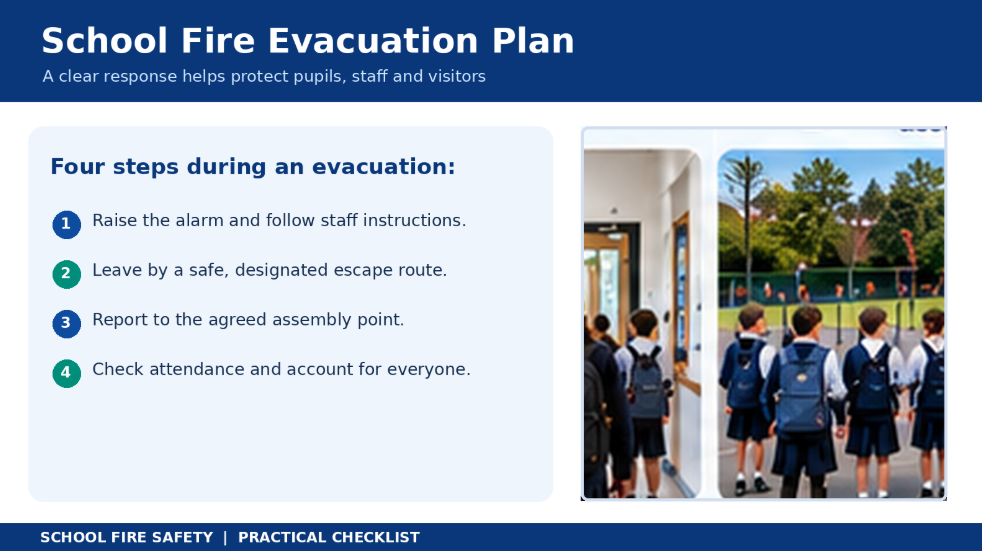
9. Prepare and Practise the School Fire Evacuation Plan
A written evacuation procedure helps staff understand their responsibilities and reduces confusion during an emergency. Everyone should know how to raise the alarm, leave the building and report to the designated assembly point.
A school evacuation plan should explain:
- The primary and alternative escape routes.
- The location of assembly points.
- Who is responsible for calling the fire and rescue service.
- How staff check attendance and account for pupils, visitors and contractors.
- How children who need additional assistance will be supported.
- What staff should do if someone is missing.
- How emergency procedures operate during lessons, lunch breaks and after-school activities.
Fire drills should be carried out at appropriate intervals and in line with applicable requirements. Record the date, any problems encountered and the improvements needed after each drill.
Pupils and staff should be reminded to leave belongings behind, follow instructions and never re-enter the building until authorised.
10. Support Pupils and Visitors Who Need Additional Assistance
Not everyone can evacuate in the same way. Younger children, pupils with mobility or sensory impairments and visitors unfamiliar with the premises may need additional support.
Schools should identify individual needs and make suitable arrangements as part of their fire risk assessment and evacuation procedures.
This may include:
- Preparing Personal Emergency Evacuation Plans (PEEPs) where appropriate.
- Assigning trained staff to assist.
- Providing suitable evacuation equipment where required.
- Ensuring alarm arrangements meet the needs of people who may not hear or recognise a standard alarm.
- Keeping visitor and contractor attendance information available.
- Practising evacuation arrangements with those who need assistance.
Plans should be reviewed whenever a pupil’s needs, staffing arrangements or the building layout changes.
Why Does Every School Need a Fire Risk Assessment?
A school fire safety checklist helps staff carry out routine checks, but it does not replace a suitable and sufficient fire risk assessment.
A fire risk assessment identifies possible sources of ignition, combustible materials, people who may be at risk and the measures needed to prevent a fire or reduce its impact. It also helps determine whether the existing fire protection systems and evacuation arrangements are suitable.
Need a Professional School Fire Risk Assessment?
Get expert support identifying fire hazards, reviewing safety arrangements and prioritising improvements across your school premises.
Request a Free QuoteSchools should ensure that their assessment covers the whole premises, including classrooms, kitchens, laboratories, assembly halls, storage rooms, offices and areas used by external organisations.
Create a Fire Safety Management Plan for Your School
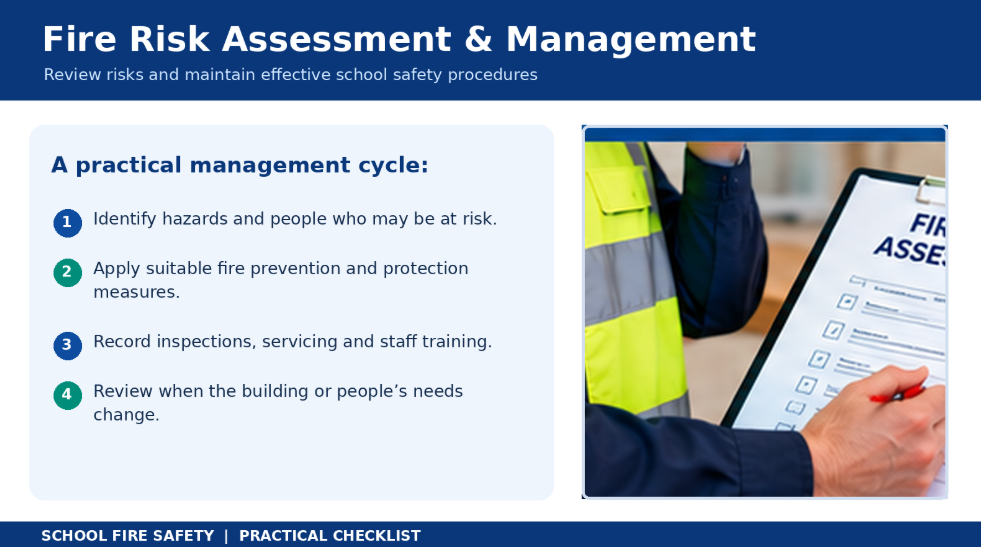
A fire safety management plan helps schools turn fire safety policies into everyday actions. It sets out who is responsible for checks, how defects are reported, how staff are trained and how emergency procedures are maintained.
A useful plan should include:
- The name of the person responsible for managing fire safety.
- A schedule for inspections, testing and equipment maintenance.
- Staff training and fire drill arrangements.
- Procedures for reporting and resolving hazards.
- Records of inspections, servicing and corrective actions.
- Evacuation arrangements for pupils, staff, visitors and contractors.
- A process for reviewing the plan when circumstances change.
Schools that manage several buildings should also maintain consistent procedures while accounting for the specific risks at each site.
Many routine checks, such as inspecting fire doors, alarms and escape routes, also apply to other types of premises. Our commercial building fire safety checklist explains these shared safety considerations in more detail. However, school-specific risks and the needs of children must still be considered.
How Risk Assessment LTD Can Help With School Fire Safety
Maintaining fire safety across a school requires regular checks, suitable documentation and a clear understanding of the risks. A professional assessment can help identify issues that routine visual inspections may not uncover.
Risk Assessment LTD provides fire risk assessment services for educational premises, including reviews of classrooms, science laboratories, assembly halls, escape routes and fire protection arrangements. Its school assessment service also considers evacuation procedures and the needs of pupils who require additional assistance.
Working with a competent fire risk assessor can help school leaders understand their responsibilities, prioritise remedial work and maintain appropriate records. For more information, visit Risk Assessment LTD’s school fire risk assessment service or read its guidance on fire evacuation plans.
Conclusion
Keeping a school safe from fire requires regular inspections, clear procedures and everyone working together. A practical school fire safety checklist helps staff identify potential hazards, maintain essential fire protection equipment and ensure that pupils and visitors can evacuate safely during an emergency.
From checking fire alarms and escape routes to reviewing laboratory risks and supporting pupils who need additional assistance, every precaution plays an important role in school fire safety.
Frequently Asked Questions
What should a school fire safety checklist include?
A school fire safety checklist should cover fire alarms, escape routes, fire doors, emergency lighting, fire safety signs, electrical equipment, kitchens, science laboratories, evacuation procedures and staff training. It should also include checks for pupils and visitors who may need additional evacuation assistance.
Are schools required to have a fire risk assessment in the UK?
Yes. Schools across the UK must comply with applicable fire safety legislation. In England and Wales, the Regulatory Reform (Fire Safety) Order 2005 requires a suitable and sufficient fire risk assessment. Scotland and Northern Ireland have separate requirements.
How often should school fire drills take place?
Schools should conduct fire drills regularly, following their fire risk assessment, emergency procedures and applicable guidance. Each drill should be recorded and reviewed to identify evacuation problems, improve staff preparedness and ensure pupils understand how to leave the building safely.
Who is responsible for fire safety in schools?
The responsible person has legal duties for fire safety under the applicable legislation. Depending on the school’s ownership and management arrangements, this may involve the employer, owner, occupier or another person with control of the premises. Headteachers, facilities teams and designated staff may carry out specific duties.
What are the most common fire hazards in schools?
Common hazards include faulty electrical equipment, overloaded sockets, cooking equipment, science laboratory heat sources, incorrectly stored chemicals, blocked escape routes and combustible waste. Regular inspections and suitable fire prevention measures help reduce these risks.