
Table of Contents
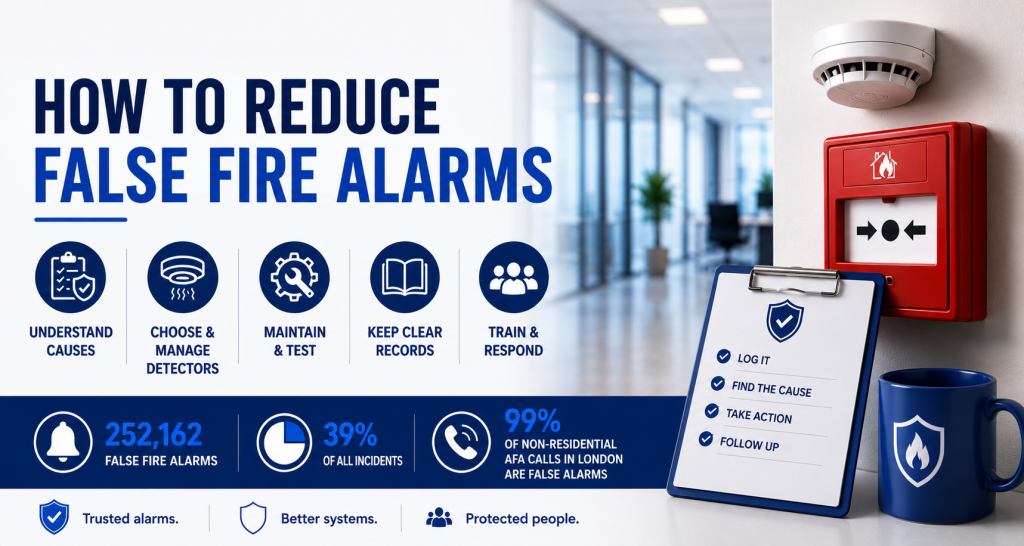
A false fire alarm is not just a noisy interruption. For a shop, office, warehouse, hotel, restaurant or HMO, it can stop trading, unsettle occupants, delay work, lead to resident complaints and weaken confidence in the alarm system. The biggest risk is not always the call-out itself. The real risk appears after the third or fourth false activation, when people begin to assume the next alarm will also be false.
That is exactly the behaviour a responsible person must avoid. A fire alarm only protects life when people trust it, hear it and respond to it. If staff, tenants or visitors have become used to nuisance alarms, evacuation can slow down when the alarm finally matters.
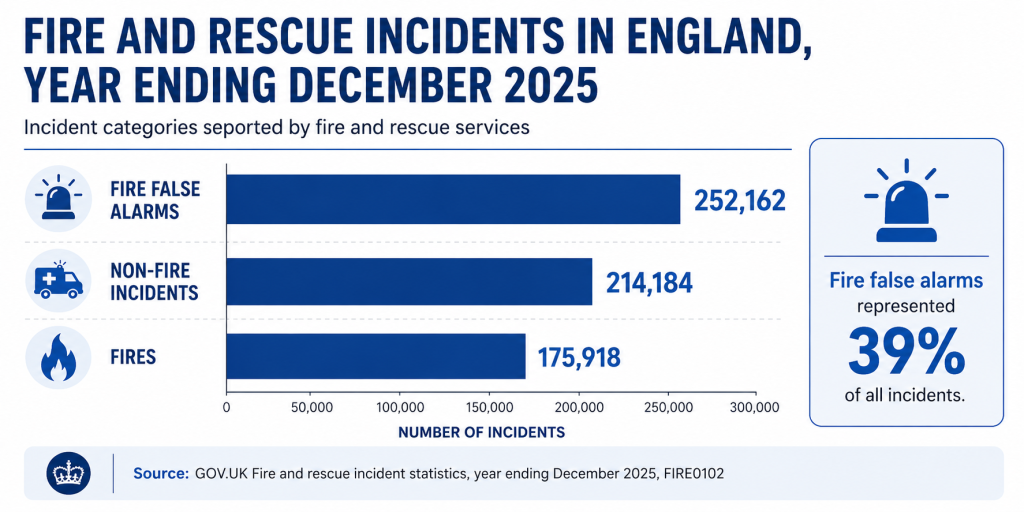
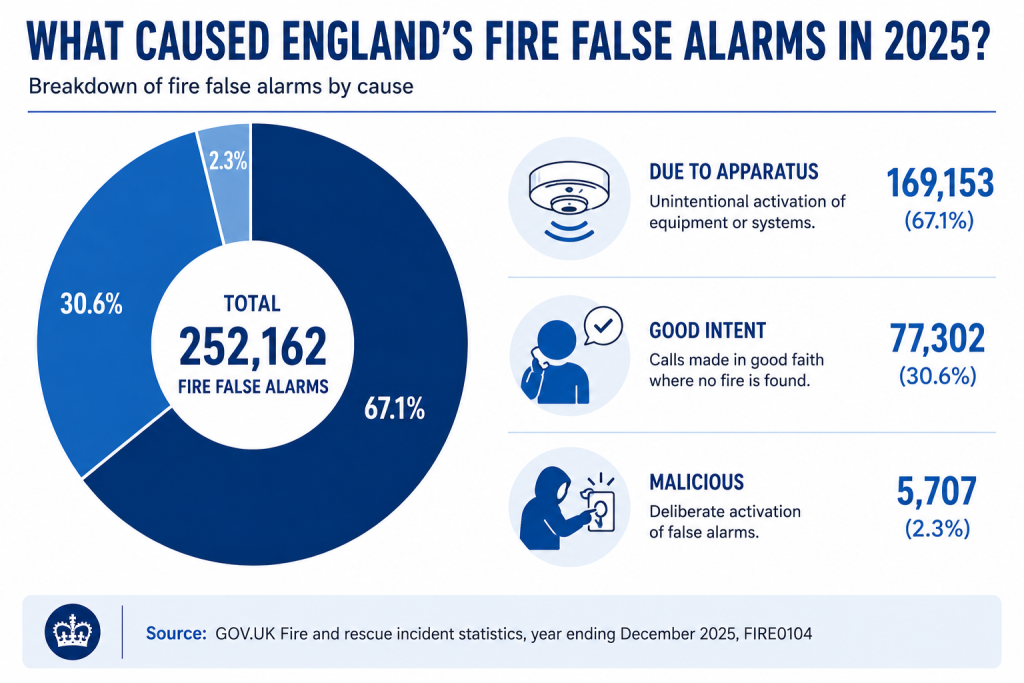
The scale of the problem is clear in the latest official incident statistics for England. In the year ending December 2025, fire and rescue services attended 642,264 incidents. Fire false alarms accounted for 39% of all incidents and there were 252,162 fire false alarms in that year. Of those, 169,153 were false alarms due to apparatus, which means fire alarm or fire-fighting equipment operated in error. The same release records 77,302 good intent false alarms and 5,707 malicious fire false alarms.
London shows why this has become a practical management issue for businesses. London Fire Brigade says automatic fire alarms made up 34% of all incidents it attended in 2025, equal to 47,500 calls. It also states that less than 1% of calls from non-residential automatic fire alarms are ultimately recorded as fires, meaning 99% are false alarms.
For FireRisk clients, the lesson is simple: weekly testing and planned servicing matter, but they do not solve every false alarm problem on their own. The building has to be managed in a way that suits the detectors installed, the people inside and the work being carried out each day. A cafe with open toasters, a student HMO with shared showers, a warehouse with dusty picking areas and an office under refurbishment all need different controls.
| Key takeaway: Treat every false alarm as a piece of evidence. If the log book only says “false alarm reset”, it is not doing enough. A useful record names the device, location, probable cause, time, activity in the area, action taken and person responsible for follow-up. |
What counts as a false fire alarm?
Government fire statistics define a fire false alarm as an incident where a fire and rescue service attends a location believing there to be a fire, but on arrival finds that no fire exists or existed. The three main categories are due to apparatus, good intent and malicious.
| Type of false alarm | What it means in practice | Typical building example |
| Due to apparatus | A fire alarm or fire-fighting system operates in error, including accidental initiation. | Smoke detector activates from steam outside an HMO bathroom or dust from drilling in an office corridor. |
| Good intent | Someone calls believing there is a real fire, but it turns out not to be one. | A member of staff smells burning from a neighbouring unit and calls 999 before the source is confirmed. |
| Malicious | A call or activation is made deliberately for a non-existent incident. | A manual call point is pressed in a shared hallway with no signs of fire. |
This blog focuses mainly on apparatus-related and avoidable good intent alarms because those are the areas where responsible persons, landlords, managing agents and duty holders have the most control. Malicious activations need a separate management response, which may involve call point covers, CCTV coverage in common areas, resident engagement and escalation to the police where appropriate.
Why false alarms need urgent attention in 2026
False alarms used to be seen by many organisations as a cost of having a sensitive alarm system. That is no longer a safe attitude. Fire and rescue services across the UK have been tightening automatic fire alarm response policies. In London, from 29 October 2024, automatic fire alarm calls from most commercial buildings between 7:00 am and 8:30 pm are no longer attended unless a person reports a fire. Residential buildings and some higher-risk premises are exempt, but businesses should not assume an engine will be sent just because an alarm receiving centre has passed on an activation.
This change does not remove the need for a fire alarm. It increases the need for a clear on-site response. If your premises is affected by an AFA policy, the people in charge must know who checks the panel, who investigates safely, who calls 999 or 112 when there are signs of fire and who records what happened after the event.
Under the Regulatory Reform (Fire Safety) Order 2005, where it applies, fire precautions must be kept in efficient working order and in good repair. The alarm system is not just a box on the wall. It forms part of the fire risk assessment, the emergency plan and the management arrangements for the premises. A recurring false alarm pattern can point to poor maintenance, unsuitable detector selection, poor control of contractors, poor tenant behaviour or a change in use that has not been reflected in the fire risk assessment.
In practice, we often see the same pattern during FireRisk assessments. The alarm panel shows several activations from the same zone, but the log book gives no cause. Staff remember “it was the kitchen again” or “probably steam”, but no one has checked whether the detector type is right, whether ventilation has changed or whether the resident information needs updating. A small pattern becomes a normalised fault.
The most common causes of false alarms
London Fire Brigade guidance for commercial premises lists several common false alarm causes. They include unsuitable fire alarm design, faults, poor maintenance, testing mistakes, contractors working, dust, cooking fumes, smoking, vaping, steam, aerosol sprays, accidental use of manual call points and poor servicing. Those causes match what assessors often find in UK businesses and HMOs.
| Cause | Why it happens | Control that usually works |
| Cooking fumes | Smoke detectors are too close to cooking, toasters or shared kitchens. | Review detector type and location. Heat detection may be more suitable in kitchen areas, subject to competent design. |
| Steam | Showers, kettles or industrial processes produce vapour that reaches smoke detectors. | Improve ventilation, close doors, review detector siting and educate occupants. |
| Dust and insects | Detectors become contaminated or contractors create airborne dust. | Clean detector heads, use temporary covers during approved works and reinstate promptly. |
| Testing errors | The system is tested without informing the alarm receiving centre or occupants. | Use a written test procedure, put the ARC on test and record completion. |
| Accidental manual call point use | People mistake a call point for a door release or press it during moving-in periods. | Fit protective covers where suitable, add clear signage and check call point position. |
| System faults | Poor maintenance, ageing devices or repeated faults in the same zone. | Use a competent fire alarm engineer and do not leave repeat faults unresolved. |
1. Start with a false alarm register, not a blame conversation
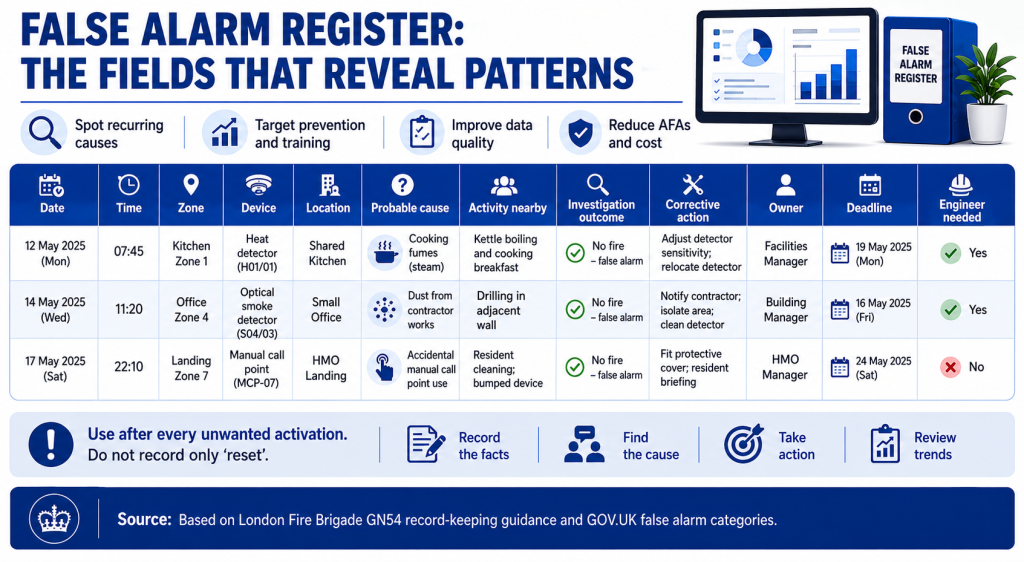
The first practical step is to record each activation in a way that allows trends to be seen. A normal fire log book may record weekly tests, call point checks and maintenance visits. A false alarm register goes further. It records what caused the alarm, what was happening in the area and what has changed since the last activation.
The minimum useful fields are:
- Date and time of activation
- Zone, device number and exact location
- Alarm category, for example apparatus, good intent or malicious
- Observed cause, such as cooking, steam, dust, contractor work, aerosol, system fault or unknown
- Who investigated and whether it was safe to do so
- Whether the fire and rescue service or alarm receiving centre was contacted
- Corrective action, owner and deadline
- Engineer attendance and parts replaced where relevant
- Whether the fire risk assessment needs review
A useful register makes patterns obvious. Three activations from the same kitchen detector in six weeks is not bad luck. It is a design, siting, ventilation or management issue. Two activations during refurbishment works point to a contractor control problem. Repeated weekend activations in an HMO may suggest tenant behaviour, poor kitchen separation or bathroom steam reaching the landing detector.
2. Match the detector to the room, not the other way round
A common false alarm mistake is treating every detector as if it belongs everywhere. It does not. Smoke detection is valuable because it can provide early warning, but the wrong detector in the wrong environment can create avoidable nuisance activations. Kitchens, shower areas, dusty stock rooms, workshops and plant rooms need careful design.
Changing a detector should never be a casual decision made after one annoying alarm. If a smoke detector is replaced with a heat detector in the wrong place, the building could lose early warning. The correct approach is to review the fire risk assessment, look at the cause and effect programming, check the detector coverage and use a competent fire alarm technician or designer. London Fire Brigade guidance notes that changing a detection device from smoke to heat or using a multi-sensor device can often eliminate false alarms, but it must be assessed case by case as part of the fire risk assessment and with competent advice.
For HMOs, this matters because kitchens and sleeping risk sit close together. A shared kitchen might need heat detection, while circulation routes need reliable early warning for escape. If steam from a bathroom is setting off a landing detector, moving the detector may solve the nuisance alarm, but the escape route still needs suitable detection. The solution should keep people safe while reducing avoidable activations.
3. Control kitchens, bathrooms and dust before resetting the panel
In businesses and HMOs, many false alarms begin with ordinary daily use. A toaster under a smoke head, a shower door left open, a decorator sanding filler below a detector or a tenant spraying deodorant in a small room can all create an activation. Resetting the panel without fixing the environment only moves the problem to another day.
For commercial kitchens, staff rooms and HMO shared kitchens, start with housekeeping and layout. Keep toasters, microwaves and air fryers away from smoke detectors where possible. Check whether extract ventilation is working. Make sure cooking is restricted to intended cooking areas. In an HMO, tenant induction should explain that bedroom cooking, overloaded plug-in appliances and wedged-open kitchen doors can affect both fire risk and alarm reliability.
For bathrooms and shower rooms, look for steam paths. A poorly closing door, failed extractor fan or detector sited too close to a bathroom entrance can produce repeat activations. In older converted HMOs, small landings and short corridors can make this problem worse. The solution may be repair, ventilation, door adjustment, detector relocation or resident guidance, but the cause needs to be recorded first.
For dust, the control is usually planning. Building works, drilling, sanding and ceiling tile removal should be managed with a permit or written instruction. Detector heads may need approved temporary covers during dusty work, with a named person responsible for removing covers immediately afterwards. If a detector is isolated, compensatory measures must be in place and the isolation must be recorded.
4. Make staff and residents part of the system
False alarm reduction fails when the alarm system is seen as an engineer’s problem only. People cause many false alarms, and people also prevent them. The right message depends on the premises.
In an office, staff need to know how weekly testing works, why the alarm receiving centre is put on test and what to do when contractors arrive. In a retail unit, the manager needs to know how to respond to an activation while customers are present. In an HMO, residents need clear, repeated instructions because occupancy changes and new tenants may not know the building. A single fire action notice at the front door is rarely enough on its own.
Training does not have to be complicated. It should cover five points:
- Take every alarm seriously and start the agreed evacuation or investigation procedure.
- Never cover, damage or disable detectors.
- Do not cook outside designated kitchen areas.
- Report repeated steam, cooking or fault activations to the landlord, manager or responsible person.
- Call 999 or 112 immediately if there are signs of fire, including sight, smell, sound, heat, smoke or flames.
For HMOs, the best time to give this message is at move-in, after any alarm incident and during routine property visits. If a tenant has caused an alarm by cooking or aerosol use, treat it first as an education opportunity. If the behaviour continues, the tenancy management route may be needed. The fire safety record should show what was explained, when and by whom.
5. Put building works under control
Refurbishment and maintenance work are common triggers for false alarms. Contractors drill ceilings, sand plaster, cut timber, create dust, isolate circuits and open ceiling voids. In a live business or occupied HMO, those works can affect detection and escape arrangements within minutes.
Before work starts, the responsible person or managing agent should check whether any activity could affect the alarm system. If it can, the contractor must be told how the fire alarm is managed. The alarm receiving centre may need to be informed. Detection devices may need temporary protection. Hot works may need a permit and fire watch. The system must be returned to normal afterwards.
A simple contractor control record should answer these questions:
- What work is taking place and where?
- Will the work create dust, fumes, heat or steam?
- Which detectors, zones or call points could be affected?
- Who is authorised to isolate or cover a detector if needed?
- What temporary fire safety measures are in place?
- Who will confirm the system is fully reinstated?
- What has been recorded in the log book?
In our experience, the last point is the one most often missed. A detector cover left in place after decorating is not just a false alarm issue. It is a life safety issue. The end-of-work check needs the same discipline as the start-of-work check.
6. Use maintenance to remove causes, not just clear faults
A maintenance visit should not be limited to clearing the panel and signing the log book. If a detector has caused repeated false alarms, the engineer should be asked to investigate why. That may involve contamination, age, sensitivity, incorrect detector type, air movement, nearby equipment, water ingress or programming.
London Fire Brigade guidance recommends a maintenance contract to ensure the system remains in efficient working order and in good repair. It also recommends the use of a company with third party certification in the relevant area of design, installation, commissioning and maintenance. This is important because a false alarm reduction plan can easily become unsafe if changes are made without competence.
When an engineer attends, give them the false alarm register rather than a vague description. A record showing repeated activations from device 03/014 near the rear kitchen at 18:30 on Friday evenings is far more useful than “the alarm keeps going off”. Good evidence helps the engineer test the right device, question the right environment and propose the right corrective action.
7. Investigate safely, but never delay a real fire response
A safe investigation process can help prevent unnecessary fire service attendance in premises affected by AFA policies. It can also help staff understand the difference between a confirmed fire and an unwanted activation. But investigation must be planned, risk assessed and carried out only where it is safe.
London Fire Brigade guidance is clear that if there are signs of fire, including sight, smell, sound, heat, smoke or flames, staff or an appointed person should call 999 or 112. It also states that alarm investigation should be carried out only by suitably trained staff and only where it is safe to do so. People should not be placed in unnecessary danger while investigating an alarm.
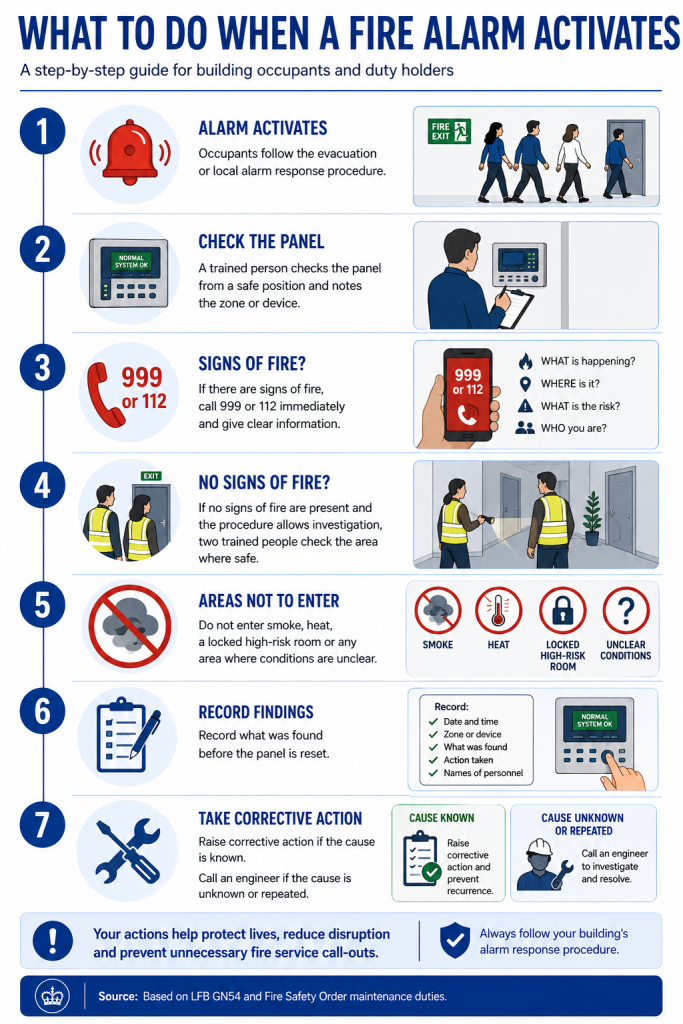
This process must be adapted to the building. A staffed office during the day can manage an investigation differently from an HMO at night. A lone worker arrangement is different again. The fire risk assessment should reflect how the alarm will be handled in the actual conditions of use, not in an ideal version of the building.
Additional advice for HMOs
HMOs need a more careful approach because people sleep there, occupancy changes and residents may not know each other. False alarms can quickly become a tenancy management problem as well as a fire safety problem. Residents complain, alarms are ignored, detectors are covered and kitchen doors are wedged open to stop nuisance activations. Each of those behaviours increases risk.
For HMO landlords and managing agents, the aim is to reduce false alarms without weakening detection. That means keeping a strong link between the fire risk assessment, HMO licence conditions, alarm design, resident information and maintenance records.
Useful HMO controls include:
- Use heat detection where appropriate in shared kitchens, while maintaining suitable smoke detection in escape routes and higher-risk areas.
- Check that bathroom steam is not drifting into corridors because of failed extract fans or poor door closers.
- Explain alarm behaviour during tenant move-in, including what not to do with detectors.
- Use clear signage near manual call points and fit protective covers where accidental or malicious use has become a pattern.
- Review alarm data after every tenant turnover period, refurbishment or change in room use.
- Keep evidence of resident briefings, engineer visits and corrective actions for council or fire authority inspection.
| HMO key takeaway: Do not solve an HMO false alarm by making the system less sensitive without competent review. The better solution is usually a mix of detector suitability, ventilation, resident behaviour, kitchen management and record keeping. |
Scenario: shared kitchen false alarms in a converted HMO
A converted three-storey HMO has repeated evening alarms from the first-floor landing. Residents say it is “always the kitchen”. The landlord resets the panel after each call and tells tenants to be careful. The false alarm register is blank apart from dates and “no fire”.
A better investigation finds four issues. The kitchen door does not close properly, the extractor fan is weak, tenants regularly use a toaster under a wall cupboard and steam from the nearby bathroom drifts towards the landing detector. The solution is not a single action. The managing agent repairs the kitchen door closer, services the extractor, moves the toaster position, adds a resident notice, checks detector siting with a competent alarm engineer and records each step. The next review looks at whether activations have reduced over the following month.
This example is common because the cause is not always one faulty device. The false alarm is the symptom. The cause is usually a combination of building layout, people, ventilation and management.
30-day action plan for reducing false fire alarms
| Timeframe | Action | Evidence to keep |
| Day 1 to 3 | Download or create a false alarm register and review the last 12 months of alarm activations. | Panel history, log book entries and incident notes. |
| Day 4 to 7 | Identify repeat zones, repeat devices and repeat times of day. | A simple trend table or marked-up floor plan. |
| Week 2 | Check kitchens, bathrooms, dusty areas, contractor zones and manual call points. | Photos, inspection notes and defects raised. |
| Week 3 | Ask a competent fire alarm engineer to review repeat devices and unsuitable detector locations. | Engineer report, certificate or written recommendations. |
| Week 4 | Update resident or staff instructions and review the fire risk assessment if changes are needed. | Briefing record, revised procedure and action plan. |
When should you update the fire risk assessment?
A false alarm by itself does not always mean the fire risk assessment is wrong. A pattern of false alarms often does. Review the assessment when the same device or zone activates repeatedly, when an alarm is linked to building use, when refurbishment starts, when a business changes layout, when an HMO changes occupancy profile or when an engineer recommends changes to detection coverage.
The review should ask:
- Are the detectors suitable for the activities now taking place?
- Has the use of any room changed since the alarm was designed?
- Do people know what to do when the alarm sounds?
- Does the emergency plan match current fire service AFA policy?
- Are records good enough to show active management?
- Are vulnerable occupants, night-time occupants or lone workers affected?
If the answer to any of these questions is uncertain, it is time to get competent advice. False alarm reduction should improve confidence in the system, not water down protection.
Conclusion
False alarms are preventable when a building is actively managed. The starting point is not to blame the alarm panel, the tenants or the staff. The starting point is evidence. Which device activated? What was happening nearby? Was the alarm design suitable? Was the system maintained? Did people know what to do? Was the corrective action recorded?
For UK businesses, the pressure is increasing because some fire and rescue services no longer attend every automatic fire alarm call from commercial premises unless there is confirmation of fire. For HMOs, the challenge is different but just as serious: sleeping risk, resident turnover and shared facilities can turn nuisance alarms into dangerous complacency.
FireRisk can help responsible persons, landlords and managing agents identify the root causes of unwanted alarm activations, review the fire risk assessment and put practical controls in place without reducing life safety. If your alarm log shows repeat activations, now is the right time to investigate, document and fix the cause.