
Table of Contents
A commercial kitchen fire rarely starts in a dramatic way. It is usually something ordinary: grease left inside an extract run, a fryer thermostat that has started to drift, cardboard stored too close to heat, a fan motor working harder than it should or a member of staff trying to move burning oil with the wrong extinguisher nearby.
That is why a commercial kitchen fire risk assessment cannot be a copy of a standard office or shop assessment. Restaurants, takeaways, hotel kitchens, dark kitchens, school catering rooms, pub kitchens and staff canteens all have the same legal starting point, but the real risk sits in the detail of the operation. How long the kitchen runs each day, how much frying takes place, who cleans the filters, whether ductwork is accessible, how staff shut down equipment and whether records would stand up if an insurer or fire officer asked for them.
In England, fire safety law expects the Responsible Person to identify fire hazards, identify people at risk, reduce those risks, record the findings and keep the assessment under review. GOV.UK lists those five steps for workplace fire risk assessments, but a food premises needs the steps translated into kitchen practice. The point is not just to prove that a document exists. The point is to stop a small kitchen fault moving into the extract system, roof void, neighbouring shop or flats above.
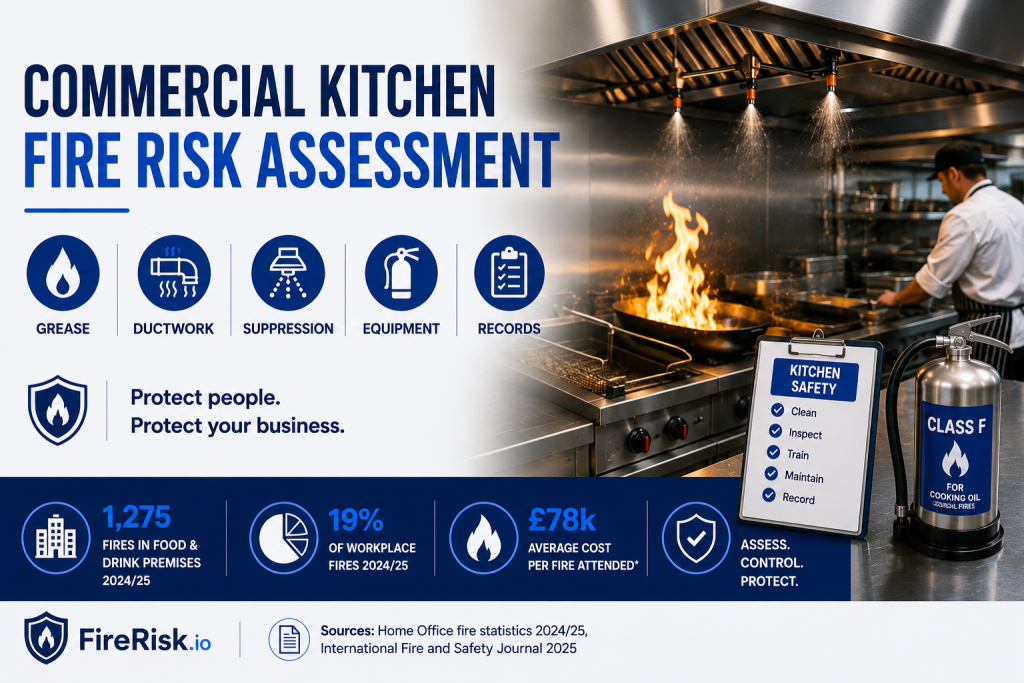
The financial case is also clear. The Home Office economic cost of fire report estimated the total economic and social cost of fire in England at £12.0 billion for the year ending March 2020, with an average unit cost of £78,000 per fire attended. That figure is not a restaurant-specific cost, but it shows why a single kitchen fire can damage far more than the cooker line. Lost trading, smoke contamination, stock loss, cancelled bookings, loss of licence confidence and insurance delays can put a hospitality business under pressure very quickly.
This guide is written for the person who has to make decisions on site. It covers the kitchen-specific fire hazards we would expect to test during an assessment, the records that should be kept and the practical controls that stop grease, ductwork and suppression becoming weak points.
| Key takeaway: A commercial kitchen fire risk assessment should follow the same legal structure as any other workplace assessment, but the evidence must be kitchen-specific. The assessor should be able to see how grease, heated oils, extract systems, suppression, staff training and cleaning records are being controlled in the real premises, not just on a template. |
Why commercial kitchens sit in a higher-risk category
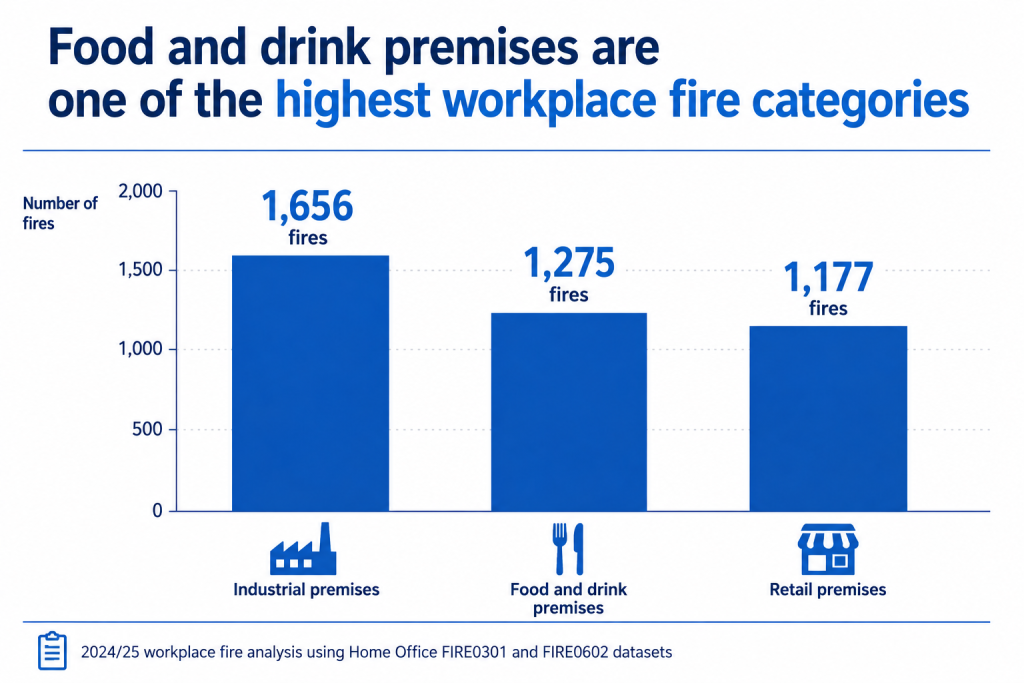
UK workplace fire data groups premises by property type, so it does not always isolate a single duct fire or fryer incident. Even with that limitation, the pattern is clear. A 2025 analysis of Home Office datasets reported by International Fire and Safety Journal found that food and drink premises recorded 1,275 fires in 2024/25. That represented 19.13% of workplace fires in the analysis, behind industrial premises and ahead of retail premises.
The risk profile is easy to recognise on site. A busy kitchen brings together ignition, fuel and oxygen in a confined space. There are open flames, hot surfaces, fryers, griddles, ovens, gas lines, electrical appliances, cleaning chemicals, packaging, waste oil, high footfall, timed service pressure and staff working long shifts. In mixed-use buildings, the kitchen may sit below flats, offices or hotel rooms. That changes the consequence of a fire because smoke can affect people who are asleep, unfamiliar with the building or outside the control of the restaurant operator.
Fire and rescue service incident reports show why ductwork cannot be treated as a cleaning issue only. In February 2025, London Fire Brigade attended a restaurant fire on Kilburn High Road with four fire engines and around 25 firefighters. The Brigade reported that a small electrical fire had occurred in an overheated fan due to dirty ducting, with dwellings above the commercial property. Their advice was direct: dirty ducting increases the risk of ducting fires and built-up fat and grease can ignite.
That example matters because it joins the dots between maintenance, cleaning and fire spread. A fan fault is not just an electrical problem when grease is present. A hood that looks clean from the cooking line can still hide deposits further along the duct. A duct route that passes through voids, risers or neighbouring areas can become a route for fire and smoke if it is not designed, protected and cleaned properly.
A competent kitchen fire risk assessment should therefore test more than whether the premises has extinguishers and an alarm. It should ask where grease is created, where it travels, how it is removed, who verifies the cleaning and whether the equipment still matches the current menu and hours of operation. A brunch cafe using one domestic-style oven is a different risk from a fried chicken takeaway operating 14 hours a day. The assessment should not treat them as the same site.
What the assessor should look for in the kitchen
A good commercial kitchen assessment starts before the first photograph is taken. The assessor should understand the service pattern. Does the kitchen open for breakfast, lunch and dinner? Is there overnight prep? Are agency staff used? Is the menu heavy in deep-fried food or flame cooking? Are deliveries stored in corridors during service? Are there flats, guest rooms or offices above? These answers shape the risk before equipment is inspected.
On site, the assessor should look at the kitchen in zones rather than as one room. The cooking line, extraction canopy, duct route, fryer area, gas isolation point, electrical intake, waste storage, cleaning chemical store, escape routes and staff areas should all be checked. Where the kitchen opens into a dining area, the assessment should also consider customer evacuation, queuing points and whether furniture or waiting customers could block escape routes during a busy service.
The most useful assessments are evidence-led. We would expect to see service certificates, extract cleaning reports, suppression maintenance records, gas safety documentation, electrical inspection evidence, emergency lighting tests, fire alarm tests, staff training records and a log of corrective actions. The site manager should be able to explain the shutdown procedure without having to search for a policy. If they cannot, that is a training gap as much as a paperwork gap.
| Key takeaway: Do not assess the kitchen only when it is spotless and quiet. The risk is created by the working rhythm: lunch rush, hot oil, cleaning shortcuts, temporary storage, agency staff, late deliveries and end-of-night shutdown. |
Grease: the fuel that travels
Grease is the risk that commercial kitchens often underestimate because it moves out of sight. It starts as vapour, mist, splatter or residue. Some of it is caught by baffle filters, some settles on canopy surfaces and some can travel into ductwork. Once it cools and builds up, it becomes a fuel load that can be ignited by flame, heat, sparks, electrical faults or an overheated fan.
London Fire Brigade instructs restaurant and takeaway owners to clean kitchen ducting regularly because grease build-up can ignite and cause smoke and fire to spread to other areas of the property and nearby premises. That warning is particularly important in terraced high street units where extract routes can pass through older buildings with hidden voids, mixed construction and shared boundaries.
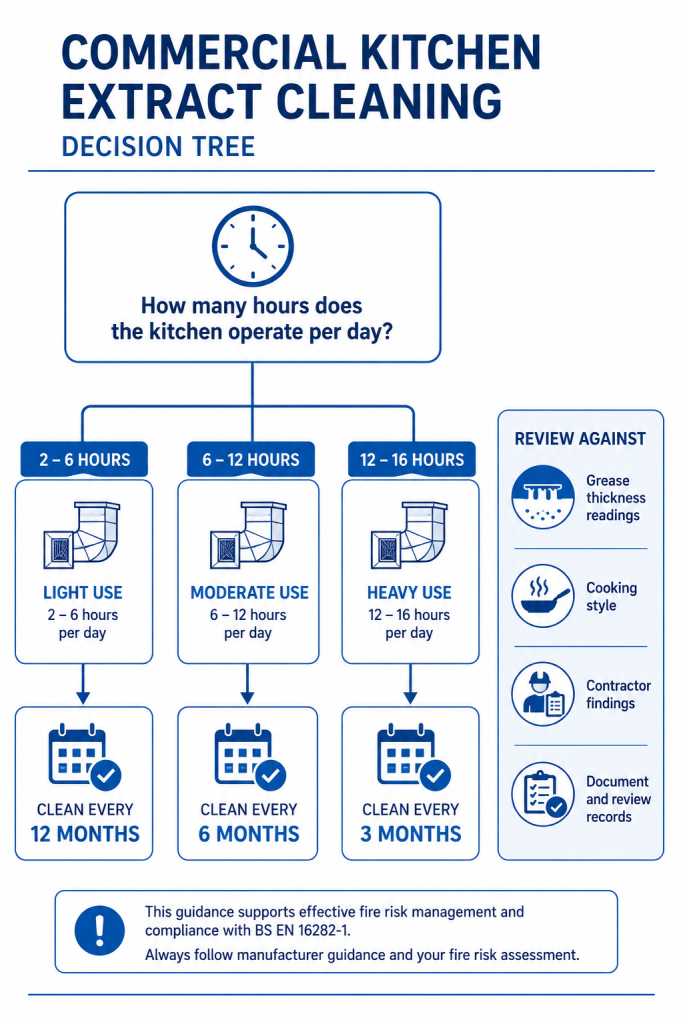
A commercial kitchen fire risk assessment should not accept ‘we clean it every year’ as enough detail. Cleaning frequency needs to match the use of the kitchen. BESA guidance for kitchen extract systems gives a practical baseline: heavy use kitchens operating 12 to 16 hours a day are cleaned every 3 months, moderate use kitchens operating 6 to 12 hours a day every 6 months and light use kitchens operating 2 to 6 hours a day every 12 months. Actual intervals should be reviewed against grease thickness readings, cooking style and history of deposits.
The evidence matters. A cleaning certificate without before and after photographs, access panel locations or grease thickness readings may not be enough for a demanding insurer after a fire. The Responsible Person should keep a record that shows what was cleaned, where access was available, what could not be reached, what defects were found and when the next clean is due.
A typical issue we see in kitchen reviews is a clean-looking canopy with poor access into horizontal duct runs. Staff may clean filters daily and still have no way of knowing what is happening above the ceiling line. In that situation, the action is not simply ‘clean more often’. It may be to install suitable access panels, get a specialist extract clean carried out and update the cleaning frequency once the true deposit level is known.
Grease control process for the Responsible Person
| Step | What to check | Evidence to keep |
| 1 | Daily canopy, hob, fryer and filter cleaning | Opening and closing cleaning checklist with supervisor sign-off |
| 2 | Weekly check for grease around filters, fan noise and obvious damage | Manager inspection log with photos where needed |
| 3 | Specialist extract inspection and clean to usage level | TR19 Grease style report, before and after photos, access panel plan and next due date |
| 4 | Defect correction, such as missing access panels or damaged filters | Action plan with named person, target date and completion evidence |
| 5 | Review after menu, hours or equipment changes | Updated fire risk assessment and cleaning frequency decision |
Ductwork: the hidden route for fire and smoke
Ductwork deserves its own section in the assessment because it can connect the kitchen to other parts of the building. A fire that begins in a fryer or canopy can travel into the extract route if the system is contaminated, badly installed or unprotected where it passes through fire-resisting construction.
The assessor should establish the route of the ductwork, not just the location of the canopy. Does it discharge safely? Does it pass through a ceiling void, riser or upper-floor accommodation? Are there fire dampers where they should not be used in grease extract systems? Are access panels fitted so the whole route can be inspected and cleaned? Has the route changed since the last assessment?
In older high street premises, a restaurant may inherit a duct route installed by a previous tenant. The layout then changes, the menu changes and fryers are added, but the extraction system remains the same. That is where risk can increase quietly. A fire risk assessment should flag when the kitchen operation has outgrown the extract design or where evidence is missing.
A simple rule helps: if nobody can show where the duct goes, when it was last cleaned and what condition it was in, the risk has not been properly controlled. The document should not rely on verbal reassurance. It should name the missing evidence and set an action.
Heated oils, fryers and Class F fire risk
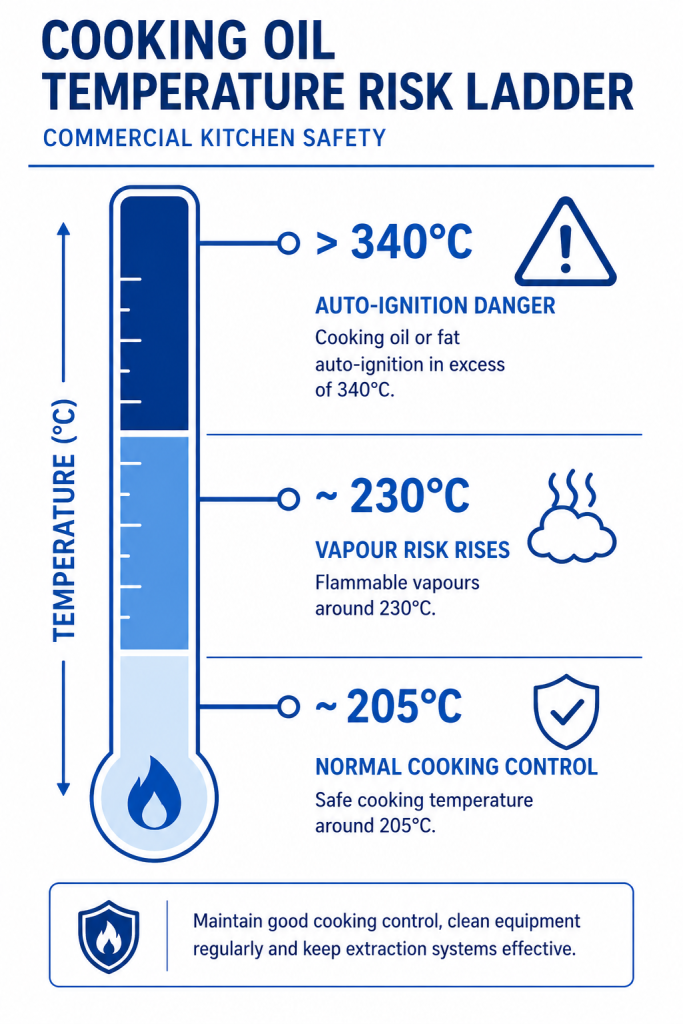
Deep fat frying is one of the sharpest risk points in a commercial kitchen. Heated oils and fats behave differently from many other liquid fire risks because of the temperatures involved. NFU Mutual guidance explains that the safe cooking temperature for oils and fats is around 205 degrees C, while flammable vapours are given off at around 230 degrees C. The Fire Industry Association states that cooking oil or fat fires have auto-ignition temperatures in excess of 340 degrees C and are very difficult to extinguish with conventional extinguishers.
The practical message is simple. Hot oil needs supervision, temperature control and the correct fire-fighting equipment. A fryer should have a working thermostat, high-limit cut-out, safe filling level and clear space around it. Staff should know that water, foam, powder or carbon dioxide can be dangerous if used incorrectly on burning oil because they may splash, disturb or fail to cool the oil properly. For Class F risks, suitable wet chemical extinguishers and fixed suppression arrangements need to be considered based on the size and type of equipment.
London Fire Brigade also advises that pans should never be filled more than one third full of fat or oil, food should be dry before being put into hot oil and electronic deep fat fryers with automatic temperature controls are safer. Those points sound basic, but they are often where real-world kitchen pressure shows. The lunch queue grows, the fryer basket is overloaded, the cleaning regime slips and temporary staff copy what they see rather than what the policy says.
The fire risk assessment should therefore check training as well as equipment. Staff need to know the difference between a small, safe-to-tackle incident and a fire that requires evacuation. They should know where the gas or electrical isolation is, how the suppression system operates and what to do after activation. No one should be expected to fight a fryer fire as the first plan. Evacuation and calling the fire and rescue service must be clear.
Suppression systems: when portable extinguishers are not enough
A fixed kitchen suppression system is designed to protect cooking appliances, hoods and sometimes duct entry points by discharging an extinguishing agent when a fire is detected. It can reduce the chance of a fire growing before staff can react, especially where high-output cooking or frying is part of the operation.
BSI identifies BS EN 16282-7 as the standard dealing with installation and use of fixed fire suppression systems for commercial kitchen ventilation components. The standard has had changes over time, so the Responsible Person should rely on a competent fire protection contractor to design, install and maintain a system suitable for the current kitchen. It is not enough to inherit a system from a previous tenant and assume it still protects the risk.
The assessor should check whether suppression nozzles still cover the equipment beneath them. If a fryer has been moved, a chargrill has been added or a new cooking line has been installed, the system may no longer match the hazard. The same applies if the menu changes from low-grease cooking to heavy frying or flame cooking. A suppression system is only as good as its current alignment with the equipment and the maintenance regime behind it.
Records should show installation details, commissioning, servicing, cylinder status, nozzle condition, manual release location, staff instruction and any isolations. After activation, the kitchen should not simply be cleaned and reopened without checking the equipment, replacing the agent, resetting the system and reviewing what caused the incident.
Commercial kitchen suppression check points
| Check point | Why it matters |
| Coverage | Nozzles must match the actual cooking equipment and layout. |
| Manual release | Staff need to know where it is and how to raise the alarm. |
| Service record | Insurers and enforcing officers may ask for proof of maintenance. |
| Shutdown link | Gas or electrical shutdown arrangements should be confirmed where fitted. |
| Changes since install | New fryers, grills or menu changes can invalidate old assumptions. |
| Post-activation plan | Reinstatement should be controlled, recorded and reviewed before reopening. |
Example: a takeaway below flats
Consider a typical UK high street takeaway with flats above. The business opens from 11 am to midnight, uses two deep fat fryers, keeps cardboard delivery boxes near the rear door and shares a stairwell lobby with the residential entrance. The canopy filters are cleaned by staff, but the extract contractor only attends once a year. The manager has a certificate, but no one can show the duct route or whether access panels cover the full length.
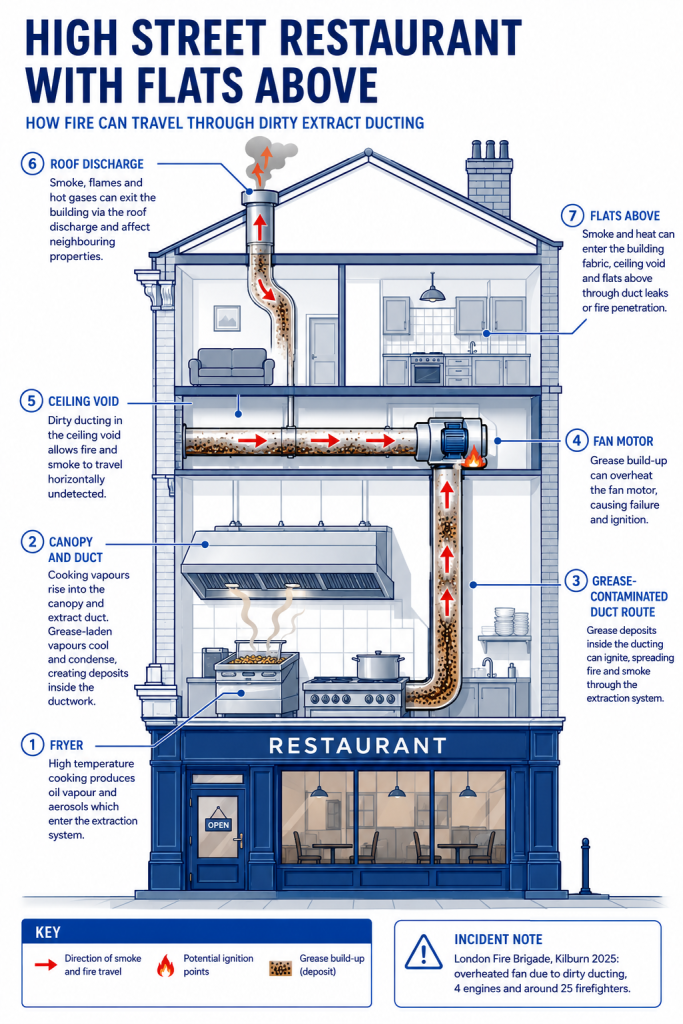
In a paper-only assessment, this site may appear to have the basics: alarm, extinguishers, emergency lighting and a signed cleaning sheet. In a kitchen-specific assessment, the risk picture changes. The cooking hours suggest heavy use. BESA’s baseline cleaning frequency for heavy use extract systems is every 3 months. The flats above increase the consequence of smoke spread. Cardboard storage near the rear exit affects escape. The missing duct route evidence means the Responsible Person cannot prove that grease is controlled beyond the visible canopy.
The action plan should not be vague. It should require a specialist extract survey, confirmation of duct route, cleaning to an appropriate interval, evidence of before and after condition, relocation of combustible packaging, fryer training for staff and review of detection and warning arrangements affecting both commercial and residential parts. If there are separate Responsible Persons for the restaurant and flats, information sharing should be recorded.
What should be recorded in the fire risk assessment
For commercial kitchens, the action plan is often more important than the risk rating itself. A high-risk finding with a named owner and a 7-day action can be managed. A moderate-risk finding that sits unresolved for six months becomes a bigger problem. The fire risk assessment should be clear enough that the owner, manager, facilities team, contractor and insurer all understand the same next step.
At a minimum, the kitchen section of the assessment should record:
- Cooking equipment present, including fryers, grills, ovens, gas appliances and temporary equipment
- Hours of operation and whether this creates light, moderate or heavy extract use
- Extract system condition, duct route, access panels, cleaning frequency and cleaning evidence
- Grease control arrangements for filters, canopy, fans and hidden ductwork
- Suppression system details or reasoning where no fixed system is fitted
- Portable extinguisher provision, including Class F risks and staff training
- Gas and electrical isolation points and whether staff know how to use them
- Storage of packaging, oils, waste oil, cleaning chemicals and linen
- Fire alarm, detection, emergency lighting and escape route arrangements
- People at risk, including staff, customers, contractors, delivery drivers and residents or guests above
- Records reviewed and records missing
- Action plan with priorities, dates and named responsibility
The assessment should also state when it needs to be reviewed. For a kitchen, review triggers are common: a new fryer, new cooking method, new tenant, altered ductwork, suppression activation, fire incident, enforcement visit, insurer requirement, increase in opening hours or repeated cleaning defects.
Records that can protect the business after a fire
After a kitchen fire, people often focus on the visible damage. Insurers, enforcing authorities and landlords will look at records. They may ask when the extract system was cleaned, whether defects were known, whether staff were trained, whether the suppression system was serviced and whether the Responsible Person acted on previous findings.
A useful kitchen fire safety file should be simple enough to maintain. It can be digital, paper-based or both, but it should be easy to find during an inspection. The best records tell a story: risk was identified, controls were put in place, checks were completed, defects were chased and the assessment was updated when the kitchen changed.
For multi-site operators, a central dashboard can help, but it should not replace local knowledge. A head office certificate does not prove that the fan above the fryer in one branch is clean. The branch manager still needs a working checklist and the authority to stop unsafe practices.
Evidence checklist for commercial kitchen fire safety
| Record | Suggested frequency | What good evidence looks like |
| Canopy/filter clean | Daily or per service pattern | Signed checklist, supervisor spot checks |
| Extract duct clean | Risk and usage based | Specialist report, photos, access panel map, next clean date |
| Fire alarm test | Routine test schedule | Log book with call point used and faults recorded |
| Emergency lighting | Routine test schedule | Log book with defects and remedial work |
| Extinguisher service | By competent contractor | Service label and certificate |
| Suppression service | As specified by system and contractor | Service report, defect sheet, cylinder/nozzle checks |
| Gas safety and isolation | As required by competent gas engineer | Certificate, isolation labels and staff briefing |
| Staff training | On induction and refresher | Attendance record, topics covered and trainer name |
Common findings in commercial kitchen assessments
The following findings come up regularly in commercial kitchen reviews and should be treated as warning signs rather than admin points:
- Annual extract cleaning used for a kitchen that now operates long hours with heavy frying
- No access panels, so the cleaning contractor cannot reach the full duct route
- Canopy filters cleaned but fan, motor housing and horizontal ducts not evidenced
- Fryers positioned under nozzles that no longer align with the suppression layout
- Extinguishers blocked by stock, bins or delivery cages
- Waste oil stored close to exits or ignition sources
- Combustible packaging kept in the kitchen during service because storage is limited
- Temporary cooking equipment introduced for events without review
- Agency or new staff unaware of isolation points and evacuation procedure
- Shared residential or commercial areas not considered in the risk assessment
None of these findings need to become a crisis if they are picked up early. The danger is when they sit between teams. The chef assumes the landlord controls the duct. The landlord assumes the tenant has arranged cleaning. The contractor assumes access is adequate. The insurer assumes records exist. A clear fire risk assessment closes those gaps by naming the control and the owner.
How often should the assessment be reviewed?
There is no sensible single review frequency for every kitchen. A small cafe with short hours and low-grease cooking will not have the same review cycle as a late-night takeaway, hotel kitchen or production kitchen. The legal expectation is that the fire risk assessment is kept up to date. In practice, the Responsible Person should review it at least annually and sooner if the risk changes.
Immediate review is sensible after any fire, near miss, suppression activation, duct fire, enforcement visit, insurance survey, kitchen refurbishment, change in menu, new cooking equipment, increased opening hours, change in occupancy above or contractor report showing significant grease deposits. These are not minor events. They change the assumptions the existing assessment was based on.
Final advice for Responsible Persons
A commercial kitchen fire risk assessment should feel practical when you read it. It should tell you what can catch fire, how fire could spread, who could be harmed and what needs to be done next. If the kitchen has a grease extract system, the assessment should prove that the hidden parts are under control, not just the visible canopy. If the kitchen uses fryers or hot oils, it should explain how Class F risk is managed. If a suppression system is fitted, it should show that the system still matches the cooking line.
For landlords and managing agents, the biggest risk is often split responsibility. A tenant may control the cooking process, while the landlord controls the structure, common areas or residential accommodation above. In those cases, the assessment should not sit in isolation. Fire safety information needs to be shared so that the building risk is understood as a whole.
For operators, the best defence is routine. Clean what needs cleaning, keep records that are worth reading, train staff in the real shutdown process and review the assessment whenever the kitchen changes. Grease, ductwork and suppression are not side notes. In a commercial kitchen, they are the centre of the fire risk assessment.
FAQ section for the blog page
Does every commercial kitchen need a fire risk assessment?
Yes. A commercial kitchen in England and Wales will normally fall under workplace fire safety duties. The Responsible Person must make sure a suitable and sufficient fire risk assessment is carried out, recorded and reviewed. This includes restaurants, takeaways, hotel kitchens, school kitchens, workplace canteens and similar premises.
How often should commercial kitchen ductwork be cleaned?
Cleaning should be risk and usage based. BESA guidance gives a useful baseline for kitchen extract systems: heavy use at 12 to 16 hours per day every 3 months, moderate use at 6 to 12 hours per day every 6 months and light use at 2 to 6 hours per day every 12 months. Grease thickness readings and site conditions may require a different interval.
Are wet chemical extinguishers required in commercial kitchens?
Where there is a Class F risk from cooking oils or fats, the extinguisher provision should be suitable for that risk. The Fire Industry Association notes that BS 5306-8:2023 gives guidance on selection and installation for Class F fire extinguishers. Staff must also be trained because the wrong extinguisher can make a cooking oil fire more dangerous.
Do I need a fixed suppression system over my cooking line?
Not every kitchen has the same requirement. The need depends on the cooking risk, equipment, layout, extract system, occupancy, insurer requirements and consequences if a fire spreads. High-output frying or cooking in mixed-use buildings often strengthens the case for fixed suppression. A competent assessor or fire protection contractor should review the specific risk.
What records should a restaurant keep for fire safety?
Keep the fire risk assessment, action plan, extract cleaning reports, before and after photos, alarm tests, emergency lighting tests, extinguisher service records, suppression service reports, staff training records, gas and electrical safety records, contractor reports and evidence that defects were completed.