
Table of Contents
A lithium-ion battery fire rarely starts like a normal waste bin fire or a small electrical fault. In a workplace or block of flats, it often starts with an everyday decision: an e-bike left on charge in a hallway, a power tool battery charging overnight in a stockroom, a converted bike stored under stairs or a replacement charger bought online because the original one was lost.
That is why a lithium-ion battery fire risk assessment needs to look beyond plugs and PAT testing. It has to look at the whole routine around the battery: who owns it, where it is charged, what charger is used, what happens if it is damaged and whether a fire would cut off escape for other people.
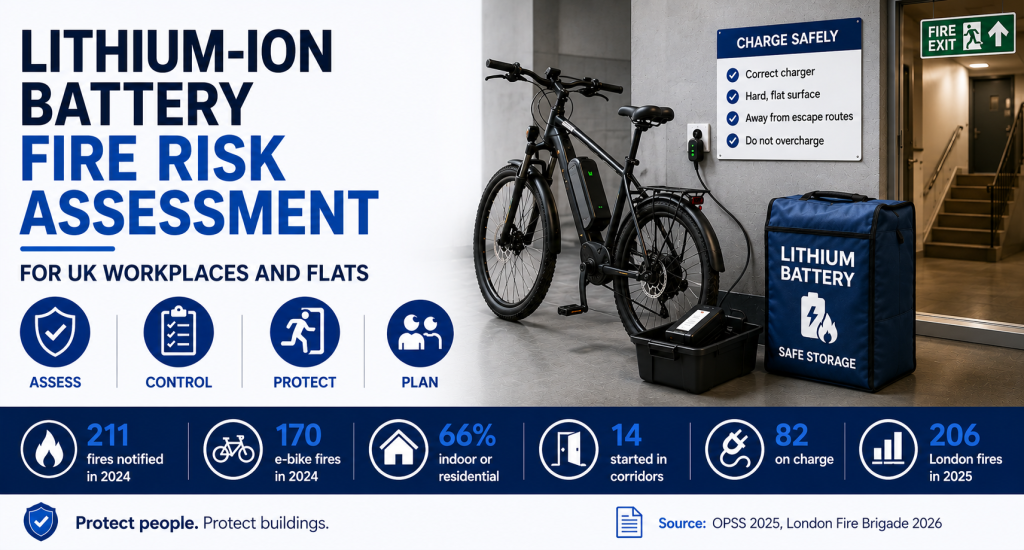
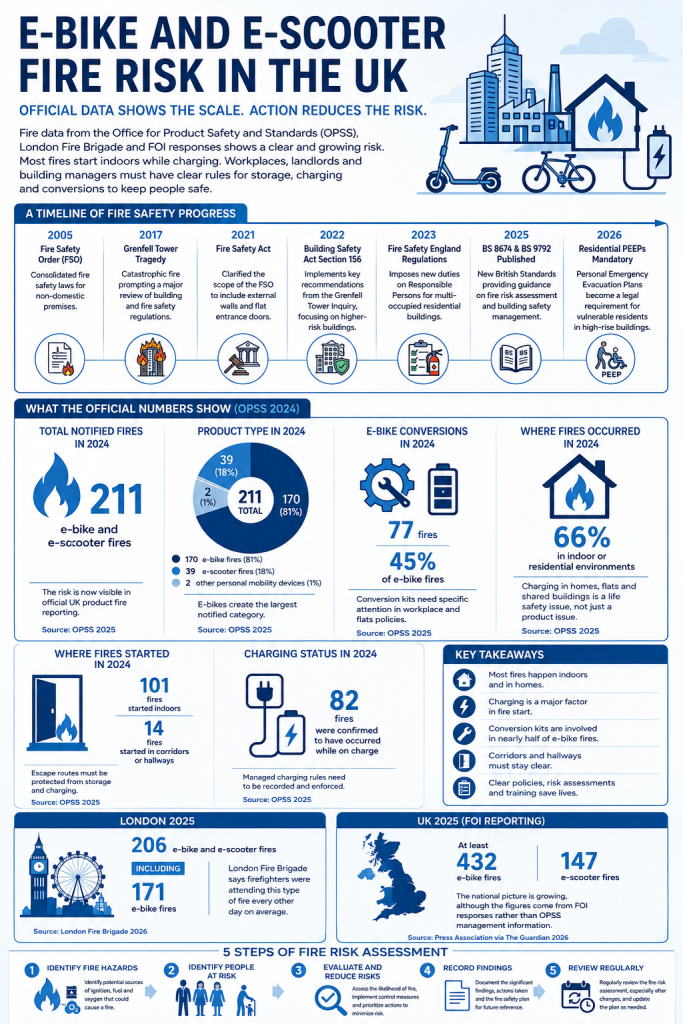
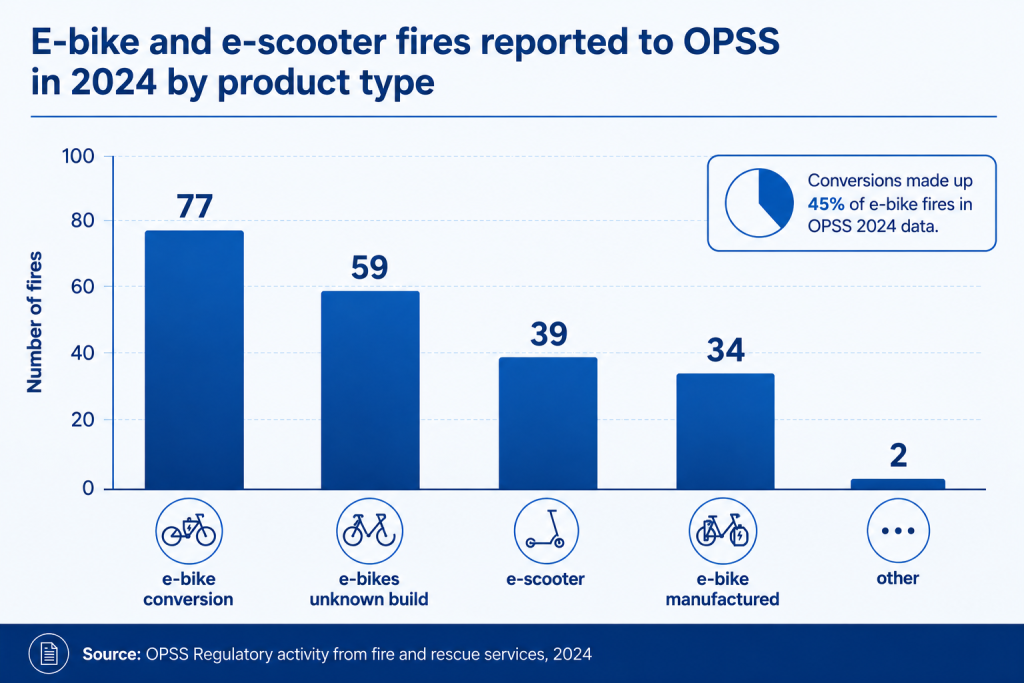
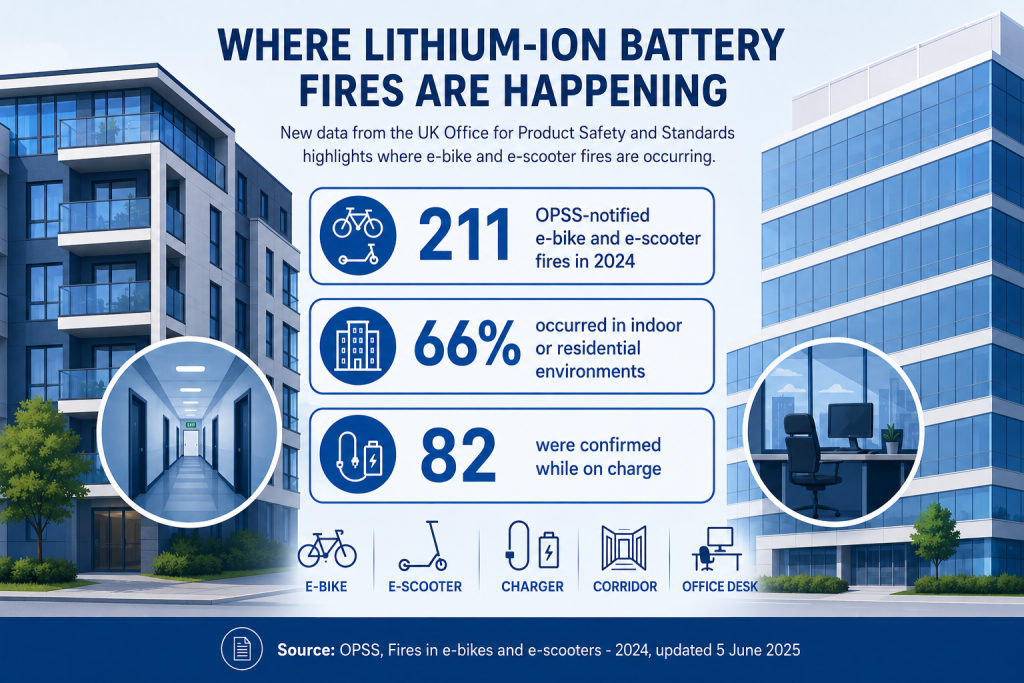
For Responsible Persons, landlords, facilities managers and employers, this is now a live UK fire safety issue. OPSS, the Office for Product Safety and Standards, received information on 211 fires involving e-bikes or e-scooters in 2024. Of those, 170 involved e-bikes and 39 involved e-scooters. OPSS also recorded that 66% of notified 2024 incidents happened in indoor or residential environments. London Fire Brigade reported 206 e-bike and e-scooter fires across London in 2025, the highest total in its published series.
| Key takeaway: The battery is not the only risk. The bigger life safety question is where the battery fails. A fire in a corridor, stairwell, lobby or small office store can remove the route people need to escape. |
What counts as a lithium-ion battery fire risk?
Most workplaces and residential blocks now contain lithium-ion batteries even when no one has deliberately introduced a battery storage area. They are found in laptops, phones, tablets, power banks, cordless tools, cleaning equipment, handheld scanners, electric bikes, e-scooters, mobility equipment and some emergency backup equipment.
The highest concern in flats and shared buildings is usually larger battery packs used for e-bikes, e-scooters and conversion kits. These packs hold more energy than a phone battery and are often charged in tight spaces. OPSS data for 2024 shows 77 fires involving e-bike conversions, which represented 45% of e-bike fires reported to OPSS that year. That does not mean every conversion is unsafe. It does mean converted bikes deserve a separate check because the battery, charger, motor controller and wiring may have been bought separately or altered after purchase.
The risk increases when the product is counterfeit, poorly manufactured, damaged, used with the wrong charger, overcharged or modified with non-compatible parts. Government consumer guidance says lithium-ion battery fires can start without warning, spread rapidly and be very hard to extinguish. OPSS statutory guidelines explain the mechanism behind this: thermal runaway can occur when battery cells reach a critical temperature, release flammable and potentially toxic gases and then set off a cascading failure through neighbouring cells.
When does the fire risk assessment need to be reviewed?
The Regulatory Reform (Fire Safety) Order 2005 requires the Responsible Person to assess fire risks in relevant premises and keep fire precautions under review. The government guidance on e-cycle and e-scooter batteries is clear that the potential introduction of a new fire hazard would require a review of the fire risk assessment.
In practice, that means a review is sensible when any of the following becomes normal in the premises: staff bring e-bikes inside, residents charge scooters in communal areas, delivery riders use a business as a charging base, a landlord adds a bike store, a cleaning contractor stores cordless machinery batteries, a warehouse handles returned battery products or a block manager receives repeated complaints about charging in corridors.
A review does not always mean a complete rewrite of the existing assessment. It may be a targeted update, provided the assessor records the hazard, the people at risk, the control measures, the residual risk and the action plan. What should not happen is silence. If the hazard is visible in the building but missing from the FRA, an enforcing officer, insurer or investigator will ask why it was not considered.
The FireRisk assessment approach: what we would check on site
A good lithium-ion battery assessment is not a lecture about chemistry. It is a building walk-through with the right questions. The assessor should inspect the places where batteries are actually used, not only the places listed in a policy.
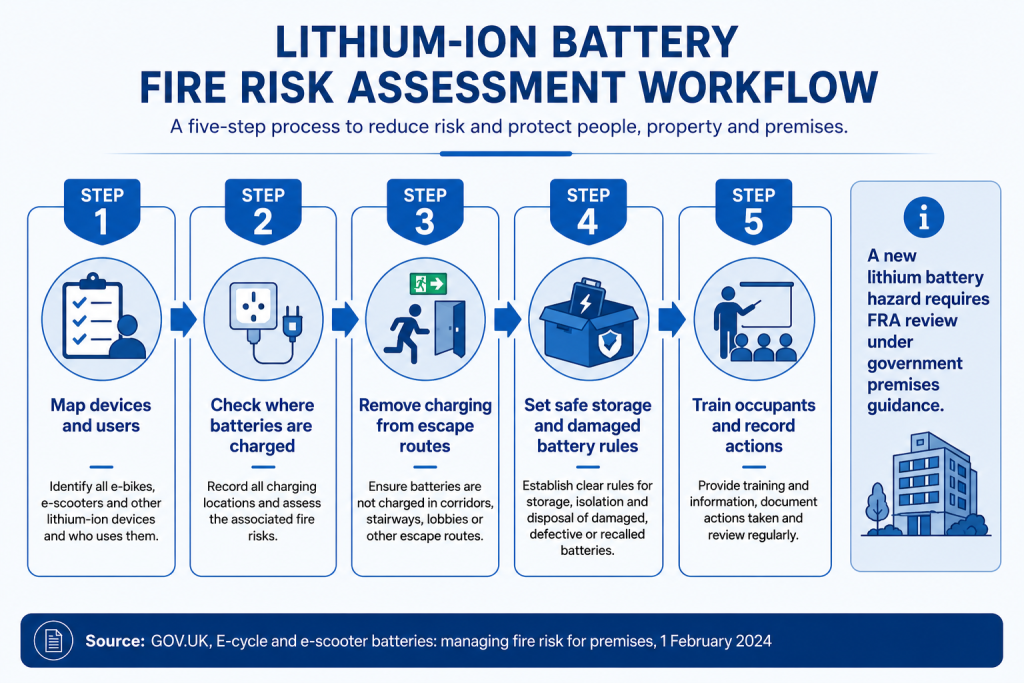
1. Map the batteries and the people using them
Start with a simple inventory. In an office, that may include laptops, power banks, e-bikes, e-scooters, camera batteries, cleaning machinery and power tools. In a residential block, it may include residents’ e-bikes, mobility scooters, scooters in pram stores, chargers in meter cupboards and bikes chained in shared corridors.
The important detail is not just the device count. Ask who uses the device, whether it is personally owned, whether it is part of work equipment and whether anyone relies on it for mobility, employment or caring duties. A blanket ban may look simple on paper but it can create equality, tenancy and practical enforcement problems. A safer route is usually to set clear charging and storage conditions that can be explained, monitored and recorded.
2. Check where charging happens
Charging location is the control point most buildings get wrong. OPSS recorded that 82 of the 211 notified 2024 e-bike and e-scooter fires were confirmed to have occurred while the product was on charge. Charging status was unknown in 49 cases, so the confirmed figure should not be treated as the full risk.
The assessment should check whether batteries are charged on hard, flat surfaces where heat can dissipate, away from escape routes, away from combustible storage and away from places where smoke or flame would block the only exit. London Fire Brigade advises that batteries should not be charged where they block a main through-route or exit. NFCC guidance also warns against charging or storing e-bikes and e-scooters in communal areas where they can affect escape.
For workplaces, the highest risk areas are often staff changing rooms, under-desk charging points, cleaning cupboards, delivery holding areas, stockrooms and improvised extension lead setups. For flats and HMOs, look at entrance lobbies, internal hallways, stair landings, riser cupboards, bin stores, bike rooms and under-stairs spaces.
3. Look at chargers, conversions and replacement parts
A lithium battery policy that ignores chargers is not complete. Government guidance tells users to buy from trusted sellers, look for UKCA or CE marking and use manufacturer recommended chargers, batteries and replacement parts. It also says connecting the wrong charger to a battery can pose serious fire risks.
During an assessment, we would ask whether the premises has rules for non-standard chargers, second-hand batteries, modified e-bikes and conversion kits. In an office with cycle facilities, a simple declaration process can help. Staff who want to charge an e-bike battery on site should confirm the make, charger compatibility and whether the bike has been converted. In a residential building, the approach may be tenant communication, lease or house rule wording and signage in common areas.
4. Keep escape routes sterile
This is the non-negotiable point. OPSS reported 14 notified 2024 fires starting in corridors or hallways. London Fire Brigade warns that when batteries are charged in corridors or stairwells, a fire can quickly block escape routes and prevent people leaving safely.
In a block of flats, a fire in a single flat may be contained by the compartmentation strategy, provided fire doors, walls and floors perform as intended. A battery fire in a common corridor is different because it can put smoke, flame, heat and debris directly into the shared route. The same logic applies to a workplace staircase, reception route or rear escape corridor.
The assessment should record any evidence of devices left on protected routes. It should also check whether management has a realistic way to keep the route clear. A sign alone is weak if residents have nowhere else to store large mobility devices or bikes. A managed store, controlled charging point or written alternative may be needed.
5. Decide what safe storage looks like for this building
There is no one-size storage arrangement. A small professional office, a high-rise residential block, a warehouse handling returned products and a student HMO all need different controls. The assessment should consider separation from combustibles, ventilation, detection, physical security, access control, charging supervision and whether the space has a direct effect on escape routes.
Where a landlord or employer provides a battery charging area, it should be easier to use the safe area than to break the rule. That may mean weather protection, power points in sensible locations, clear user instructions and a routine inspection. If the approved area is hidden, inconvenient or always full, people will revert to desks, corridors and bedrooms.
For larger battery volumes, returned products or damaged packs, get specialist advice. Battery fires can involve toxic smoke, violent venting and re-ignition risk. A standard office cupboard is not a lithium battery store simply because it has a lock on the door.
6. Set a damaged battery rule before the first incident
People often keep using a battery after the first warning sign because they are not sure what to do. The policy should be clear: stop using a battery if it overheats, swells, smells unusual, hisses, cracks, smokes, leaks, charges unpredictably or loses charge unusually quickly. GOV.UK guidance tells users to stop using chargers or batteries immediately if they notice overheating, deforming, hissing or cracking noises, smells, smoking or poor performance.
The assessment should ask who a resident, employee or contractor reports this to. It should also ask where the item goes next. Damaged batteries should not be put in normal waste or left in a reception area while someone decides what to do. NFCC guidance warns that incorrect disposal of lithium-ion batteries in household and recycling waste can lead to waste fires.
7. Train people for the response, not just the prevention
People need to know that a lithium-ion battery fire is not a small fire to tackle with a nearby extinguisher. NFCC guidance tells people not to attempt to extinguish an e-bike, e-scooter or lithium-ion battery fire. The message is simple: get out, stay out and call 999.
In a workplace, this message should be reflected in fire marshal training and emergency instructions. In flats, it should be reflected in resident communications and common area notices. The tone matters. Residents and staff are more likely to comply when the message explains the reason: rapid fire spread, toxic smoke and escape route risk.
| Key takeaway: The policy should be practical enough to enforce. A safe charging rule that nobody follows is not a control measure. It is a document risk. |
Flats, HMOs and managed residential buildings
In flats and HMOs, the Responsible Person usually has control over common parts, not the inside of each private home. That does not make the issue irrelevant. OPSS data for 2024 recorded fires in purpose-built flats or maisonettes, converted flats or maisonettes and houses in multiple occupations. London Fire Brigade also says many of these fires occur in homes or communal areas while batteries are being charged.
A residential assessment should focus on common area risk, resident information and foreseeable behaviour. If there is a lift lobby full of delivery bikes every evening, that is foreseeable. If the building has no cycle storage but houses gig economy riders, that is foreseeable too. If mobility scooter users have no safe charging option, a blanket instruction not to charge in common parts may fail in practice.
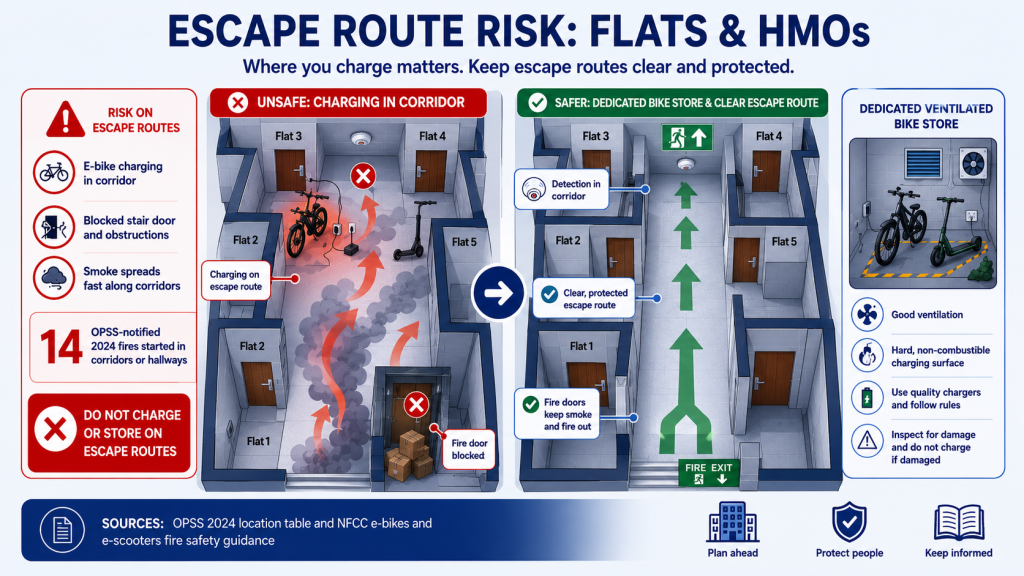
The controls may include a no-charging rule in escape routes, resident notices, a dedicated external or fire separated charging location, periodic inspections, tenancy pack inserts, reporting routes for unsafe charging and engagement with residents who rely on powered mobility. The aim is to remove the hazard from escape routes while still recognising how people live and work.
What should be in the written action plan?
The action plan should be specific enough that the building manager can complete it without guessing. Weak wording says “manage lithium battery risk”. Strong wording says “remove e-bike charging from second floor corridor, write to residents by 12 June, inspect weekly for four weeks, then include in monthly common area checks”.
A useful action plan records: the location, the unsafe behaviour or condition, who is at risk, the immediate control, the permanent control, who owns the action, the date due and how completion will be evidenced. For higher risk premises, the action plan may also require insurer consultation, fire alarm review, a dedicated charging facility or specialist advice on battery storage cabinets.
What FireRisk would include in a lithium-ion battery FRA review
A focused FireRisk review would normally include a visual inspection of charging and storage areas, common parts, offices, stores, bike rooms, risers, escape routes and any contractor areas where batteries are used. It would also check current documentation: the existing fire risk assessment, fire strategy where available, resident or staff communications, fire alarm coverage, inspection logs, contractor arrangements and emergency procedures.
The output should not be a generic warning sheet. It should be a site-specific record showing where lithium-ion battery risks exist, what the likelihood and consequence look like in that building and what controls are proportionate. A low-rise office with occasional laptop charging does not need the same controls as a high-rise residential block with repeated e-bike charging in communal corridors.
The most useful assessments are blunt about priority. Life safety comes first: escape routes, sleeping risk, communal charging and damaged batteries. Property protection comes next: separation from stock, detection, compartmentation, insurer requirements and business continuity.
Quick checklist for Responsible Persons
- Do we know where e-bikes, e-scooters and larger battery packs are stored or charged?
- Are any batteries charged in corridors, stairwells, lobbies, under stairs or near final exits?
- Do staff, residents and contractors know that only compatible chargers should be used?
- Do we have a rule for converted bikes, second-hand batteries and replacement chargers?
- Is there a safe, realistic alternative to charging on escape routes?
- Do we know what to do with a damaged, swollen or overheating battery?
- Have fire marshals, cleaners, concierge teams or building managers been briefed?
- Does the current fire risk assessment mention lithium-ion battery risks clearly?
- Are the actions recorded, owned and reviewed?
Lithium-ion batteries are not going away. E-bikes, e-scooters, cordless tools and portable electronics are now part of daily life in UK workplaces and residential buildings. The answer is not panic. The answer is to assess the real behaviour in the building and put the fire risk controls where they matter most.
For Responsible Persons, the main question is simple: if a battery failed tonight, would people still have a safe route out? If the answer is uncertain, the fire risk assessment needs to be reviewed now, not after an incident.
FAQs
Do lithium-ion batteries need to be included in a fire risk assessment?
Yes, where they are present in a way that could introduce or increase fire risk. Government premises guidance says the potential introduction of a new fire hazard would require a review of the fire risk assessment.
Can residents charge e-bikes in flat block corridors?
They should not charge or store e-bikes where they block or compromise escape routes. The Responsible Person should assess common parts, communicate the rule and provide a safer alternative where reasonably practicable.
Are e-bike conversion kits a higher fire risk?
OPSS data shows conversions feature prominently in notified e-bike fires. In 2024, 77 of the e-bike fires reported to OPSS involved conversions. They should be treated as a specific assessment point because parts may have been supplied, altered or matched outside the original manufacturer system.
Should a workplace ban e-bike charging?
A ban may be appropriate in some premises but it is not the only control. Many workplaces can reduce risk through designated charging areas, charger compatibility rules, no overnight charging, damaged battery reporting and staff training.
What should people do if a lithium-ion battery catches fire?
Do not try to tackle the fire. Follow the emergency plan, leave the area, close doors if safe to do so and call 999. Battery fires can develop rapidly and produce toxic smoke.