
Table of Contents
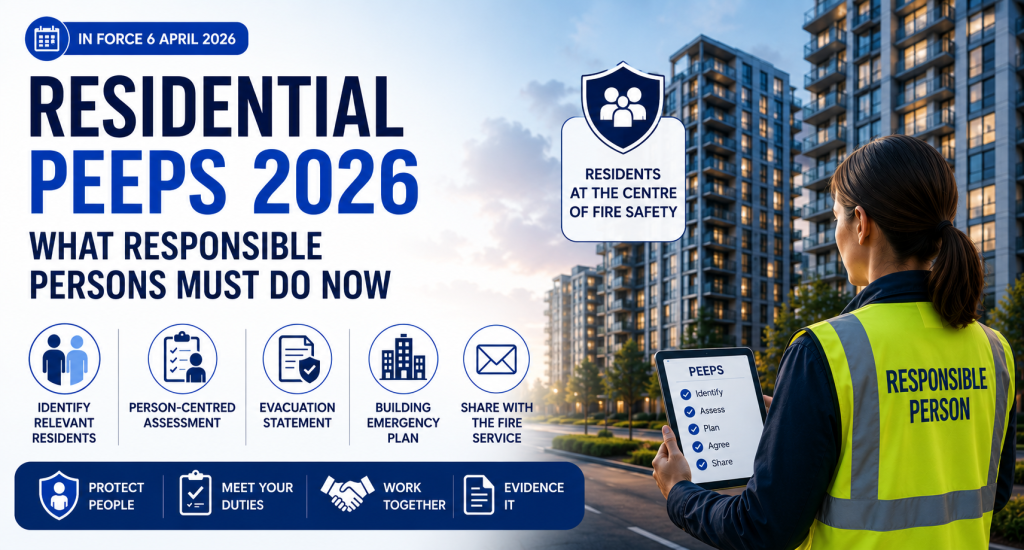
A managing agent can have a recent fire risk assessment, compliant fire doors and a clear stay put policy, yet still fall short of the Residential PEEPs requirements that came into force in England on 6 April 2026.
The reason is simple. Residential PEEPs are not just another paragraph to add to a fire risk assessment. They create a separate process for identifying residents who may not be able to evacuate without assistance, offering them a person-centred fire risk assessment and turning that conversation into a practical evacuation statement where the resident agrees.
This matters because the new duty sits where fire safety, housing management, resident engagement and data protection meet. In our work with residential blocks, the weakest point is rarely the wording of the policy. It is the evidence trail. Who was contacted? When did the annual reminder go out? Was a resident offered a person-centred assessment? What changed after the conversation? Was information shared with the local fire and rescue authority only with explicit consent?
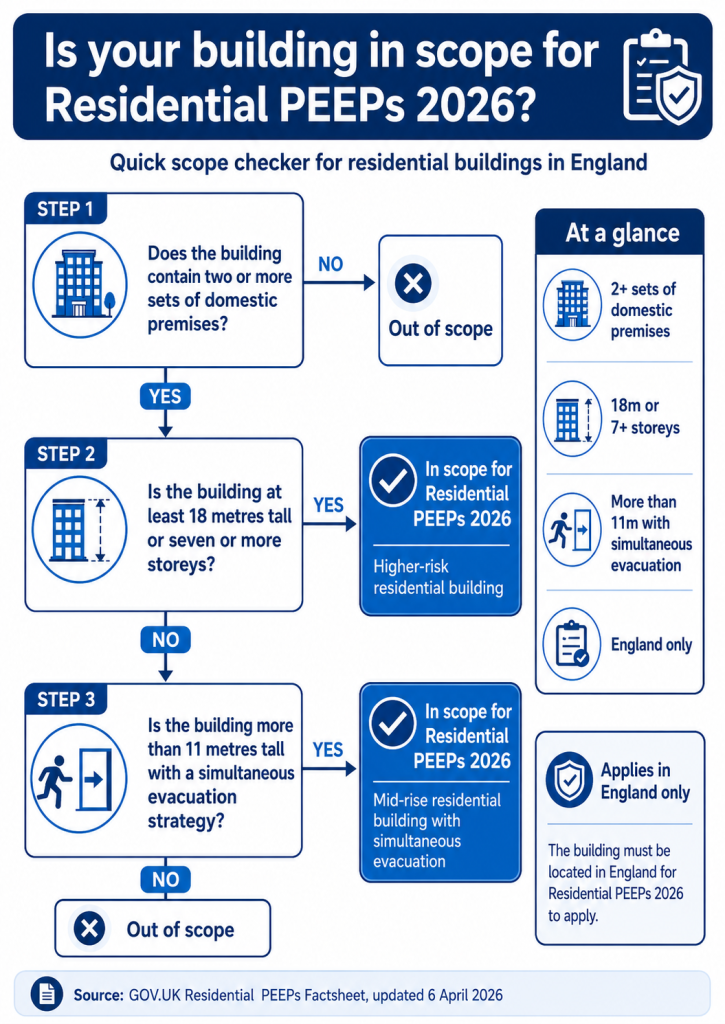
The Fire Safety (Residential Evacuation Plans) (England) Regulations 2025 apply in England to specified residential buildings. The government factsheet confirms that the regulations came into force on 6 April 2026 and apply to buildings with two or more sets of domestic premises that are at least 18 metres high or have at least seven storeys, and to multi-residential buildings over 11 metres where a simultaneous evacuation strategy is in place.
This guide is for building owners, landlords, housing associations, managing agents, resident management companies and anyone with control of the common parts who may be the Responsible Person. It focuses only on Residential PEEPs implementation. It does not repeat the general fire risk assessment process already covered elsewhere on FireRisk.io, which helps avoid keyword cannibalisation with our fire risk assessment template and high-rise fire risk assessment content.
Key takeaway: if your building is in scope, do not wait for the next routine fire risk assessment review. Residential PEEPs now require a live resident engagement process, a person-centred assessment route, a building emergency evacuation plan and a review cycle that can be evidenced.
Why Residential PEEPs became a 2026 priority
Residential PEEPs are part of the post-Grenfell reform programme. The government progress report published in May 2026 records that the Grenfell Tower Inquiry Phase 1 recommended personal emergency evacuation plans for residents whose ability to self-evacuate may be compromised, including people with reduced mobility or cognition. It also records that the 2025 Regulations came into force on 6 April 2026.
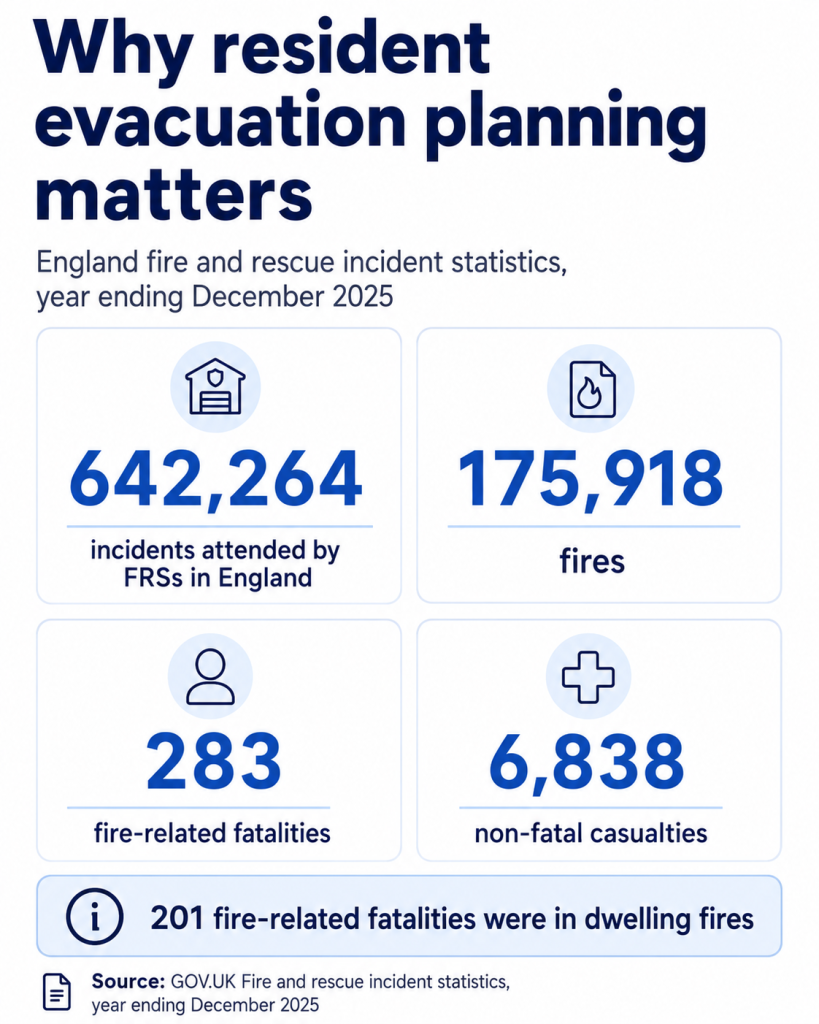
The latest national fire statistics show why residential fire planning cannot be treated as paperwork. In the year ending December 2025, fire and rescue services in England attended 642,264 incidents, including 175,918 fires. There were 283 fire-related fatalities and 6,838 non-fatal casualties. Dwelling fires accounted for 201 of those fire-related fatalities.
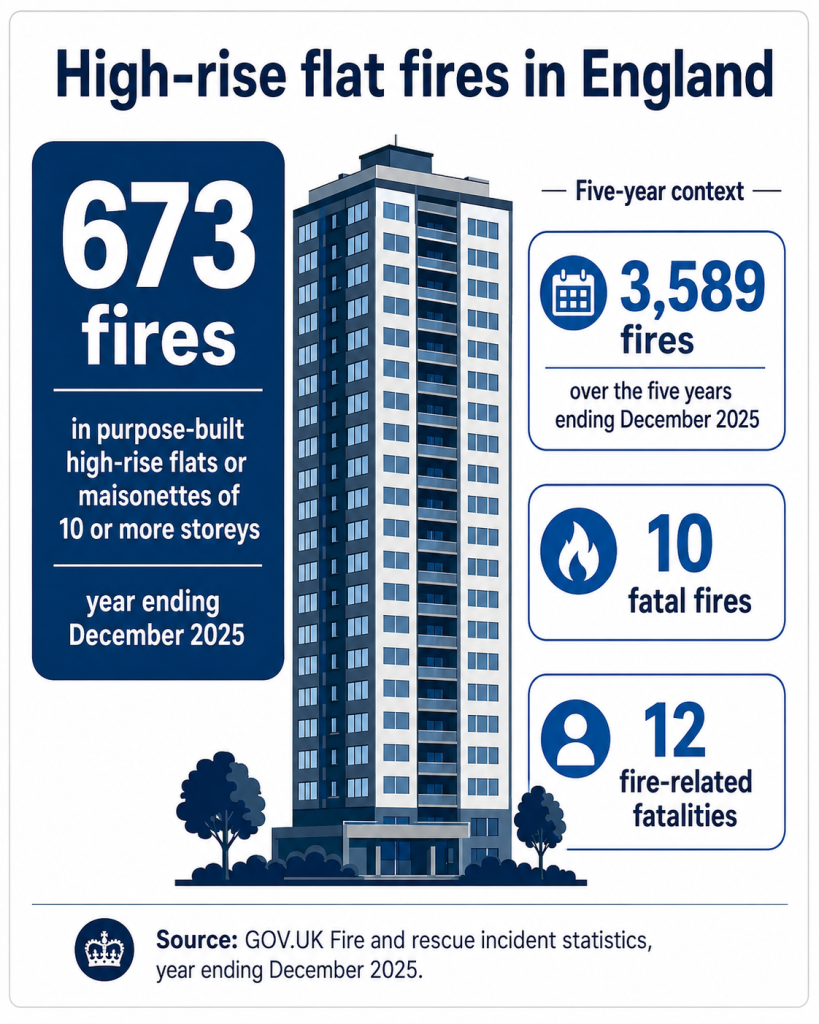
High-rise flat fires are a smaller subset of national fire incidents, but they are exactly the type of setting where evacuation planning becomes more complex. In the year ending December 2025, fire and rescue services attended 673 fires in purpose-built high-rise flats or maisonettes of 10 or more storeys. Over the five years ending December 2025, there were 3,589 fires in that building category, resulting in 10 fatal fires and 12 fire-related fatalities.
Age and vulnerability also affect outcomes. In the detailed fire analysis for the year ending March 2025, 39% of all fire-related fatalities in England were people aged 65 and over. The fatality rate for people aged 80 and over was 13.8 per million, and the non-fatal casualty rate was highest in the same age group at 183.6 casualties per million people. Those figures should not be used to make assumptions about any individual resident. They should remind Responsible Persons why a passive notice in the lobby is not enough.
Residential PEEPs put the focus back on the practical question: who in this building may need support, what do they understand about the evacuation strategy, what can they realistically do and what information would help firefighters if an evacuation or rescue is needed?
Buildings in scope: the quick test
The first job is to decide whether the regulations apply to the building. The scope is specific, and it is worth documenting your conclusion even where you decide a building is out of scope.
| Question | In scope if the answer is yes | Evidence to keep |
| Does the building contain two or more sets of domestic premises? | Yes, this is the base requirement. | Premises description, address, number of flats, mixed-use notes |
| Is it at least 18 metres above ground level or does it have seven or more storeys? | Yes. This captures high-rise multi-residential buildings. | Height information, fire strategy, building file, floor count |
| Is it more than 11 metres above ground level and under a simultaneous evacuation strategy? | Yes. This captures medium-rise residential buildings with simultaneous evacuation. | Current evacuation strategy, fire risk assessment, interim measures, waking watch notes if relevant |
| Is it outside England? | No. The 2025 Regulations apply in England only. | Jurisdiction note, portfolio tracker |
In mixed-use buildings, do not rely on the commercial address alone. A shop with flats above, a podium development or a block managed through several legal entities may still have a Responsible Person for the common parts of the residential premises. Where there are multiple Responsible Persons, the safest approach is to map who controls what and record how information is shared.
What counts as a relevant resident?
The government guidance defines a relevant resident as someone whose domestic premises in the building is their only or principal residence and who would have difficulty evacuating the building without assistance in the event of fire. This may be because of a physical mobility issue or a cognitive condition. Examples in the guidance include a wheelchair user, a blind person, someone unable to go down several flights of stairs or someone with a condition such as dementia that may affect their understanding of what to do.
This is not a label to be guessed from age, appearance or tenancy type. A fit 82-year-old resident may not need support. A younger resident recovering from a serious injury may. A resident with a hidden disability may be very capable day to day but may struggle to understand or act on fire instructions under stress.
The Responsible Person must use reasonable endeavours to identify relevant residents. Government guidance says this should include the point where a new resident moves in, an annual reminder to all residents every 12 months and when an individual makes an approach. In practice, this means the process needs to be built into housing management, not left to the fire risk assessor alone.
The five duties Responsible Persons should evidence now
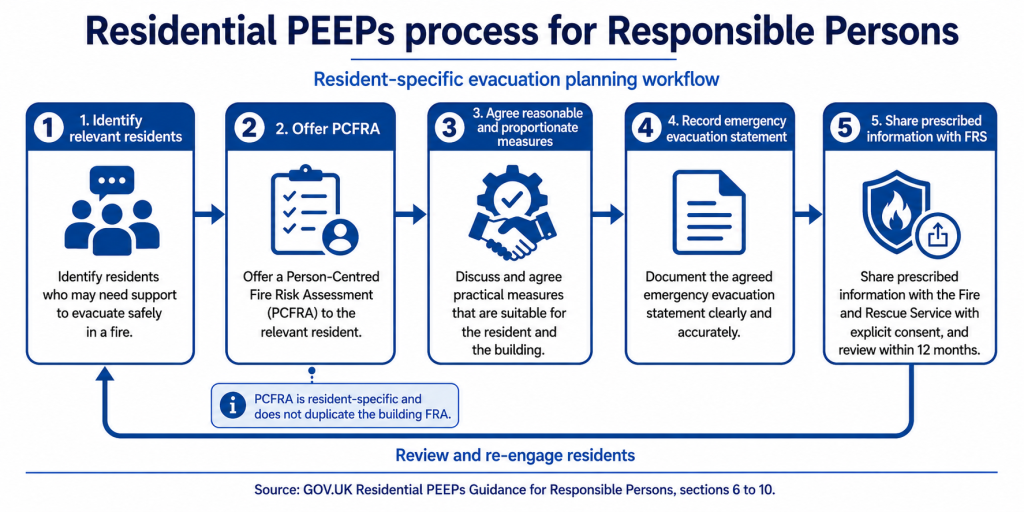
1. Identify relevant residents using reasonable endeavours
Reasonable endeavours are not a single email sent once a year. For a block with transient tenants, leaseholders, sublets and residents who may not use email, a reasonable approach usually needs more than one channel. That may include a move-in pack, annual letter, email, resident portal notice, accessible formats, posters in common parts and a reminder through the managing agent or housing officer.
Keep a simple log showing the date, method, audience, wording and outcome of each contact attempt. If a resident does not respond, that does not automatically mean the Responsible Person has failed. But without a record, it is hard to show that reasonable endeavours were made.
2. Offer a person-centred fire risk assessment
Where a relevant resident is identified, the Responsible Person must offer a person-centred fire risk assessment, often shortened to PCFRA. The government guidance is clear that this assessment is specific to the resident and should consider the additional risks and needs relating to that person, not duplicate the building fire risk assessment.
A PCFRA is normally a structured conversation. It should explore what the resident would do if a fire occurs in their flat, what they would do if the alarm sounds or if they are told to evacuate, whether they can hear alarms and understand instructions, whether stairs are a barrier, whether any mobility aid is used and whether any support from family, carers, neighbours or volunteers is already in place.
The guidance also confirms there is no requirement in the regulations for a specialist to carry out the PCFRA, and many Responsible Persons use trained staff for the process. That said, complex buildings or complex resident needs may justify input from a competent fire risk assessor, occupational therapist, housing support worker or the local fire and rescue authority.
3. Agree reasonable and proportionate measures
After the PCFRA, the Responsible Person must discuss potential measures and implement those that are reasonable and proportionate. This is where poor processes often become exposed. A resident may ask for a measure that sounds helpful but would compromise compartmentation, obstruct a common escape route or impose a cost on other leaseholders. The government guidance says such measures are extremely unlikely to be reasonable and proportionate.
Examples of measures that may need consideration include improving resident instructions, adding tactile or clearer signage, reviewing alarm audibility in common areas, checking whether evacuation alert systems are relevant to the building, improving handrails, updating common area lighting or making sure information for firefighters is accurate and accessible. Measures should be tied back to the specific risk identified during the PCFRA.
Cost needs careful handling. The guidance recognises that costs may fall to the Responsible Person, the relevant resident or all residents where the measure benefits the majority and leases allow it. Social housing providers should also check funding guidance where relevant. The key is to record how the cost decision was reached, not just the final answer.
4. Record an emergency evacuation statement
The emergency evacuation statement is the written summary of what the resident should do in the event of fire, where the Responsible Person and resident agree to it. The statement should be clear enough for the resident to understand and short enough to be useful. The Responsible Person must provide the resident with a copy.
Avoid turning the statement into a technical appendix. A resident does not need three pages of legal wording at 2am. A strong statement explains the building strategy, the resident action, the support or equipment relied on if any, and the circumstances in which they should call 999 or move to a safer place.
Consent is central. The resident cannot be forced to engage with the process, and information sharing with the fire and rescue authority requires explicit informed consent. Refusal to consent does not mean firefighters would not help the resident. It means the fire service may not have specific information about the flat location or assistance required before arrival.
5. Prepare and maintain the building emergency evacuation plan
Residential PEEPs also require a building emergency evacuation plan for the whole building. The Responsible Person must prepare the plan, share it with the local fire and rescue authority and place a copy in the secure information box if the building has one. The plan must be reviewed no later than 12 months after it is first prepared and then before the end of every 12-month period, as well as when there is reason to believe it needs updating.
The plan must include a copy of the instructions to residents required under the Fire Safety (England) Regulations 2022, whether there are relevant residents and information on any other evacuation arrangements, such as an evacuation alert system. The government guidance says the plan needs to be aligned with the property fire risk assessment.
This is where fire risk assessment and Residential PEEPs meet. The building FRA should not become a long list of personal data, but it should recognise the building strategy, resident information arrangements, common area measures and any building-wide findings that came out of the Residential PEEPs process.
Example: a 12-storey block moving from paper policy to working process
Consider a 12-storey block of flats in London with a stay put strategy, a secure information box and a mixture of leaseholders, private tenants and a few short-term sublets. The fire risk assessment is current and common parts are well maintained. The managing agent sends service charge letters by post but most day-to-day updates go through email.
A weak Residential PEEPs process would be to add a paragraph to the fire risk assessment saying residents should contact the managing agent if they need help. That may look tidy, but it does not show reasonable endeavours. It does not show move-in contact. It does not show an annual reminder. It does not create a route for a PCFRA, and it does not produce a building emergency evacuation plan for the fire service.
A stronger process would look like this. First, the managing agent confirms the building is in scope because it has more than seven storeys. Second, every household receives a plain-English letter, email and resident portal notice explaining Residential PEEPs. Third, the move-in checklist is updated so new residents are asked whether they may need support in an emergency. Fourth, any resident who responds is offered a PCFRA conversation. Fifth, the outcome is recorded as an emergency evacuation statement where agreed. Sixth, only the prescribed information is shared with the London Fire Brigade, and only where the resident gives explicit informed consent. Seventh, the building emergency evacuation plan is updated, stored correctly and reviewed each year.
That is the difference between policy and compliance. One is a sentence. The other is a repeatable process with records.
Common mistakes we would expect enforcing officers to challenge
| Mistake | Why it creates risk | Better approach |
| Treating Residential PEEPs as a generic fire risk assessment section | It may miss the resident-specific duties and consent requirements. | Keep a separate Residential PEEPs process linked to the FRA. |
| Assuming no one needs support because no one has complained | Many residents will not know what to ask for or may avoid disclosing needs. | Use move-in checks, annual reminders and accessible resident communications. |
| Collecting too much medical information | This creates unnecessary data protection risk. | Record the minimum information needed for fire safety and evacuation planning. |
| Sharing personal information without explicit consent | The regulations require explicit informed consent for sharing prescribed resident information with the fire and rescue authority. | Use a clear consent form and record withdrawn consent promptly. |
| Letting PCFRAs drift without review dates | The process must be reviewed within 12 months and when circumstances change. | Track review dates in the fire safety action plan or compliance system. |
| Agreeing measures that obstruct common parts | A mitigation for one resident must not create a new risk for others. | Assess proportionality, compartmentation, escape routes and leaseholder impacts before implementation. |
What to do in the next 30 days
If you manage a portfolio, start with a scope register. List every residential building, height, storey count, evacuation strategy, secure information box status, fire risk assessment date and local fire and rescue authority. Mark buildings that are clearly in scope, potentially in scope and out of scope. This prevents the common mistake of dealing only with obvious high-rise blocks while missing 11 metre plus buildings under simultaneous evacuation.
Next, create a resident engagement pack. It should include a plain-English Residential PEEPs letter, an accessible contact route, a short response form, a privacy and consent note, and a process for representatives or trusted persons. Keep the wording practical. Residents should understand that this is about evacuation support, not tenancy enforcement or medical screening.
Then train the people who will handle responses. A receptionist, property manager or housing officer may be the first person a resident contacts. They need to know what not to ask, how to handle sensitive information, how to book a PCFRA and when to escalate to a competent fire safety adviser.
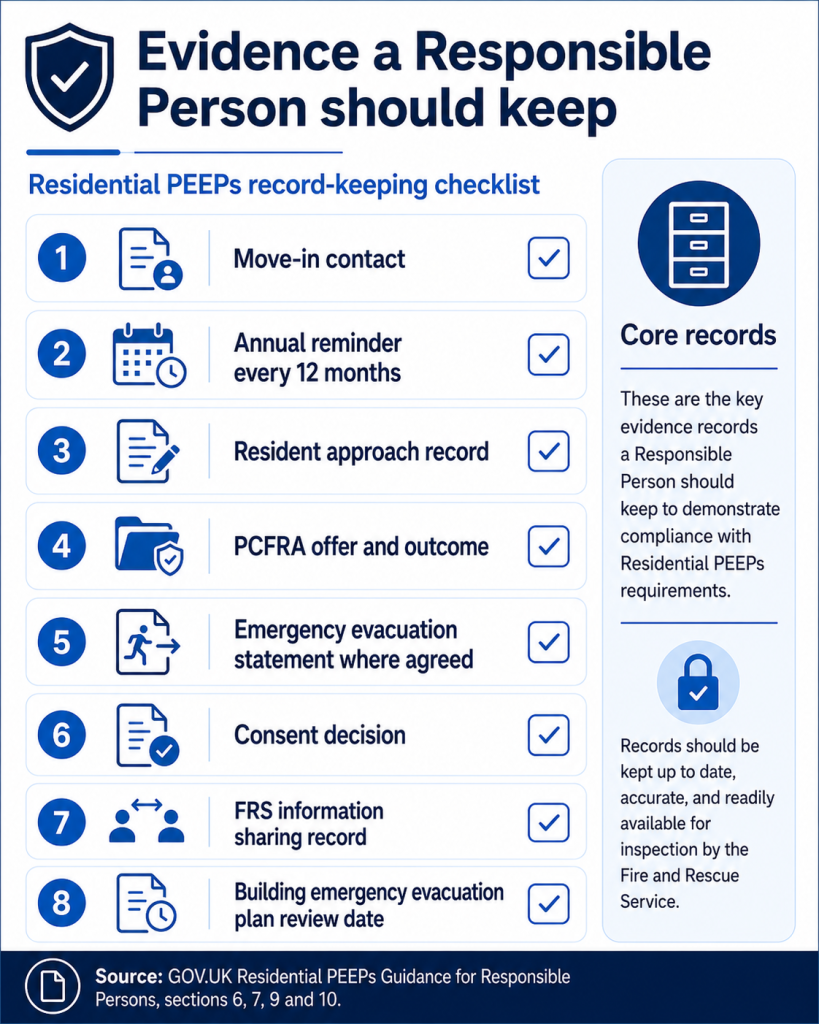
Finally, align your records. The PCFRA outcome, emergency evacuation statement, consent decision, prescribed information shared with the fire and rescue authority and building emergency evacuation plan should all be traceable. Do not scatter them across inboxes and spreadsheets with no owner.
How Residential PEEPs should connect to your existing fire safety documents
Residential PEEPs should not sit in isolation. They should connect to four existing document sets.
- Fire risk assessment: should reference the building evacuation strategy, resident information arrangements and any building-wide findings that arise from the Residential PEEPs process.
- Fire safety action plan: should include responsible owners and target dates for agreed reasonable and proportionate measures.
- Resident information: should match the current evacuation strategy and be consistent with the building emergency evacuation plan.
- Secure information box or digital fire service submission: should contain or provide access to the building emergency evacuation plan and any prescribed resident information shared with consent.
This is also a good time to check that fire doors, common escape routes, emergency lighting, alarms and signage are being maintained. Residential PEEPs do not replace those controls. They expose where those controls need to work for people with different evacuation needs.
What has not changed
The new regulations do not mean every resident needs a personalised plan. They do not mean a Responsible Person can force a resident to take part. They do not mean the building owner must agree to measures that compromise compartmentation or create a hazard in common parts. They do not mean sensitive health information should be placed in a lobby file.
They also do not remove the need for a suitable and sufficient fire risk assessment under the Fire Safety Order. The government guidance says the PCFRA is not intended to duplicate the building fire risk assessment, but it may identify measures that should be considered by that assessment.
One final point needs care. The May 2026 government progress report says the remaining element of the policy, mandating consideration of in-flat risks and mitigations, requires primary legislation and will be put in place when Parliamentary time allows. Responsible Persons should avoid claiming that current regulations already require a full in-flat fire risk assessment under Residential PEEPs. They should, however, keep an eye on future changes.
Need help with Residential PEEPs?
FireRisk.io can help Responsible Persons review whether their buildings are in scope, prepare a Residential PEEPs implementation process, align it with the existing fire risk assessment and produce building emergency evacuation plan documentation. For higher-risk residential buildings, it is usually faster and safer to build the process correctly now than to retrofit records after a complaint, audit or fire service inspection.
If you manage flats, high-rise blocks, supported living schemes or mixed-use residential premises, book a fire safety review and ask specifically for Residential PEEPs compliance to be included in the scope.