
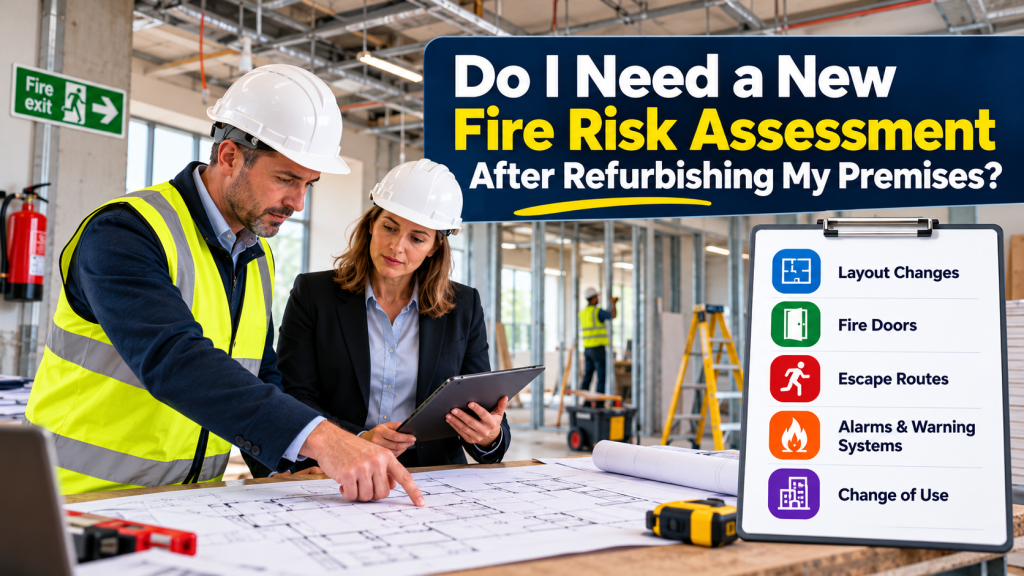
The paint has dried, the new partition walls are in place, and staff are ready to move in. However, behind those newly installed walls, there are escape routes that were documented in the previous fire risk assessment that may no longer be available.
A new fire risk assessment is not always required after refurbishment, but by law a fire risk assessment review should be done after a significant change in the premises. If the refurbishment affects the layout, escape routes or fire protection measures, the existing assessment must be reviewed and updated. In some cases, a new assessment may be more appropriate.
What Changes Are Considered Significant?
The impact of building alterations on fire safety is more important than the type of work carried out. The following changes may be considered significant:
- Walls have been altered, or new openings have been created, causing a change in layout or fire risk.
- Cables or pipes have gone through fire-resistant walls or floors.
- Fire doors were changed, removed or relocated.
- Changes in exits, staircases or escape routes.
- Alarm, detection or emergency lighting installation altered.
- A change in building use or an increase in occupancy.
Is a Review or a New Assessment Required?
An existing assessment can be reviewed and updated by a competent person, such as a fire risk assessor, who can verify changes and modify the current document. A new assessment or reassessment after building works should be considered only if an existing one is no longer valid for describing the building.
When is the Best Time to Review?
As a matter of good practice, assessments should be reviewed – both at the start and completion of construction works. The former looks at hot work and obstruction issues; the latter compares doors, fire stopping and alarm installation against what has been built.
Is Building Control Approval Sufficient?
No, because in the fire strategy vs fire risk assessment comparison, building control approval and the package from the contractor, including any fire strategy report, are not a fire risk assessment, and legal responsibility remains with the responsible person.
What Information Must Be Recorded?
Since 1 October 2023, the entire assessment has had to be documented for non-domestic premises and their common parts, together with details of whoever performed the work. Changes to the evacuation plan will also be required, with briefings for employees before the reopening takes place.
Who Can Assess Refurbished Premises?
Risk Assessment London, which operates from offices located in The Strand and Marshgate Lane in east London, carries out inspections of premises in urban and rural locations throughout England. Their five-stage process covers everything from the initial quotation to the inspection.