
Fire Alarm Testing
BS 5839 Certified | From £80
BAFE registered engineers. Every system type covered. Compliance certificate included with every visit.



What is fire alarm testing?
What does fire alarm testing involve?
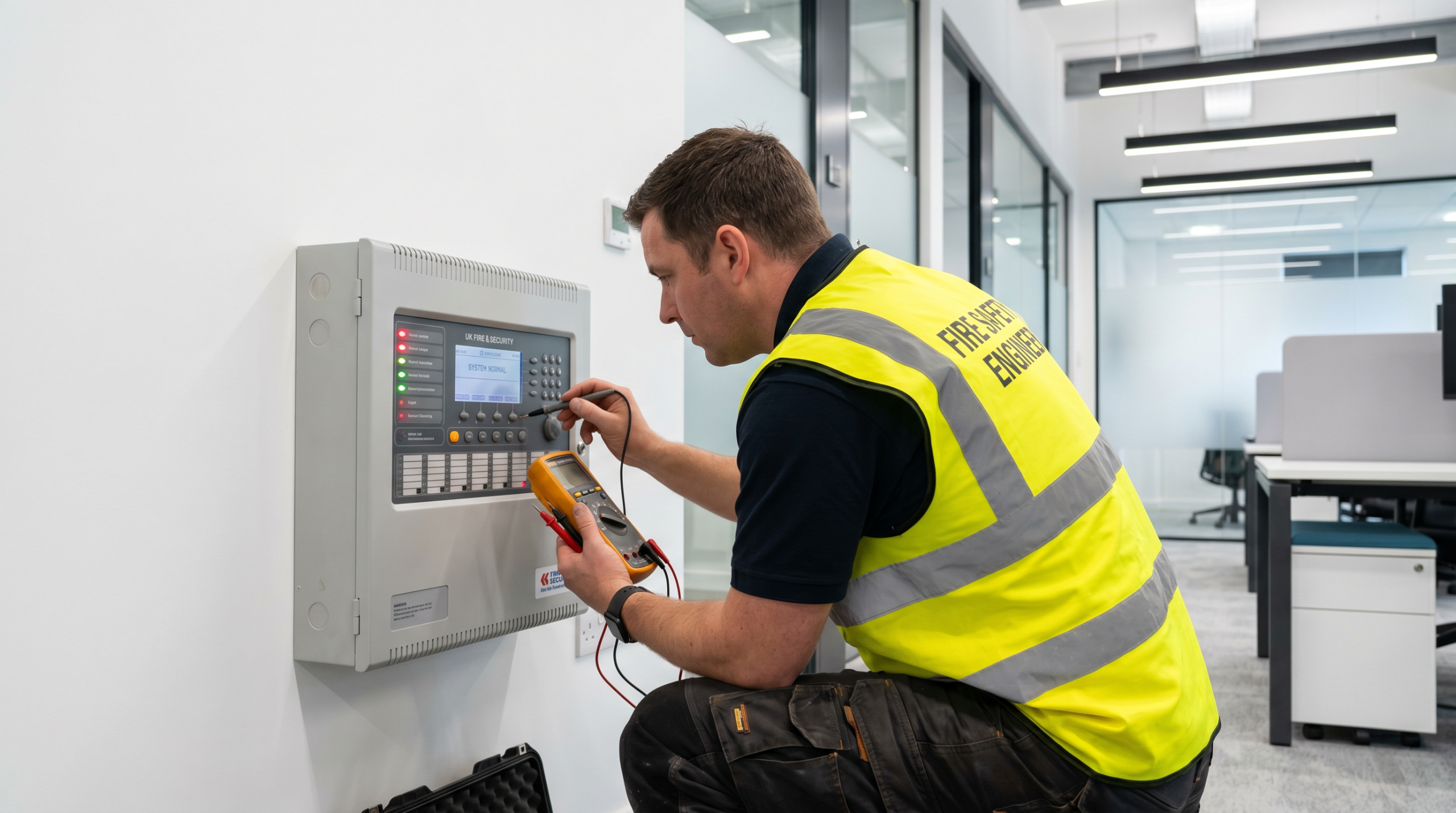
We check every part of your fire alarm system — detectors, call points, sounders, wiring, and the control panel. If a fire starts, your alarm needs to detect it and warn everyone in the building. Testing confirms that it will.
All fire alarm testing in the UK must follow BS 5839-1:2017, the British Standard for fire detection and alarm systems. The Regulatory Reform (Fire Safety) Order 2005 makes this a legal duty. The “responsible person” — usually the owner, landlord, or employer — must keep the system in working order.
Testing runs on a cycle: weekly call point checks, monthly inspections, and professional servicing every six months.
Why fire alarm testing matters
It is a legal requirement
Under the Regulatory Reform (Fire Safety) Order 2005, the responsible person for any non-domestic premises must ensure fire detection and warning systems are maintained in good working order. This is not guidance. It is law.
Penalties for non-compliance
- Enforcement notices requiring immediate action
- Prohibition notices that can shut your building down on the spot
- Unlimited fines for failing to comply with fire safety duties
- Up to 2 years imprisonment for serious breaches
Since Grenfell, fire safety enforcement has stepped up. Local fire and rescue authorities are running more audits and prosecuting more often.
Insurance and liability risks
Most commercial property insurance policies require evidence of regular fire alarm testing and maintenance. If your system has not been professionally serviced and a fire occurs, your insurer can refuse your claim. A lapsed maintenance record can void your cover entirely.
The human cost
A working fire alarm gives people the early warning they need to get out safely. A faulty detector, a dead backup battery, or a sounder that does not go off in one wing of the building — any single failure can turn a contained incident into a fatal one. Regular testing catches these faults before they matter.
Why choose FireRisk.io?
BAFE registered engineers with 25 years of fire safety experience
BS 5839 compliance
Every test meets BS 5839-1:2017. Our BAFE registered engineers check every device, circuit, and panel function. You get a compliance certificate on completion — accepted by insurers and fire authorities across the UK.
Annual maintenance contracts
One contract covers the full year — both six-monthly service visits and the annual inspection. Fixed pricing, priority booking, no surprise invoices. Saves 15-20% compared to ad-hoc visits.
24-hour emergency callout
System fault at 2am? Our engineers are positioned across the UK with common spares on every van. Most callouts attended within 4 hours, most faults fixed in a single visit.
Fire alarm testing frequencies
BS 5839-1:2017 sets out a clear schedule for fire alarm testing. Each level of inspection has a different purpose, and skipping any of them puts you out of compliance.
| Frequency | What is tested | Who should do it |
|---|---|---|
| Weekly | One manual call point (rotating zones) | Trained on-site staff |
| Monthly | Visual check of all devices and panel | Trained on-site staff |
| Quarterly | Functional test of detectors (rotating) | Trained staff or engineer |
| Six-monthly | Full professional service and inspection | Qualified fire alarm engineer |
| Annually | Comprehensive BS 5839 inspection | Qualified fire alarm engineer |
Weekly testing tip
Rotate through different zones each week so that every call point in the building gets tested over the course of a few months. A trained member of staff can do this — you do not need a professional engineer for weekly tests.
Systems we test
Qualified across all major manufacturers and system types

Conventional fire alarms
Zone-based systems that divide a building into numbered areas. When a device activates, the control panel shows which zone the alarm came from. Common in smaller buildings and relatively cheap to install and maintain.

Addressable fire alarms
Each device has a unique digital address. When an alarm triggers, the panel identifies the exact device and its location. This speeds up response times and is the go-to choice for larger buildings with multiple rooms or floors.

Wireless fire alarms
Radio frequency systems where devices communicate wirelessly with the control panel. These work well in listed buildings, heritage properties, and premises where running cables is impractical. We test wireless signal strength as part of every visit.
Fire alarm categories explained
BS 5839-1:2017 classifies fire alarm systems into categories based on their purpose and how much of the building they cover. Knowing which category applies to your building matters — it determines the number and placement of detectors you need.
Category M — manual systems
Manual-only systems with no automatic detection. Protection relies entirely on someone discovering the fire and pressing a manual call point. Only suitable for very small, simple premises.
Category L — life protection
- L1: Automatic detection throughout the entire building, including roof voids and ceiling spaces. Required for high-risk premises such as care homes and HMOs.
- L2: Detection in defined areas beyond escape routes — typically high-risk rooms where fires are likely to start.
- L3: Detection in escape routes only — corridors, stairwells, and lobbies. Common in residential blocks of flats.
- L4: Detection in escape routes within individual dwellings only.
- L5: Detection in specific locations determined by the fire risk assessment.
Category P — property protection
- P1: Automatic detection throughout the entire building.
- P2: Detection in defined high-risk areas only.
Which category do you need?
Most commercial buildings need at least a Category L2 or L3 system. HMOs and residential care homes typically require L1. Your fire risk assessment will specify the correct category for your premises.
What is included in our fire alarm testing service
Every fire alarm test we carry out follows BS 5839-1:2017. Here is what the service covers:
Our service includes
- Control panel inspection — full functional test of zone indicators, fault conditions, and communication with all connected devices
- Detector and call point testing — every detector and manual call point individually tested for correct activation and response
- Sounder and visual alarm verification — all sounders, bells, and visual alarm devices checked across their designated coverage area
- Battery backup testing — standby batteries tested under load to verify they can power the system during a mains failure
- Log book completion — fire alarm log book completed on-site, recording all tests carried out and faults found
- Fault identification and reporting — any faults documented with clear recommendations and priority levels
- Certificate of compliance — certificate confirming your system has been tested to BS 5839-1:2017
Fire alarm testing costs
What you pay depends on the size of your system and the complexity of the building. Here are typical costs for a professional fire alarm test and service visit:
| Premises size | Devices | Typical cost |
|---|---|---|
| Small premises | Up to 10 devices | £80 – £150 |
| Medium premises | 10 to 50 devices | £150 – £300 |
| Large premises | 50+ devices | £300 – £500+ |
Several factors affect the price: the number of devices on the system, building access requirements, system age and condition, and whether any parts need replacing during the visit.
We offer annual maintenance contracts that include both six-monthly service visits and priority callout rates. Contracts typically save 15-20% compared to booking individual visits.
Our fire alarm testing process
From booking to certificate in 5 steps
Book your test
Call us or fill in the form. We schedule around your operations to minimise disruption.
Engineer arrives
A BAFE registered engineer arrives at your premises with all necessary testing equipment.
System tested
Every device, circuit, and panel function is tested to BS 5839-1:2017 standards.
Report delivered
Detailed report with any faults found, recommendations, and priority levels within 24 hours.
Certificate issued
BS 5839 compliance certificate issued. Log book completed on-site.
512+
Projects Completed
25+
Years Experience
150+
UK Areas Covered
24hr
Report Turnaround
What our clients say
Trusted by 500+ UK businesses for fire safety compliance
“FireRisk.io completed our fire alarm testing within 24 hours when we were facing a compliance deadline. Professional, thorough, and the certificate was ready the same day.”
“Used this company for fire alarm testing and servicing across multiple properties. Always arrived on time and had the certificates back within 24 hours. Highly recommend.”
“Very professional and knowledgeable engineers. Great quality work on our fire alarm system and competitive pricing. Would definitely recommend.”
“Professional company, professional staff. Fire alarm testing and fire risk assessment both completed efficiently. Clear communication throughout.”
“FireRisk.io completed our fire alarm testing within 24 hours when we were facing a compliance deadline. Professional, thorough, and the certificate was ready the same day.”
“Used this company for fire alarm testing and servicing across multiple properties. Always arrived on time and had the certificates back within 24 hours. Highly recommend.”
“Very professional and knowledgeable engineers. Great quality work on our fire alarm system and competitive pricing. Would definitely recommend.”
“Professional company, professional staff. Fire alarm testing and fire risk assessment both completed efficiently. Clear communication throughout.”
Frequently asked questions
Common questions about fire alarm testing
Ready to book your fire alarm test?
BAFE registered engineers. BS 5839 compliant. Prices from £80. 24-hour turnaround.
Explore more fire safety resources
Fire alarm guides
Related services
Building types
Tools and resources
Fire alarm testing across the UK
BAFE registered engineers available in every major region
Serving 150+ areas across England
Get a quote for fire alarm testing
BS 5839 compliant testing from £80. 24-hour turnaround.