

Table of contents
Table of Contents
- What Is a Fire Strategy Document?
- When You Need a Fire Strategy Document
- Legal and Regulatory Framework
- The 17 Essential Fire Strategy Template Sections
- 1. Executive Summary
- 2. Building Description
- 3. Design Standards and Guidance
- 4. Fire Risk Assessment Summary
- 5. Means of Escape (B1)
- 6. Fire Detection and Alarm Systems (B1)
- 7. Internal Fire Spread – Linings (B2)
- 8. Internal Fire Spread – Structure (B3)
- 9. External Fire Spread (B4)
- 10. Access and Facilities for Fire Service (B5)
- 11. Fire Suppression Systems
- 12. Smoke Control Systems
- 13. Fire Safety Management & Procedures
- 14. Emergency Lighting & Signage
- 15. Fire Strategy Drawings Package
- 16. Assumptions and Limitations
- 17. Appendices and Supporting Information
- Download Your Free Fire Strategy Checklist
- Common Mistakes to Avoid
- The Fire Strategy Development Process
- Conclusion: Getting Your Fire Strategy Right
You’re three weeks from submitting your building control application when the approval officer asks for your fire strategy document. You scramble to understand what’s required, only to discover that a poorly structured document could delay your project by months and cost tens of thousands in redesign work.
Fire strategy documents aren’t just bureaucratic paperwork. They’re the blueprint that demonstrates how your building will protect lives in a fire emergency. Missing a single critical section can result in immediate rejection, expensive retrofits, or worse—a building that puts occupants at risk.
In this comprehensive guide, you’ll discover exactly what must be included in a professional fire strategy document template. We’ll walk through all 17 essential sections, explain why each matters, and show you how to avoid the costly mistakes that derail 40% of first-time submissions.
What Is a Fire Strategy Document?
A fire strategy document is a comprehensive technical report that outlines how a building is designed to prevent, detect, and respond to fire. Think of it as the master plan that brings together every fire safety element—from the materials in your walls to the width of your escape routes.
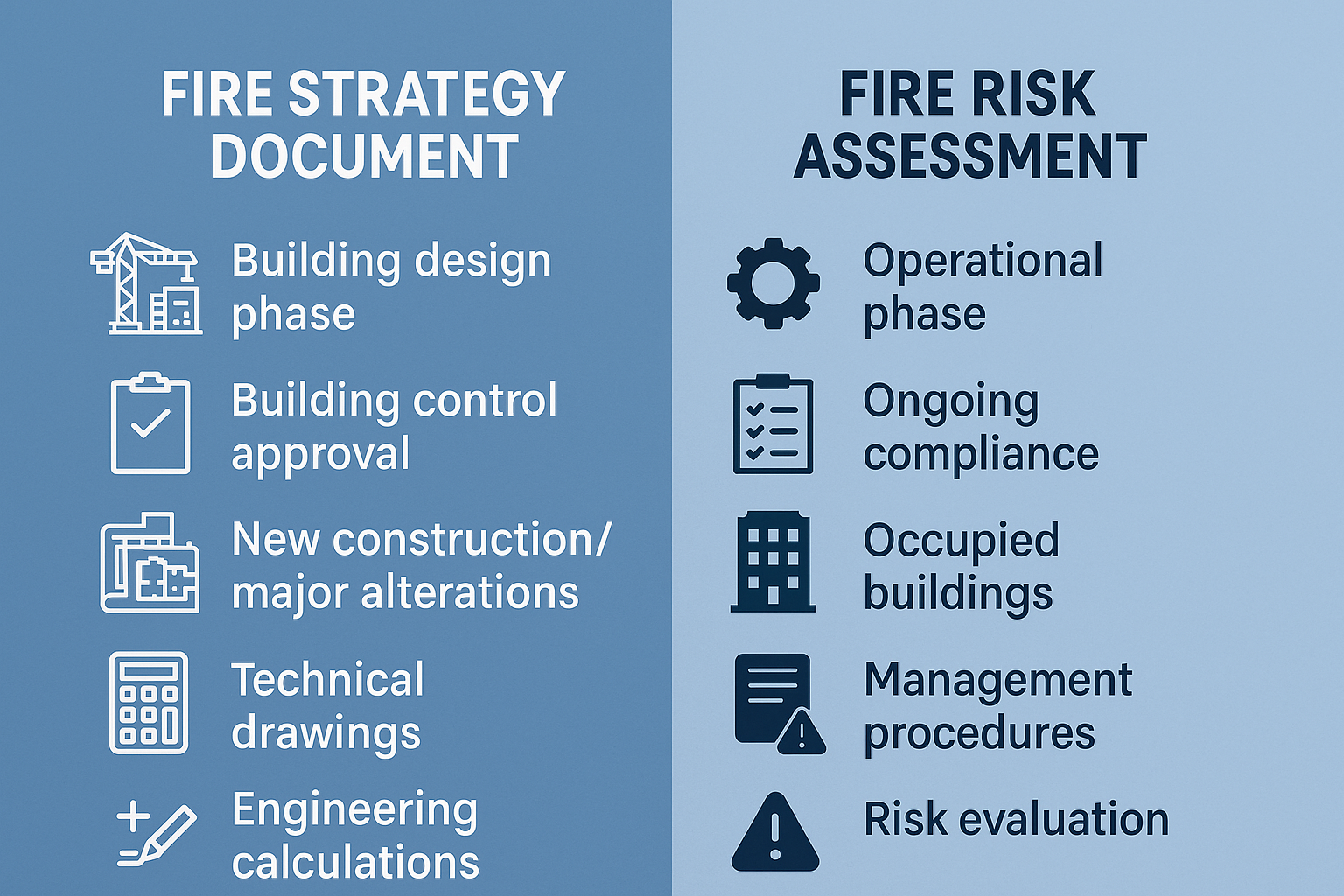
Unlike a fire risk assessment, which evaluates existing hazards in an occupied building, a fire strategy is created during the design phase. It’s a forward-looking document that demonstrates compliance with Building Regulations Approved Document B and other relevant standards before construction begins.
Here’s what makes fire strategies unique: they must demonstrate how your building achieves equivalent or better safety than prescriptive guidance. While Approved Document B provides standard solutions, many modern buildings require performance-based approaches that need detailed justification.
Professional fire strategy services integrate multiple disciplines. Your fire engineer must understand structural fire resistance, mechanical ventilation systems, human behaviour during evacuation, and the latest regulatory changes. This isn’t a document you can template from another project—each building requires bespoke analysis.
The document serves multiple purposes simultaneously. Building control officers use it to grant approval. Main contractors rely on it during construction. Facilities managers reference it throughout the building’s lifecycle. And in the unfortunate event of a fire, it provides a clear record of intended safety measures.
Most critically, a fire strategy creates a single source of truth. When your architect specifies fire doors, your MEP engineer designs the alarm system, and your contractor builds the compartmentation, everyone is working from the same safety philosophy.
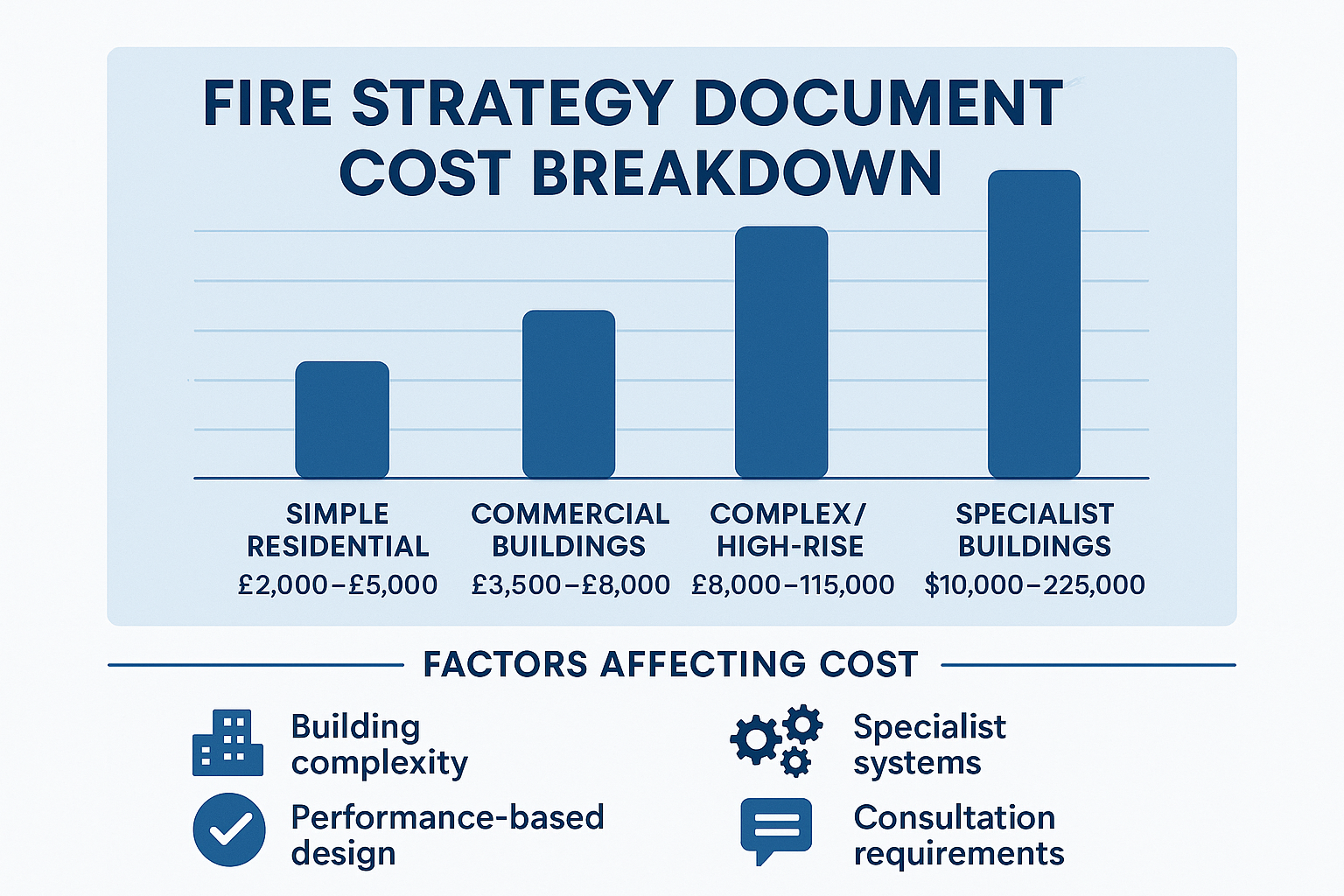
The stakes are significant. A comprehensive fire strategy document can cost £3,500–£15,000 for commercial projects, but the cost of getting it wrong runs far higher. Building control rejections, redesign fees, and construction delays can easily exceed £100,000 on medium-sized developments.
When You Need a Fire Strategy Document
Not every building project requires a formal fire strategy document, but the threshold is lower than most developers realize. Any building where you’re deviating from standard Approved Document B guidance needs one. That simple criterion catches far more projects than you might expect.
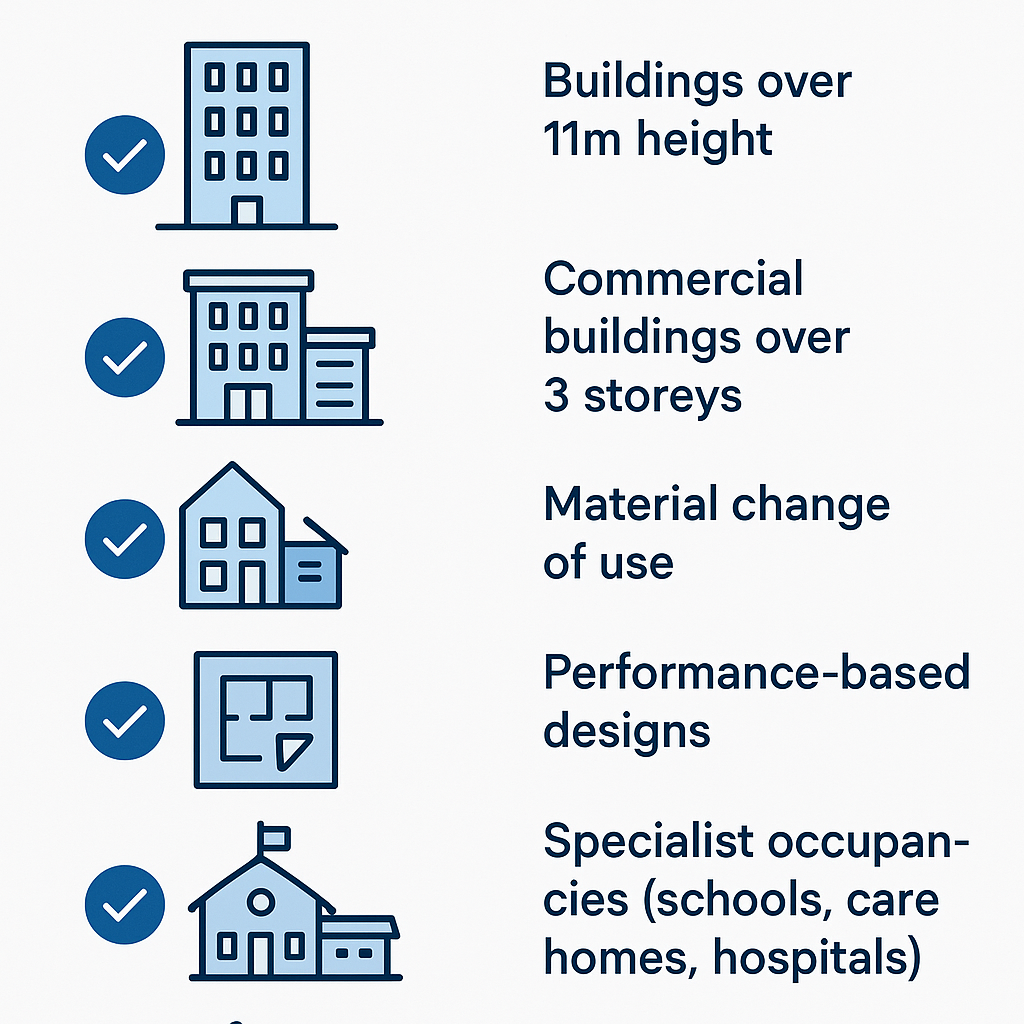
Commercial buildings over three storeys almost always need a fire strategy. The complexity of multi-storey evacuation, the potential for high occupancy, and the mixture of uses make prescriptive guidance insufficient. Your building control officer will expect to see detailed analysis.
Residential buildings trigger requirements based on height and complexity. Buildings over 11 metres (roughly four storeys) require fire strategies under current regulations. But even lower-rise developments need them if you’re proposing unusual layouts, mixed-use spaces, or innovative construction methods.
Here’s where projects commonly go wrong: assuming that following Approved Document B exempts you from documentation. Even when using standard solutions, you still need to demonstrate how your specific building applies those solutions. A fire strategy provides that demonstration.
Material changes of use require new fire strategies. Converting a warehouse to residential flats, turning offices into a hotel, or adding commercial units to a residential building all create new fire safety challenges that demand fresh analysis.
Extensions and refurbishments fall into a grey area. Minor works might not need a full fire strategy, but significant alterations do. The test is simple: if your changes affect means of escape, compartmentation, or fire spread, you need professional fire strategy services to document the approach.
Buildings with specific occupancy types always need strategies. Schools, care homes, hospitals, prisons, and entertainment venues all have unique evacuation challenges. Standard guidance cannot adequately address the needs of vulnerable occupants or complex operational requirements.
Performance-based designs are becoming increasingly common. When your architectural vision requires glass atriums, open-plan staircases, or extended travel distances, you’ll need a fire strategy that proves these innovations maintain adequate safety. This is where understanding Part B Building Regulations becomes essential.
Legal and Regulatory Framework
Fire strategy documents exist within a comprehensive legal framework that has evolved significantly in recent years. The primary driver is the Building Regulations, specifically Approved Document B (Fire Safety), which sets out functional requirements for new buildings and material alterations.
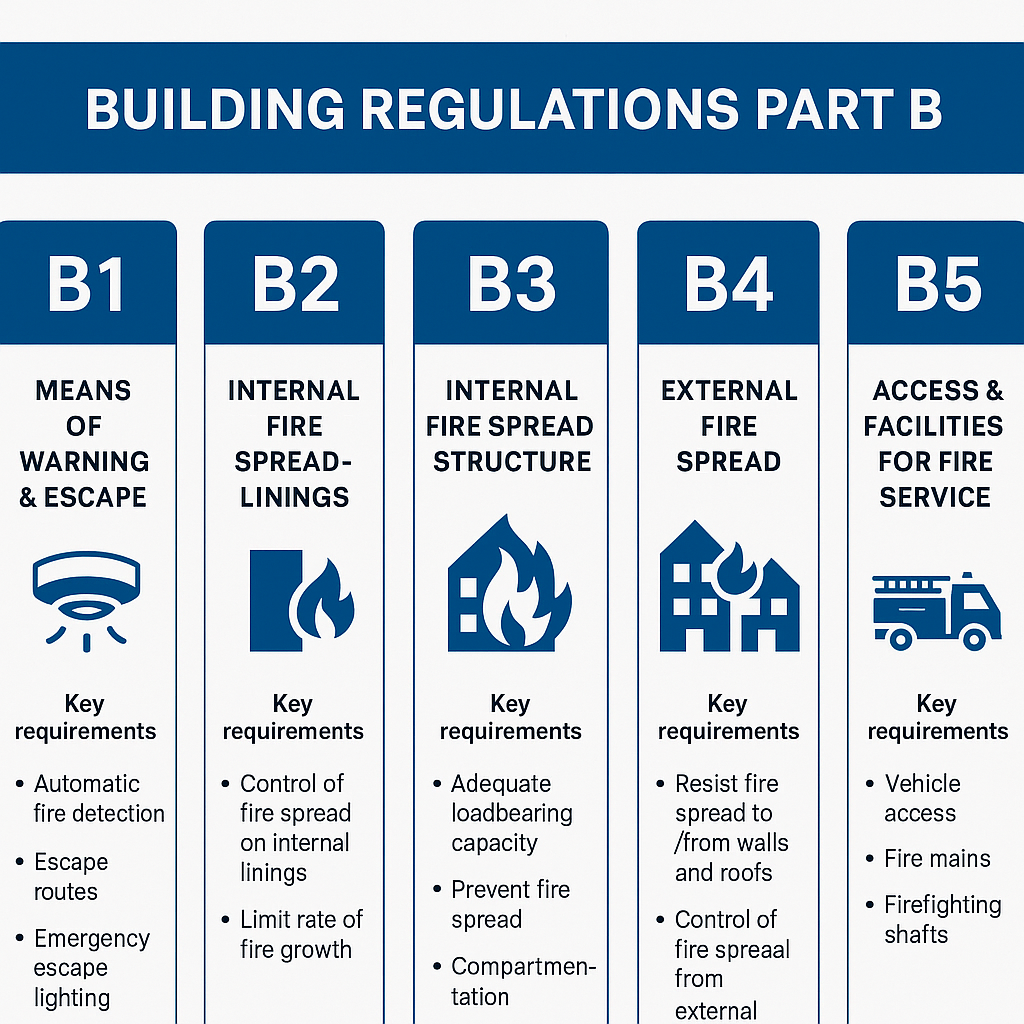
The Regulatory Reform (Fire Safety) Order remains the cornerstone of fire safety law for occupied buildings. While it doesn’t directly require fire strategies during design, the Order creates the duty to maintain fire safety throughout a building’s life. A well-documented fire strategy becomes essential evidence of compliance.
Post-Grenfell regulatory changes have dramatically increased scrutiny. The Building Safety Act introduced the Gateway process for higher-risk buildings, requiring fire strategies at multiple stages. Even for buildings outside the Gateway regime, building control bodies now demand far more detailed documentation than before.
The Fire Safety Act amended the Fire Safety Order to explicitly cover external walls and flat entrance doors. This means your fire strategy must address these elements comprehensively—surface treatments, fire resistance ratings, and maintenance protocols all need documentation.
BS 9999 provides the technical backbone for many fire strategies. This code of practice for fire safety in non-residential buildings offers alternative approaches to Approved Document B. When you reference BS 9999 in your strategy, you’re committing to its methodology throughout the design.
Here’s where competency requirements bite: the Building Safety Act introduced strict competency standards for those producing fire strategies. Your fire engineer must demonstrate relevant qualifications, experience, and professional indemnification. Building control will verify these credentials before accepting your submission.
Industry guidance supplements the regulations. Documents like the RIBA Fire Safety Guidance, NFCC guidance for high-rise residential buildings, and CIBSE guides all inform best practice. While not legally binding, building control officers increasingly expect strategies to reference these documents.
The relationship between fire strategies and fire risk assessments often confuses developers. The strategy is a design document for building control approval. The fire risk assessment is an operational document required under the Fire Safety Order. You need both, but they serve different purposes at different project stages.
Enforcement comes from multiple directions. Building control can reject applications with inadequate strategies. Fire and rescue services can object to plans during consultation. And once occupied, the Responsible Person must ensure the building operates as the fire strategy intended—making comprehensive documentation crucial for ongoing compliance.
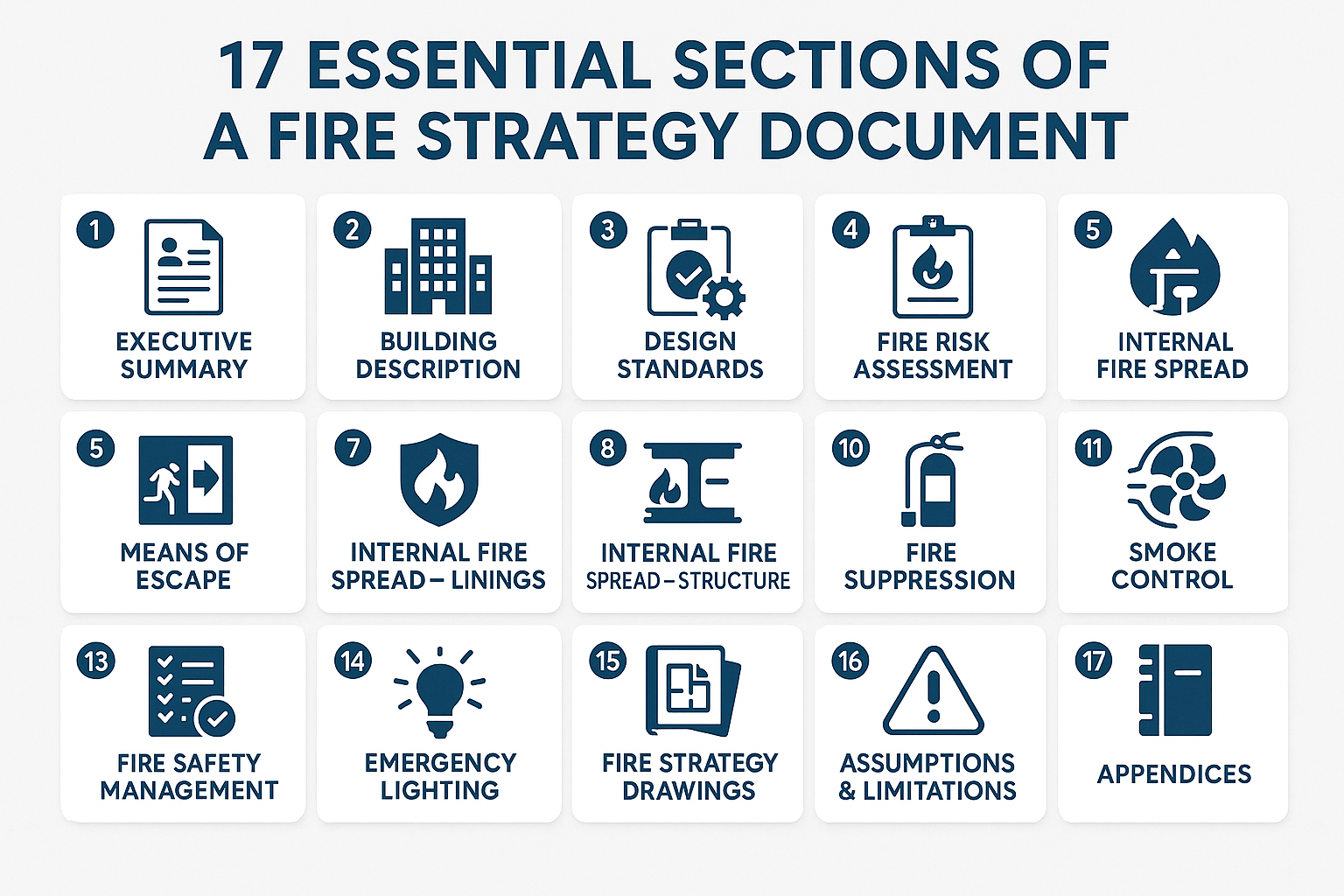
The 17 Essential Fire Strategy Template Sections
This is where fire strategy documents succeed or fail. A comprehensive template must cover every aspect of fire safety design in a logical, auditable structure. Missing sections or inadequate detail will result in immediate rejection by building control.
1. Executive Summary
The executive summary provides a high-level overview that building control officers can quickly scan to understand your approach. This section should be concise—typically two pages maximum—but must capture every key decision. A good executive summary will briefly explain the building’s use, size, and occupancy, state the fire safety design basis (e.g., Approved Document B, BS 9999), and highlight any performance-based solutions or deviations from standard guidance. It should also confirm that a competent person has prepared the strategy.
2. Building Description
Comprehensive building description goes far beyond basic dimensions. You need to paint a complete picture that allows anyone reading the strategy to understand the building’s fire safety implications without visiting the site. This includes details on the building’s layout, construction materials, number of storeys, and the use of each area. For complex buildings, it should also describe the occupant characteristics, such as whether they are visitors, residents, or staff, and if there are any vulnerable occupants.
3. Design Standards and Guidance
This section establishes the technical foundation for your entire fire safety approach. You’re creating a contract with building control about which standards apply and how you’ll demonstrate compliance. It’s crucial to list all relevant documents, including their specific versions (e.g., BS 9999:2017). If there are conflicts between different guidance documents, the strategy must explain the hierarchy of precedence. For performance-based designs, this section will be extensive, detailing the engineering principles and methodologies used.
4. Fire Risk Assessment Summary
While the detailed fire risk assessment is a separate document, your fire strategy needs to summarize key findings that influenced design decisions. This creates a clear link between risk identification and mitigation measures. The summary should identify the significant fire hazards anticipated in the building, the potential for fire spread, and the groups of people who are most at risk. This section demonstrates that the fire safety design is risk-informed.
5. Means of Escape (B1)
Means of escape is often the most detailed section of any fire strategy. You’re demonstrating that everyone in the building can reach a place of safety before conditions become untenable—typically within 2.5 to 3 minutes. This involves detailed calculations of travel distances, escape route widths, and staircase capacities. It must also specify the fire resistance of escape corridors and the type and location of final exit doors. For buildings with phased evacuation or a ‘stay put’ policy, this section will be particularly complex.
6. Fire Detection and Alarm Systems (B1)
This section details how you’ll provide early warning to occupants. It covers the type of system (e.g., L1, L2, M, P1, P2), detector types and locations, sounder levels, and integration with other building systems. The choice of system category depends on the building’s use and risk profile. For example, a residential building will require a different system from a commercial office. The strategy must also specify the cause and effect—what happens when a specific detector is activated.
7. Internal Fire Spread – Linings (B2)
Here, you’ll specify the fire performance of wall and ceiling linings to control the rate of fire growth. This section references classifications like Class 0 or Euroclass B to ensure materials don’t contribute excessively to fire spread. It’s not just about the main surfaces; the strategy must also consider the fire performance of decorative finishes, noticeboards, and other items that could affect how quickly a fire develops.
8. Internal Fire Spread – Structure (B3)
This critical section outlines how the building’s structure will maintain stability during a fire. It specifies fire resistance periods for elements like columns, beams, and floors, and details the compartmentation strategy that divides the building into fire-resisting cells. This includes the specification of fire doors (e.g., FD30, FD60), the treatment of service penetrations through compartment walls, and the use of cavity barriers in walls and voids.
9. External Fire Spread (B4)
This section demonstrates how you’ll prevent fire from spreading up the building’s facade or to adjacent properties. It includes calculations for unprotected areas (windows) and specifies the fire performance of cladding and roofing materials. Following the Grenfell Tower fire, this section is under intense scrutiny. The strategy must provide clear evidence that the external wall construction complies with the latest regulations and guidance, including the combustibility of all components.
10. Access and Facilities for Fire Service (B5)
Here, you’ll detail provisions for firefighters. This includes vehicle access routes, hard-standing areas, fire mains, firefighting shafts, and smoke control overrides. Early consultation with the local fire and rescue service is essential for this section. The strategy must demonstrate that firefighters can get to, into, and around the building with the necessary equipment to fight a fire effectively.
11. Fire Suppression Systems
If your building includes sprinklers, misting systems, or other forms of automatic suppression, this section provides the design details. It covers the system type, coverage areas, water supply requirements, and integration with the fire alarm system. If sprinklers are being used as a compensatory feature to justify a deviation from standard guidance (e.g., extended travel distances), this section must provide a robust argument.
12. Smoke Control Systems
For buildings with atriums, extended escape routes, or firefighting shafts, smoke control is critical. This section details the design of natural or mechanical smoke ventilation systems, including calculations and performance criteria. This may involve complex computational fluid dynamics (CFD) modelling to prove the effectiveness of the proposed system. The strategy must also detail the system’s activation and control philosophy.
13. Fire Safety Management & Procedures
This section bridges the gap between design and occupation. It outlines the requirements for the building’s fire safety manual, including maintenance schedules, staff training, evacuation procedures, and record-keeping. While the fire strategy is a design document, it must consider how the building will be managed in practice. This section provides the basis for the information that will be handed over to the building operator under Regulation 38 of the Building Regulations.
14. Emergency Lighting & Signage
This section details the provision of emergency lighting to illuminate escape routes during a power failure and the signage required to guide occupants to safety. It references standards like BS 5266 and BS 5499. The strategy must specify the required illuminance levels, the duration of the emergency lighting, and the location of all escape signs.
15. Fire Strategy Drawings Package
A fire strategy is incomplete without a comprehensive set of drawings. This section lists all the required plans, including compartmentation, means of escape, fire alarm layouts, and fire service access plans. The drawings must be clear, to scale, and fully coordinated with the information in the written report. Poor quality or inconsistent drawings are a common reason for rejection.
16. Assumptions and Limitations
No fire strategy can cover every eventuality. This section documents the key assumptions made during the design process (e.g., management standards, occupant characteristics) and clarifies the scope and limitations of the document. This is a crucial section for managing liability. It makes it clear that the fire strategy is based on a specific set of circumstances and that any changes to those circumstances may require a review of the strategy.
17. Appendices and Supporting Information
The appendices contain the detailed technical data that supports the main strategy. This includes product specifications, test certificates, calculations, and correspondence with authorities. This section provides the evidence to back up the claims made in the main body of the report. It allows a third-party reviewer, such as a building control officer, to verify the design without having to request further information.
Download Your Free Fire Strategy Checklist
To ensure you cover every critical detail in your fire strategy document, we’ve created a comprehensive 17-section checklist. This downloadable PDF follows the structure outlined above and helps you track progress, conduct quality assurance reviews, and prepare for submission.
[DOWNLOAD CHECKLIST HERE:
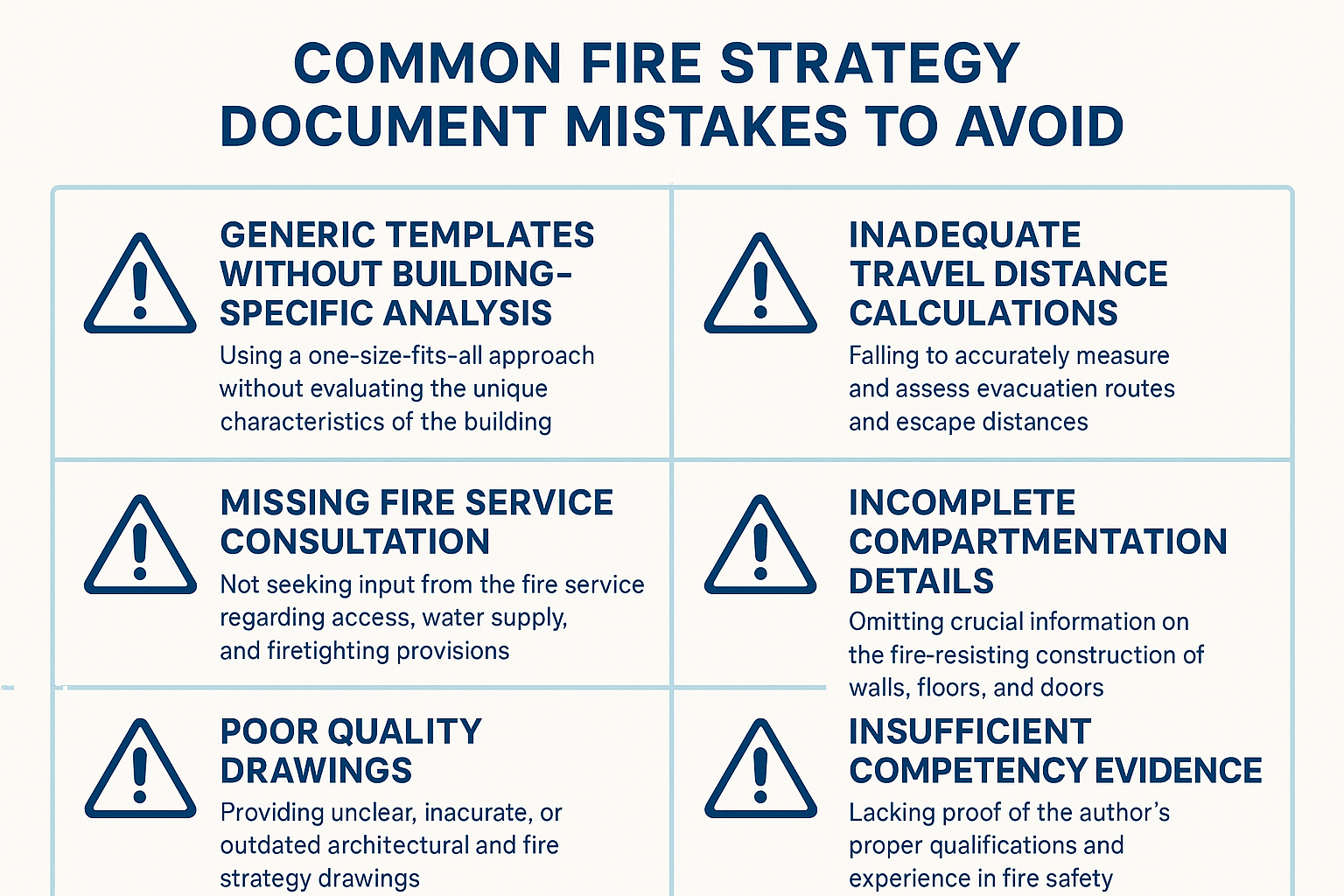
Common Mistakes to Avoid
Even with a comprehensive template, it’s easy to make mistakes that lead to rejection. Here are some of the most common pitfalls to avoid:
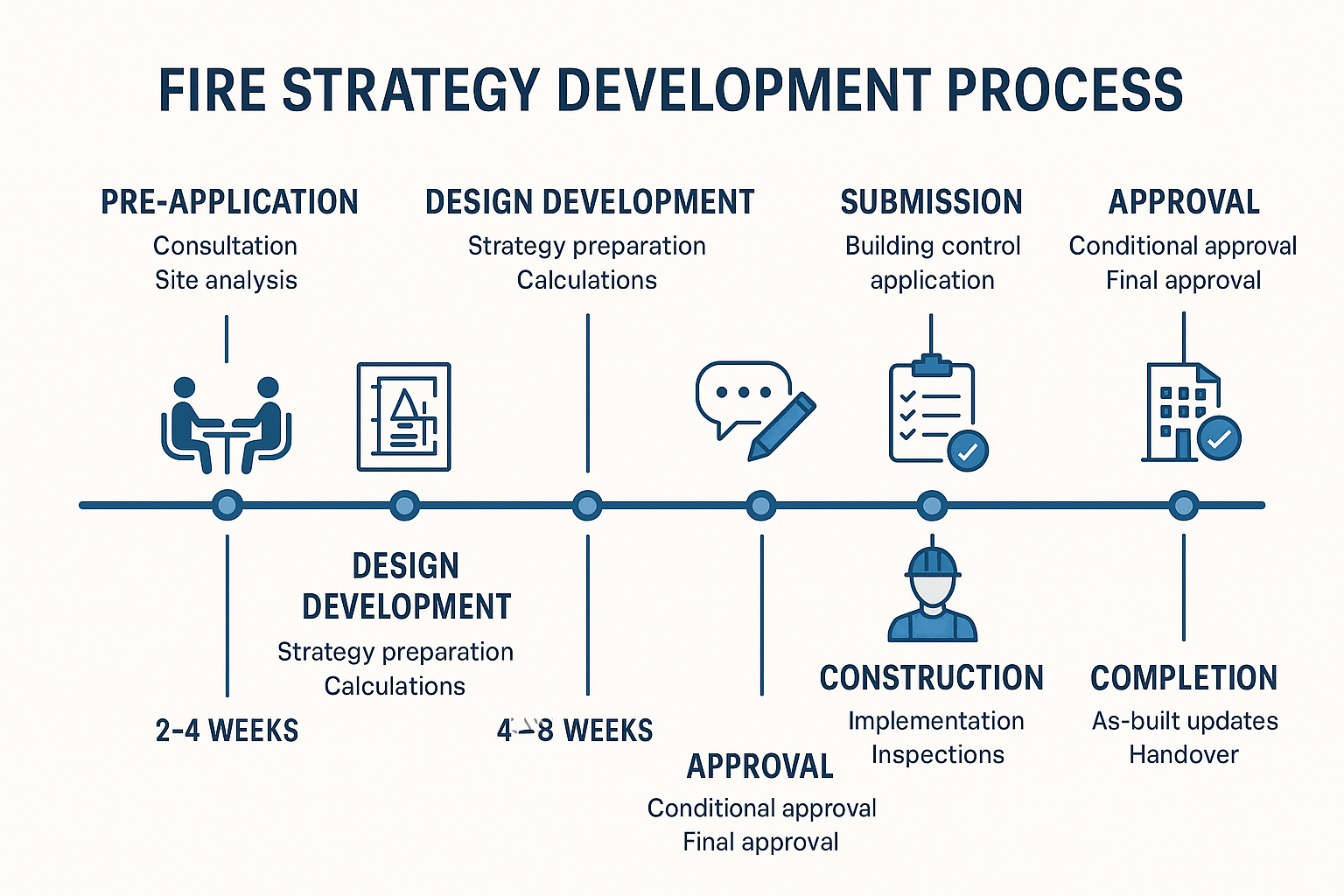
The Fire Strategy Development Process
Developing a fire strategy is a multi-stage process that should run parallel to your main design programme. Early engagement is key to avoiding costly late-stage changes.
Conclusion: Getting Your Fire Strategy Right
A comprehensive fire strategy document is your building’s safety blueprint. It demonstrates to building control, fire authorities, and future occupants that you’ve considered every aspect of fire safety in a rigorous, professional manner.
The 17 essential sections we’ve explored form the framework for a robust strategy that will achieve approval without expensive delays or revisions. From means of escape through compartmentation to ongoing management, each section plays a critical role in the complete safety picture.
Getting your fire strategy right the first time requires professional expertise, comprehensive information, and meticulous attention to detail. The cost of professional fire strategy services represents a small fraction of your total project budget but delivers enormous value through regulatory compliance, design optimization, and risk management.
Don’t leave fire strategy development to the last minute. Early engagement with fire safety professionals allows their expertise to inform and improve your design while changes are still relatively inexpensive. Late-stage fire safety interventions invariably cost more and deliver less value.
Your fire strategy is ultimately about protecting lives. While regulations and building control approval matter, the real measure of a successful strategy is whether it would genuinely keep people safe during a fire emergency. Professional fire engineers understand this responsibility and design with life safety as the paramount consideration.
Ready to develop a comprehensive fire strategy for your project? Contact our team for professional fire strategy services that deliver compliant, robust documentation tailored to your building’s unique requirements. We’ll guide you through the entire process from initial consultation through building control approval and beyond.
Our fire safety experts understand current regulations, building control expectations, and the technical details that make strategies successful. Whether you’re developing residential flats, commercial offices, mixed-use buildings, or specialist occupancies, we have the experience to create strategies that work.
Get in touch today to discuss your project requirements and receive a detailed quotation. Visit our fire strategy services page or contact us directly to start your project with confidence.