
Table of Contents
Table of Contents
A London landlord received a prohibition notice last month. His property management company had been using a generic fire risk assessment template downloaded from a free website three years ago. The document sat in a filing cabinet, never reviewed, never updated. When the fire service inspected following a tenant complaint, they found 14 fire safety deficiencies the template had completely missed. The remediation costs? Just over £47,000. The potential fine for non-compliance? Up to £150,000.
This scenario plays out across the UK every week. And with 2026 bringing the most significant changes to fire risk assessment requirements in nearly two decades, the stakes have never been higher.
Whether you manage a single HMO or oversee a portfolio of commercial properties, getting your fire risk assessment right is no longer just about ticking boxes. The new BS 8674:2025 competency framework, BS 9792:2025 housing methodology, and the April 2026 Residential PEEPs deadline have fundamentally changed what a “suitable and sufficient” fire risk assessment looks like.
In this guide, we’ll walk you through everything you need to know about fire risk assessment templates in 2026, including free downloadable templates that actually meet current legal requirements, not the outdated government versions that only cover “the simplest premises.”
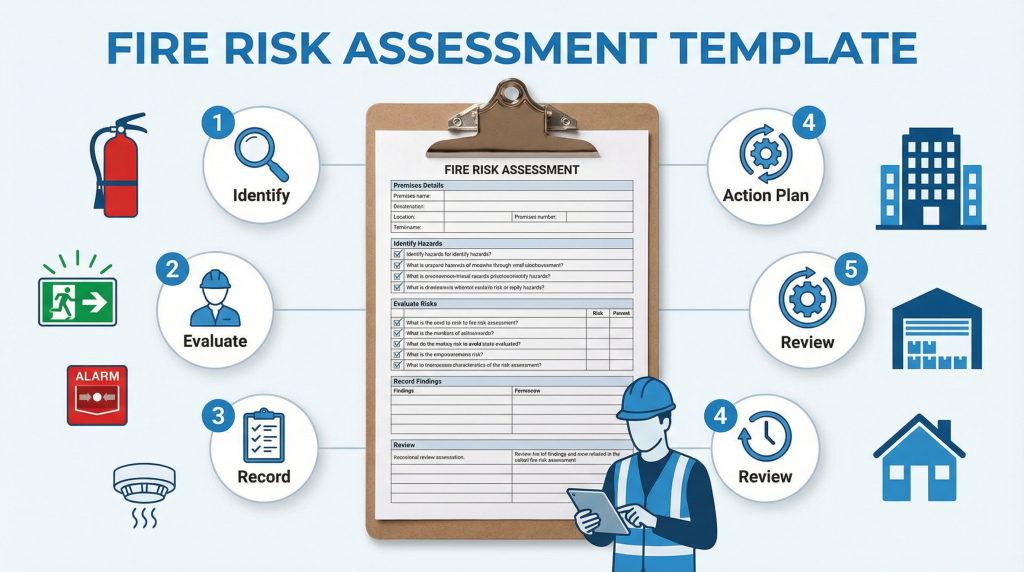
Free Fire Risk Assessment Template Download
Our fire risk assessment template has been updated for 2026 to include:
- All Section 156 recording requirements
- Fire door inspection checklists
- Resident information sections
- BS 8674:2025 aligned assessor documentation
- Action plan tracking with responsibility assignment
- Review scheduling with automatic reminders
The template includes:
- Fillable PDF format
- Editable Word document
- Guidance notes for each section
- Example completed assessment
- Supporting checklists
What is a Fire Risk Assessment?
A fire risk assessment is a systematic evaluation of your premises that identifies potential fire hazards, determines who might be at risk, and establishes measures to eliminate or reduce those risks. Under UK law, it must be recorded in writing, reviewed regularly, and kept up to date with any changes to the building or its use.
That’s the textbook definition. But here’s what it really means in practice:
A fire risk assessment is your legal proof that you’ve done everything reasonably practicable to prevent a fire from starting and to protect people if one does occur. It’s the document fire officers will ask for during an inspection. It’s what your insurance company will scrutinise if you make a claim. And it’s what prosecutors will examine if something goes wrong.

The assessment covers five main areas:
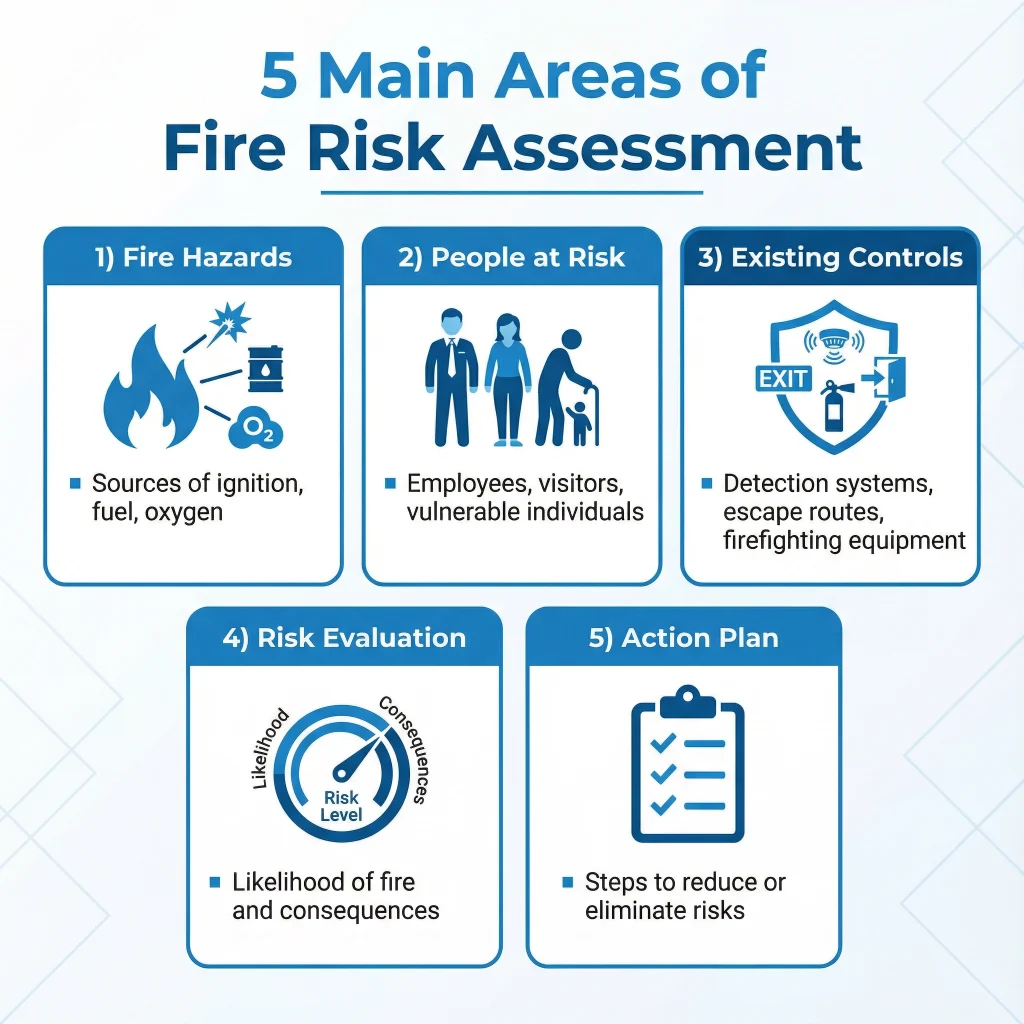
- Fire hazards – Sources of ignition, fuel, and oxygen
- People at risk – Employees, visitors, vulnerable individuals, neighbouring properties
- Existing controls – Detection systems, escape routes, firefighting equipment
- Risk evaluation – Likelihood of fire and potential consequences
- Action plan – Steps to reduce or eliminate identified risks
A proper fire risk assessment isn’t a one-time exercise. It’s a living document that evolves with your premises. Move a photocopier, change your storage arrangements, or take on a new tenant with mobility issues, and your assessment needs updating.
For more details on the process, see our guide on how to conduct a fire risk assessment.
Fire Risk Assessment Legal Requirements 2026
The legal framework for fire risk assessments has undergone substantial changes since the Grenfell Tower tragedy. If you’re still working from pre-2022 knowledge, you’re almost certainly missing critical compliance requirements.

The Regulatory Reform (Fire Safety) Order 2005
The foundation of UK fire safety law remains the Regulatory Reform (Fire Safety) Order 2005 (commonly called the Fire Safety Order or FSO). This legislation:
- Applies to virtually all non-domestic premises in England and Wales
- Creates the concept of the “Responsible Person” who holds legal accountability
- Requires a suitable and sufficient fire risk assessment
- Mandates appropriate fire safety measures based on that assessment
- Covers common areas of residential buildings (but not individual flats)
The Responsible Person is typically the employer, building owner, landlord, or managing agent. If you have any degree of control over premises, you could be a Responsible Person. For a detailed breakdown, read our guide on who is responsible for fire risk assessments.
Building Safety Act 2022 Changes
Section 156 of the Building Safety Act 2022 introduced several amendments

Full Written Recording Required
Previously, you only needed to record the “significant findings” of your fire risk assessment, and even then, only if you employed five or more people or were subject to a licence or alterations notice.
Now, all Responsible Persons must record their fire risk assessment in full, regardless of how many employees they have. This includes:
- All findings from the assessment (not just significant ones)
- The identity of anyone who assisted with the assessment
- Your fire safety arrangements
- Your name and UK-based address
Information Sharing Obligations
If your building contains two or more domestic premises, you must now provide residents with:
- Risks identified in the fire risk assessment
- Fire safety measures in place
- Your name and UK address as Responsible Person
- Identity of anyone who helped complete the assessment
- Information about competent persons nominated for firefighting measures
Cooperation Between Responsible Persons
Where multiple Responsible Persons share duties for the same premises (common in mixed-use buildings), there’s now a legal requirement to:
- Take reasonable steps to identify other Responsible Persons
- Share your name and UK address with them
- Inform each other of your respective responsibilities
- Keep records of this information sharing
Handover Requirements
When you cease to be a Responsible Person, you must share all relevant fire safety information with your successor, including the complete fire risk assessment, assessor details, and any information received under Building Regulations.
Fire Safety (England) Regulations 2022
These regulations added specific requirements for residential buildings with two or more domestic premises:
Quarterly Fire Door Checks
For buildings 11 metres or more in height, the Responsible Person must:
- Check all fire doors in common areas at least every three months
- Check flat entrance doors annually (as far as reasonably practicable)
- Keep records of these checks
Floor Plans and Wayfinding
Buildings 18 metres or more must have:
- Floor plans for each floor showing escape routes
- Wayfinding signage in stairways
- Secure information boxes containing building plans
Resident Information
All residential buildings in scope must provide residents with fire safety instructions, including:
- The building’s evacuation strategy
- How to report a fire
- Importance of fire doors
For the complete legal picture, visit our fire risk assessment legal requirements page and learn about fire risk assessment steps.
What’s New in 2026?
Three major developments are reshaping fire risk assessment practice this year:
BS 8674:2025 – Fire Risk Assessor Competency Framework
Published in August 2025, this British Standard establishes a formal competency framework for fire risk assessors across three levels: Foundation, Intermediate, and Advanced. While Section 156(4) of the Building Safety Act already requires that anyone appointed to complete a fire risk assessment must be “competent,” BS 8674 now defines what competence actually looks like.

The government has stated its intention to mandate competency requirements for fire risk assessors, and BAFE has already updated its SP205 certification scheme to align with BS 8674.
BS 9792:2025 – Housing Fire Risk Assessment Code of Practice
This new standard replaces PAS 79-2:2020 and provides a structured methodology specifically for housing fire risk assessments. It offers a risk-proportionate approach to assessing fire risks in residential settings and is particularly relevant for:
- HMOs (Houses in Multiple Occupation)
- Purpose-built blocks of flats
- Converted residential buildings
- Sheltered housing and extra care schemes
Residential PEEPs – April 6, 2026 Deadline
The Fire Safety (Residential Evacuation Plans) (England) Regulations 2025 come into force on 6 April 2026.

This applies to:
- All high-rise residential buildings (18m+ or 7+ storeys)
- Multi-residential buildings over 11m with simultaneous evacuation strategies
The 5 Steps of Fire Risk Assessment
The Health and Safety Executive and fire service guidance both follow a five-step approach to fire risk assessment. Here’s how each step works in practice:
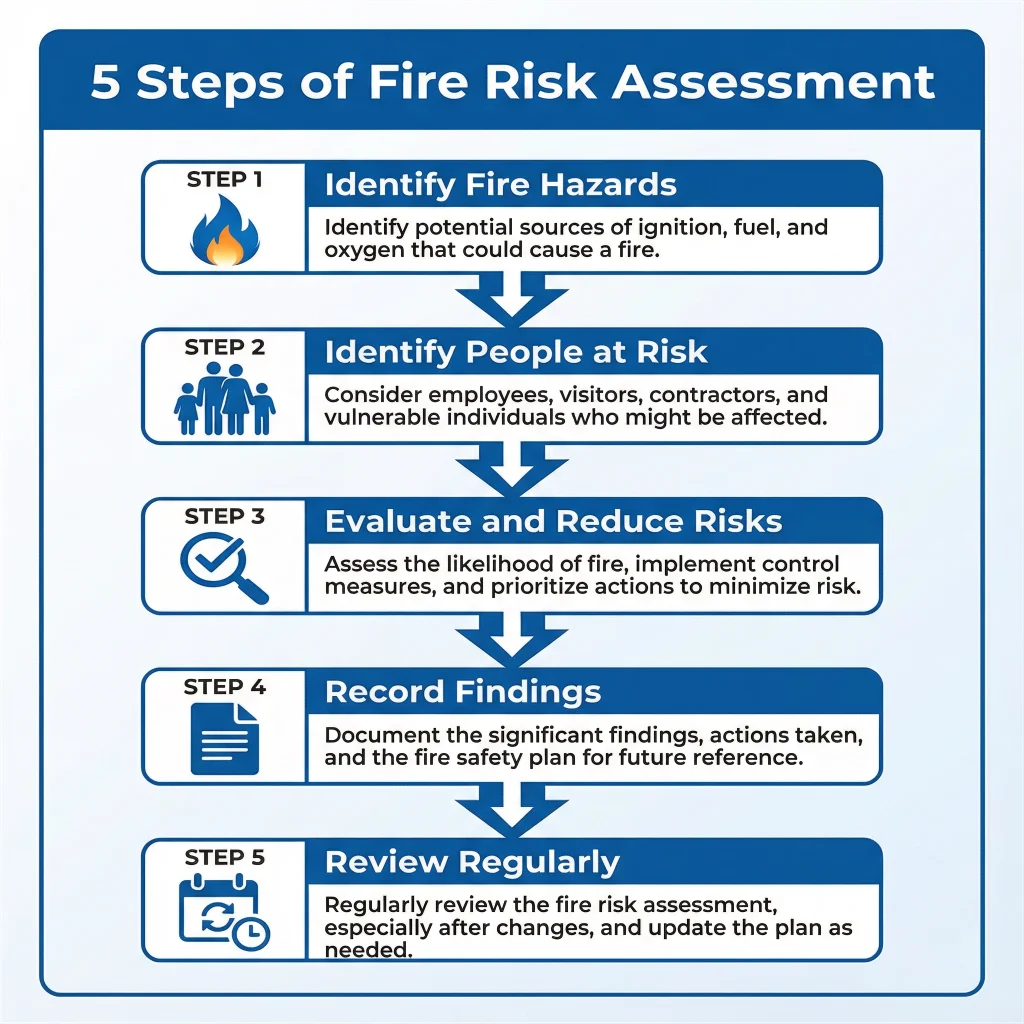
Step 1: Identify Fire Hazards
Fire needs three elements: ignition sources, fuel, and oxygen.

Common Ignition Sources:
- Electrical equipment (especially older items or those used incorrectly)
- Heating systems and portable heaters
- Cooking equipment
- Smoking materials
- Arson (deliberate fire-setting)
- Hot work activities (welding, grinding)
- Lighting equipment
- Friction from machinery
Common Fuel Sources:
- Paper, cardboard, packaging materials
- Textiles (curtains, bedding, upholstery)
- Flammable liquids and gases
- Wood and timber
- Plastics
- Waste materials
- Building materials (some insulation, cladding)
Oxygen Sources:
- Normal atmospheric air
- Mechanical ventilation systems
- Air conditioning
- Medical oxygen supplies
- Oxidising chemicals
Walk through your premises systematically. Don’t just look at the obvious. Check storage areas, plant rooms, roof spaces, and external bin stores. Consider what happens outside normal working hours.
Step 2: Identify People at Risk
Not everyone faces the same level of risk. You need to consider:
People in your premises:
- Employees and their locations throughout the day
- Visitors, customers, clients
- Contractors working on site
- Children and young people
- Elderly individuals
- People with disabilities (mobility, sensory, cognitive)
- Pregnant women
- People unfamiliar with the premises
People near your premises:
- Occupants of neighbouring buildings
- Members of the public passing by
- People in shared escape routes
People at particular risk:
- Those working alone or in isolated areas
- Night workers or shift workers
- People in basement or upper floor locations
- Anyone who might be sleeping on the premises
For residential buildings, the new Residential PEEPs regulations require specific identification of “relevant residents” who would have difficulty evacuating without assistance.
Step 3: Evaluate, Remove, Reduce, and Protect
This step involves three activities:
Evaluate the Risk
For each hazard, consider:
- How likely is a fire to start?
- If it did start, how quickly would it spread?
- How serious would the consequences be?
Use a simple risk matrix combining likelihood (unlikely, possible, likely) with severity (slight harm, moderate harm, serious harm) to prioritise your actions.
Remove or Reduce Hazards
The best approach is eliminating the hazard entirely:
- Replace paper files with digital storage
- Switch to safer heating methods
- Remove unnecessary combustible materials
- Implement strict smoking policies
Where removal isn’t possible, reduce the risk:
- Store flammable materials in appropriate containers
- Keep quantities to the minimum needed
- Separate ignition sources from fuel
- Install appropriate electrical equipment
Protect People
Provide appropriate protection through:
- Detection and warning – Smoke detectors, heat detectors, fire alarm systems appropriate to your premises. See our fire alarm testing services.
- Escape routes – Clearly marked, adequately lit, kept clear at all times. Enough exits for the number of occupants. Protected stairways in multi-storey buildings.
- Emergency lighting – To illuminate escape routes if normal lighting fails. Our emergency light testing ensures compliance.
- Firefighting equipment – Appropriate extinguishers for the types of fire risk present. Regular fire extinguisher testing is required.
- Fire doors – Properly installed, maintained, and kept closed. Fire door surveying identifies defects before they become dangerous.
- Staff training – Fire awareness, evacuation procedures, use of firefighting equipment.
Step 4: Record, Plan, and Train
Record Your Findings
Under Section 156 of the Building Safety Act, you must now record your fire risk assessment in full. This includes:
- All hazards identified
- People at risk
- Existing fire safety measures
- Further actions needed
- Who is responsible for each action
- Target completion dates
- The assessor’s identity and qualifications
Use a structured template to ensure you capture everything. The Firerisk.io template includes all required sections and prompts.
Create an Emergency Plan
Your emergency plan should cover:
- Action on discovering a fire
- How to raise the alarm
- Calling the fire service
- Evacuation procedures
- Assembly points
- Procedures for checking everyone is out
- Liaison with fire service on arrival
- Duties of specific staff (fire wardens, etc.)
Train Your Staff
Everyone needs to know:
- What to do if they discover a fire
- How to raise the alarm
- How to evacuate the building
- Location of assembly points
- Their specific responsibilities
Fire wardens and those with additional responsibilities need more detailed training.
Step 5: Review and Update
A fire risk assessment isn’t a one-time exercise. You must review it:
Regularly – At least annually for most premises, more frequently for higher-risk buildings
After significant changes:
- Building alterations or extensions
- Changes in use or layout
- New processes or materials introduced
- Changes in occupancy numbers
- After a fire or near miss
- When new legislation comes into force
When it’s no longer valid:
- If you discover the original assessment was flawed
- If circumstances have changed significantly
- If recommended actions haven’t been completed
For guidance on review frequency, see our article on how often should fire risk assessments be reviewed.
Our step-by-step guide provides more detail: fire risk assessment steps.
Fire Risk Assessor Competency Requirements 2026
The competency of whoever conducts your fire risk assessment has never been more important. With BS 8674:2025 now published and government legislation expected, understanding what “competent” actually means is critical.
BS 8674:2025 Competency Framework
Published by the British Standards Institution in August 2025, BS 8674 establishes a framework for fire risk assessor competence across three levels:
Foundation Level
Fire risk assessors at Foundation level can assess:
- Simple premises with straightforward fire risks
- Single-storey buildings with simple layouts
- Premises with limited sleeping accommodation risks
- Buildings where the fire risk assessment is relatively uncomplicated
Foundation assessors should not work on:
- Complex multi-storey buildings
- Premises with sleeping risks
- Buildings with complex means of escape
- Properties with unusual construction or high-risk activities
Intermediate Level
Intermediate assessors can handle:
- More complex premises and building types
- Multi-storey buildings with standard layouts
- Hotels, care homes, and other sleeping accommodation (with appropriate experience)
- Buildings requiring more sophisticated fire safety solutions
Advanced Level
Advanced assessors are qualified for:
- The most complex premises and situations
- High-rise residential buildings
- Buildings with complex compartmentation
- Premises requiring specialist fire engineering solutions
- Buildings where previous assessments have proved inadequate
The framework emphasises that fire risk assessors must never work beyond their competence level. An assessor qualified for simple offices shouldn’t be assessing a 20-storey residential tower.
How to Verify Assessor Credentials
When appointing a fire risk assessor, verify their competence through:
Third-Party Certification – Look for BAFE SP205 certification from a UKAS-accredited body. BAFE has updated SP205 Version 6 to align with BS 8674:2025. Check the BAFE register at bafe.org.uk.
Qualifications – Assessors should hold regulated qualifications from bodies like FireQual, mapped to Foundation, Intermediate, or Advanced competency levels.
Experience – Request evidence of experience with your building type and knowledge of relevant regulations.
Professional Memberships – Look for Institution of Fire Engineers (IFE) membership or Fire Risk Assessors Association affiliation.
Insurance – Professional indemnity insurance protects you if the assessor makes errors.
At Firerisk.io, all our assessors are BAFE registered, UKAS accredited, and IFE members, with 25+ years of combined experience.
DIY vs Professional Assessment
Can you do your own fire risk assessment? Legally, yes. The Responsible Person can complete the assessment themselves if they have the necessary competence.
For simple premises, a competent manager might handle the assessment using appropriate guidance. The government’s fire safety risk assessment guides cover basic premises.
However, consider professional help when:
- Your premises are complex or unusual
- People sleep in the building
- You’re unsure about fire safety requirements
- You want independent verification
- Previous assessments have been challenged
- You need specialist advice on remediation
A professional assessment from Firerisk.io starts at just £79. Given the potential fines for non-compliance (unlimited for some offences), professional assessment often makes financial sense.
See our fire risk assessment cost guide for detailed pricing information, or use our cost and timeline calculator for an instant estimate.
Fire Risk Assessment Templates by Building Type
Different premises require different assessment approaches. Here’s what matters for common building types:
Office Buildings

Offices typically present moderate fire risks, but don’t underestimate them. Key considerations:
- Electrical equipment density (computers, servers, printers)
- Kitchen and break room facilities
- Storage of paper and office supplies
- Accessibility for all employees
- Visitor management and evacuation
- Out-of-hours working
For office-specific guidance, see our office fire risk assessment service page.
Houses in Multiple Occupation (HMOs)

HMOs require particularly careful assessment because of:
- Multiple households sharing facilities
- Varied occupancy patterns (day/night)
- Potential for locked bedroom doors
- Cooking in individual rooms (sometimes illegally)
- Higher fire risk demographics (students, low-income renters)
- Landlord licensing requirements
HMO fire safety is heavily regulated. Most local authorities require specific fire safety standards for HMO licensing. See our HMO fire risk assessment guide.
Care Homes

Care homes combine sleeping accommodation with vulnerable residents, creating significant fire risk management challenges:
- Residents with mobility difficulties
- Residents with cognitive impairments
- Complex evacuation requirements
- Night-time staffing levels
- Medical oxygen and other healthcare equipment
- Laundry and kitchen facilities
The new Residential PEEPs regulations will significantly impact care homes from April 2026. Our care home fire risk assessment specialists understand these specific requirements, including PEEP fire safety obligations.
Hotels and Guest Houses

Hotels present unique challenges:
- Transient population unfamiliar with the building
- 24-hour operation
- Multiple escape routes and staircases
- Kitchen and restaurant facilities
- Laundry operations
- Guest room fire risks
Read more about hotel fire risk assessment requirements.
Warehouses and Industrial Premises

Industrial premises often have higher fire loads:
- Storage of flammable materials
- Manufacturing processes
- Large open spaces affecting fire spread
- High racking affecting sprinkler effectiveness
- Limited staffing in some areas
- Vehicle movements and charging
Our warehouse fire risk assessment service addresses these specific risks.
Schools and Educational Buildings

Schools must protect children who may not respond appropriately to fire emergencies:
- Large numbers of children
- Varied age groups with different capabilities
- Science labs with chemical hazards
- Kitchen facilities
- Drama and art departments
- After-hours community use
See our school fire risk assessment information.
High-Rise Residential Buildings

High-rise buildings face the most stringent requirements:
- Building Safety Act obligations
- External wall and cladding assessments
- Fire door inspection requirements
- Evacuation strategy considerations
- Secure information boxes
- Resident information requirements
- Residential PEEPs from April 2026
Our high-rise fire risk assessment team specialises in these complex buildings. Understanding fire risk assessment costs for high-rise buildings is important for budgeting.
Firerisk.io Template vs GOV.UK Template: Direct Comparison
Many Responsible Persons start with the free government templates. Here’s how they compare to a professional template:
| Feature | GOV.UK Template | Firerisk.io Template |
|---|---|---|
| Scope | “Simplest premises” only | All building types |
| 2025-2026 Legislation | Not included | Full coverage of BS 8674, BS 9792, Residential PEEPs |
| Section 156 Requirements | Not addressed | Full documentation sections |
| Competency Framework | Not referenced | BS 8674 aligned |
| Housing Methodology | Separate document | Integrated BS 9792:2025 approach |
| PEEPs Integration | Not included | Person-centred assessment sections |
| Building Types | Generic only | Type-specific versions available |
| Fire Door Checks | Not included | Quarterly check templates |
| Resident Information | Not included | Information sharing templates |
| Action Plan Tracking | Basic | Detailed with responsibility assignment |
| Review Scheduling | Manual | Built-in review reminders |
| Legal Updates | Infrequent | Regularly updated |
| Support | None | Phone and email support |
The government templates were last substantially updated before the Building Safety Act changes. They explicitly state they cover only “the simplest premises” and recommend professional help for anything more complex.
Housing Fire Risk Assessments: BS 9792:2025
The publication of BS 9792:2025 marks a significant development for housing fire risk assessments. This new British Standard replaces PAS 79-2:2020 and provides updated methodology specifically designed for residential settings.
What BS 9792:2025 Covers
The standard applies to fire risk assessments in:
- Purpose-built blocks of flats
- Converted residential buildings
- Houses in Multiple Occupation
- Sheltered housing
- Extra care housing
- Student accommodation
- Other residential buildings
Key Changes from PAS 79-2:2020
BS 9792:2025 brings several updates:

Risk-Proportionate Approach
The standard emphasises proportionate assessment based on building characteristics and resident vulnerability. A simple two-storey converted house doesn’t need the same assessment depth as a 15-storey tower block.
Integration with Building Safety Act Requirements
BS 9792:2025 aligns with the new legal requirements introduced by Section 156 of the Building Safety Act, including full recording requirements and information sharing obligations.
Consideration of External Walls – Following the Fire Safety Act 2021 amendments, the standard addresses assessment of external walls, cladding, balconies, and windows in scope.
Fire Door Assessment – The standard incorporates guidance on fire door inspection requirements introduced by the Fire Safety (England) Regulations 2022.
Person-Centred Considerations – With Residential PEEPs coming into force in April 2026, BS 9792:2025 addresses how fire risk assessors should consider residents who may have difficulty evacuating.
Implications for Responsible Persons
If you’re responsible for housing fire risk assessments, BS 9792:2025 means:
- Existing assessments should be reviewed against the new standard
- Assessors should demonstrate familiarity with BS 9792:2025 methodology
- Documentation should follow the standard’s recommended format
- Review cycles should incorporate the standard’s guidance
Vulcan Fire Training and other providers have already developed example templates aligned with BS 9792:2025.
Residential PEEPs: April 2026 Deadline
The Fire Safety (Residential Evacuation Plans) (England) Regulations 2025 come into force on 6 April 2026.

This is a firm deadline with no transition period announced.
Buildings in Scope
The regulations apply to:
All high-rise residential buildings:
- 18 metres or more above ground level, OR
- 7 or more storeys
- Containing two or more domestic premises
Multi-residential buildings over 11m with simultaneous evacuation:
- More than 11 metres above ground level
- Two or more domestic premises
- Operating a simultaneous evacuation strategy
What Responsible Persons Must Do
Identify Relevant Residents
Use reasonable endeavours to identify residents who would have difficulty evacuating without assistance. This might be due to:
- Physical mobility issues
- Sight or hearing impairment
- Cognitive conditions
- Any other disability affecting evacuation capability
Conduct Person-Centred Fire Risk Assessments (PCFRAs)
For each relevant resident who agrees to participate, conduct an assessment covering:

- Risks arising from their compromised evacuation ability
- Other fire safety risks given their impairment
- Potential mitigating measures
- What they should do in the event of fire
Implement Reasonable and Proportionate Measures
Put in place measures identified through the PCFRA, considering:
- Feasibility and practicality
- Cost and who bears it
- Benefit to the resident and others
- Impact on other residents’ rights
Create Emergency Evacuation Statements
Document what each relevant resident has agreed to do in the event of fire. Provide them with a copy.
Share Information with Fire and Rescue Authority
With the resident’s explicit consent, share:
- Flat number
- Floor number
- Basic information on assistance required
- Whether they have an emergency evacuation statement
Prepare Building Emergency Evacuation Plans
Create a plan including:
- Copy of resident fire safety instructions
- Whether there are relevant residents in the building
- Information on other evacuation arrangements
Timeline for Compliance
Now:
- Review which buildings fall within scope
- Assess current resident engagement processes
- Budget for any measures required
Q1 2026:
- Begin identifying relevant residents
- Train staff on PCFRA processes
- Establish information sharing protocols with local FRS
By 6 April 2026:

Costs and Funding
For social housing providers, government has established the Residential PEEPs Social Housing Fund to support implementation. Costs should not fall to social housing renters.
For private sector buildings, costs will typically fall to:
- The Responsible Person (building owner/manager)
- All residents via service charges (where measures benefit the majority)
- Individual relevant residents (for measures benefiting only them)
Residents may challenge unreasonable service charge costs through the First-tier Tribunal (Property Chamber).
For detailed PEEP guidance, see our PEEP fire safety page.
How to Complete a Fire Risk Assessment
Here’s a practical walkthrough of completing a fire risk assessment using a proper template:
Before You Start
Gather building plans, previous assessments, maintenance records, and incident reports. Prepare your equipment: clipboard, torch, camera, and tape measure. Schedule time when you can access all areas and notify occupants.
During the Assessment
Walk the building systematically from entrance to roof:
- External areas – Bin stores, car parks, perimeter
- Ground floor – Reception, common areas, all rooms
- Upper floors – Each floor in turn
- Plant rooms – Boiler rooms, electrical intake
- Escape routes – All stairs, corridors, exits
At each location, identify ignition and fuel sources, note who’s present, assess existing measures, and photograph any issues. Talk to occupants about concerns and evacuation understanding.
Completing the Template
Your template should capture nine key sections:
- Premises Information – Address, description, layout, occupancy
- Responsible Person Details – Name, UK address, contact details
- Assessor Details – Name, qualifications, certification, date
- Fire Hazard Identification – Ignition sources, fuel, hazardous processes
- People at Risk – Categories, numbers, those needing assistance
- Existing Fire Safety Measures – Detection, lighting, equipment, escape routes, fire doors, training
- Risk Evaluation – Overall risk level, high-risk areas, consequences
- Action Plan – Actions, priorities, responsibility, deadlines
- Review Schedule – Next review date, triggers, interim checks
After the Assessment
Finalise documentation with photographs and supporting documents. Brief the Responsible Person and share relevant information with other duty holders and residents. Assign responsibility for actions and track progress to completion. Set calendar reminders for the next review.
Fire Risk Assessment Documentation Requirements
Under Section 156 of the Building Safety Act, your documentation must include:
What Must Be Recorded:
- The complete fire risk assessment (all findings, not just significant ones)
- Assessor identity, organisation, and qualifications
- Responsible Person’s full name and UK address
- Fire safety arrangements (maintenance schedules, training, emergency procedures)
Information Sharing Requirements:
| Share With | Information Required |
|---|---|
| Other Responsible Persons | Your name, UK address, extent of responsibilities |
| Residents (2+ dwellings) | Risks identified, safety measures, RP and assessor identity |
| Incoming Responsible Persons | Complete assessment, review records, assessor details, other RP contacts |
Record Retention: Keep current assessments readily accessible, retain previous assessments for at least 6 years, and maintain indefinitely for buildings with serious incidents.
Format: Records must be in writing (electronic or paper), legible, and readily accessible to enforcement officers.
Common Fire Risk Assessment Mistakes
After 25 years in fire safety, these are the mistakes that cause the most problems:

| Mistake | Consequence | Solution |
|---|---|---|
| Using outdated templates | Missing Section 156 requirements, enforcement action | Use 2026-compliant templates with fire door and resident sections |
| Treating it as one-time | Assessment becomes invalid, discrepancies found | Schedule regular reviews, update after changes |
| Missing common parts | Non-compliance with Fire Safety Order | Cover all staircases, corridors, plant rooms, external areas |
| Inadequate fire door checks | Doors fail in fire, false confidence | Quarterly checks for 11m+ buildings, consider fire door surveying |
| Not identifying all at risk | Evacuation plans fail, PEEPs non-compliance | Systematically identify all building users including vulnerable |
| Generic action plans | Actions never completed | Specify who, what, when, and how for every action |
| Ignoring external risks | External fires spread to buildings | Assess bin stores, vegetation, external walls |
| No assessor competence record | Section 156 non-compliance | Record full name, organisation, qualifications, certification |
| DIY on complex buildings | Missing risks, liability | Engage professionals for sleeping accommodation or high-risk premises |
Fire Risk Assessment Costs UK 2026
Costs vary based on building size, type, complexity, existing documentation, and assessor qualifications. BAFE-registered assessors charge more but provide legally defensible assessments.
Typical Costs by Building Type

| Building Type | Size/Complexity | Typical Cost Range |
|---|---|---|
| Small office | Under 500 sqm | £79 – £150 |
| Medium office | 500-2000 sqm | £150 – £350 |
| Large office | Over 2000 sqm | £350 – £750+ |
| Small HMO | 3-4 bedrooms | £99 – £180 |
| Large HMO | 5+ bedrooms | £180 – £350 |
| Purpose-built flats | Per block | £200 – £600+ |
| Care home | 20-40 beds | £350 – £750 |
| Care home | 40+ beds | £750 – £1,500+ |
| Hotel | Under 50 rooms | £300 – £600 |
| Hotel | 50+ rooms | £600 – £1,500+ |
| Warehouse | Under 1000 sqm | £150 – £300 |
| Warehouse | Over 1000 sqm | £300 – £750+ |
| School | Primary | £250 – £500 |
| School | Secondary | £500 – £1,000+ |
| High-rise residential | Per block | £500 – £2,000+ |
At Firerisk.io, our professional fire risk assessments start from just £79 for simple premises. Get an instant quote using our cost and timeline calculator.
What’s Included
A professional assessment should include:
- Site visit and full assessment
- Comprehensive written report
- Action plan with priorities
- Compliance recommendations
- Assessor certification details
- Digital and paper copies
- Support answering questions
Hidden Costs to Avoid
Unqualified Assessors
Cheap assessments from unqualified individuals may need redoing. If enforcement action follows, you can’t claim you relied on professional advice.
Template-Only Services
Some providers sell templates without assessment. A template is useless without competent completion.
Incomplete Assessments
Assessments that don’t cover all areas or all requirements create false confidence and potential liability.
Return on Investment
Consider the cost of fire risk assessment against:

- Fines for non-compliance: Up to £150,000+ (unlimited for some offences)
- Prohibition notice costs: Loss of use of premises until compliant
- Insurance implications: Policies may be voided if non-compliant
- Fire damage: Average commercial fire claim exceeds £50,000
- Reputational damage: Particularly significant for hospitality and care sectors
A £200 assessment is excellent value against these potential costs.
For detailed pricing information, see our fire risk assessment cost guide.
Fire Risk Assessment Review Frequency
How often should you review your fire risk assessment? Here’s guidance based on building type and risk level:
| Building Type | Minimum Review Frequency | Notes |
|---|---|---|
| Offices (simple) | Every 2-3 years | Sooner if changes occur |
| Offices (complex) | Annually | Multiple floors, high occupancy |
| HMOs | Annually | Tenant turnover requires regular review |
| Care homes | Annually | Or more frequently due to resident changes |
| Hotels | Annually | Seasonal variations may require interim checks |
| Schools | Annually | Before start of academic year |
| Hospitals | 6-12 months | High vulnerability, complex premises |
| Warehouses | Annually | Or when stock/processes change |
| High-rise residential | Annually | Statutory requirements may mandate more |
| Industrial | 6-12 months | Depends on hazard level |
Triggers for Immediate Review
Review your assessment immediately when:
- There’s been a fire or near miss
- Building work or alterations occur
- Use of the building changes
- New processes or materials are introduced
- Staffing levels change significantly
- Vulnerable occupants are identified
- Enforcement action is taken
- New legislation comes into force
- You become aware the assessment is inadequate
For complete guidance, see how often should fire risk assessments be reviewed.
Fire Risk Assessment FAQ
General Questions
What is a fire risk assessment template?
A fire risk assessment template is a structured document that guides you through the process of identifying fire hazards, evaluating risks, and recording your findings. It ensures you cover all required elements and meet legal documentation requirements. A good template includes sections for building details, hazard identification, people at risk, existing controls, risk evaluation, action planning, and review scheduling.
Is a fire risk assessment a legal requirement?
Yes. Under the Regulatory Reform (Fire Safety) Order 2005, anyone responsible for non-domestic premises (including common areas of residential buildings) must complete a suitable and sufficient fire risk assessment. Since October 2023, Section 156 of the Building Safety Act 2022 requires all fire risk assessments to be recorded in full, regardless of the number of employees.
Who can complete a fire risk assessment?
The Responsible Person can complete the assessment themselves if they have sufficient competence. However, for complex premises, it’s advisable to engage a competent fire risk assessor. Under Section 156(4) of the Building Safety Act (not yet in force), anyone appointed to complete an assessment must be competent. BS 8674:2025 provides a framework for assessor competence across Foundation, Intermediate, and Advanced levels.
How long does a fire risk assessment take?
For simple premises, an experienced assessor might complete an assessment in 1-2 hours. Complex buildings can take a full day or longer. The time depends on building size, complexity, number of floors, variety of uses, and accessibility of all areas. Writing up the report typically takes additional time beyond the site visit.
How much does a fire risk assessment cost?
Costs vary based on building type and size. Simple assessments start from around £79. Complex care homes or high-rise buildings might cost £1,000 or more. Firerisk.io offers professional assessments starting at £79. Use our cost calculator for an instant estimate.
Legal and Compliance Questions
What happens if I don’t have a fire risk assessment?
Failing to complete a fire risk assessment is a criminal offence. Penalties include fines (unlimited for most offences), prohibition notices preventing use of the building, and potential imprisonment for serious breaches. Additionally, insurance may be invalidated, and you could face civil liability if someone is injured.
What are the penalties for non-compliance?
Under Article 32 of the Fire Safety Order, most offences carry unlimited fines. Serious breaches, particularly those putting people at risk, can result in imprisonment for up to two years. Since Section 156 increased some fine levels, even offences like failing to provide information to inspectors now carry unlimited fines.
Do I need a fire risk assessment for a rented flat?
Individual flats (domestic premises) are not directly covered by the Fire Safety Order. However, the common parts of any building with two or more flats require assessment. As the leaseholder or tenant of a flat, you should ensure your landlord or managing agent has completed the required assessment for the building.
Does the assessment cover the inside of flats?
No. The Fire Safety Order covers common parts only. However, the Fire Safety Act 2021 brought flat entrance doors into scope for the purpose of assessing the building’s compartmentation. The Responsible Person can inspect these doors (externally) as part of building safety. The Residential PEEPs regulations (from April 2026) will require consideration of relevant residents’ specific needs, which may involve discussions about in-flat measures, but this is with consent.
Template and Documentation Questions
What should a fire risk assessment template include?
A compliant template for 2026 should include:
- Building and premises details
- Responsible Person information (name and UK address)
- Assessor details and qualifications
- Fire hazard identification sections
- People at risk identification
- Existing fire safety measures evaluation
- Risk rating methodology
- Action plan with responsibilities and dates
- Review schedule
- Sections for fire door assessments (where applicable)
- Resident information sections (residential buildings)
Can I use a free government template?
The government provides fire safety risk assessment guides with basic templates, but these explicitly cover only “the simplest premises.” They don’t address 2025-2026 legislative changes, Section 156 requirements, BS 8674 competency framework, or Residential PEEPs. For most buildings, you’ll need a more comprehensive template.
How long should I keep fire risk assessment records?
There’s no statutory retention period. Best practice is to keep the current assessment readily accessible, retain previous assessments for at least 6 years (aligning with limitation periods for civil claims), and keep records indefinitely for buildings where serious incidents have occurred.
Do I need to share my fire risk assessment with anyone?
Yes. For residential buildings with two or more dwellings, you must share relevant information with residents and other Responsible Persons. Fire and rescue authorities can request copies during inspections. You must share all relevant information with any incoming Responsible Person when you transfer responsibilities.
Review and Update Questions
How often must I review my fire risk assessment?
There’s no single legal requirement for review frequency. The assessment must remain “suitable and sufficient,” which typically means annual review for most premises, more frequent for high-risk buildings, and immediate review after significant changes, incidents, or new legislation. See the review frequency table above.
What changes trigger an immediate review?
- Building alterations or extensions
- Change of use or layout
- Fire or near-miss incident
- Enforcement action
- Identification of new vulnerable occupants
- Introduction of new hazardous processes
- New legislation coming into force
- Discovery that the assessment is inadequate
Can I update my existing assessment or do I need a new one?
If changes are minor, you can update the existing assessment with clear records of what changed and when. For significant changes, or after several years, a fresh assessment is advisable. A competent assessor can advise whether an update or new assessment is appropriate.
Specific Building Type Questions
What’s different about HMO fire risk assessments?
HMOs present specific challenges including shared facilities, locked bedroom doors, cooking in bedrooms, and tenant turnover. Most local authority licensing schemes have specific fire safety requirements that must be addressed. See our HMO fire risk assessment guide.
Do I need a specialist for care home assessments?
Care homes combine sleeping accommodation with vulnerable residents, making them high-complexity premises. An assessor needs experience with care settings and understanding of evacuation challenges for residents with mobility or cognitive difficulties. The new Residential PEEPs requirements add further complexity from April 2026. Our care home fire risk assessment specialists have specific expertise.
What additional requirements apply to high-rise buildings?
High-rise residential buildings (18m+ or 7+ storeys) face additional requirements including:
- External wall and cladding assessment
- Quarterly fire door checks (common areas)
- Annual flat entrance door checks
- Secure information boxes with building plans
- Information to residents
- Residential PEEPs requirements from April 2026
- Potential Building Safety Act accountable person duties
2026-Specific Questions
What is BS 8674:2025 and how does it affect me?
BS 8674:2025 is the new British Standard establishing competency requirements for fire risk assessors across Foundation, Intermediate, and Advanced levels. While appointing a competent assessor is already legally required, this standard defines what competence means. When engaging an assessor, look for BAFE registration and certification aligned with BS 8674.
What is BS 9792:2025?
BS 9792:2025 is the new code of practice for fire risk assessments in housing, replacing PAS 79-2:2020. It provides a structured, risk-proportionate methodology specifically for residential buildings and aligns with Building Safety Act requirements.
What are Residential PEEPs and when do they apply?
Residential PEEPs (Personal Emergency Evacuation Plans) become mandatory from 6 April 2026 for high-rise residential buildings (18m+/7+ storeys) and multi-residential buildings over 11m with simultaneous evacuation strategies. Responsible Persons must identify residents who need assistance evacuating, conduct person-centred fire risk assessments, and share information with fire services.
What should I do now to prepare for April 2026?
- Determine if your buildings fall within scope of Residential PEEPs
- Review your current resident engagement processes
- Plan how you’ll identify “relevant residents”
- Consider training needs for person-centred assessments
- Budget for any measures that might be required
- Establish contact with your local fire and rescue authority
- Update your fire risk assessment templates
Get Professional Help
When to Get Professional Help
While templates help with documentation, consider professional assessment when:
- You’re unsure about fire safety requirements
- Your premises are complex or high-risk
- People sleep in the building
- Previous assessments have been challenged
- You need independent expert opinion
- Time constraints prevent thorough self-assessment
Why Choose Firerisk.io
With 25+ years of fire safety experience, Firerisk.io provides:
Proven Expertise
- 500+ verified Google reviews with 4.9-star rating
- BAFE registered assessors
- UKAS accredited certification
- Institution of Fire Engineers members
Comprehensive Service
- All building types covered
- Assessors matched to your premises type
- Full documentation meeting all legal requirements
- Action plan support and follow-up
Outstanding Value
- Professional assessments from just £79
- Transparent pricing with no hidden fees
- Fast turnaround when you need it
- Ongoing support included
Get Your Professional Fire Risk Assessment
Call us today on 020 3051 1294 or visit firerisk.io/fire-risk-assessment to book your assessment.
Use our cost and timeline calculator for an instant quote based on your specific premises.